

When God’s Math Replaces Yours
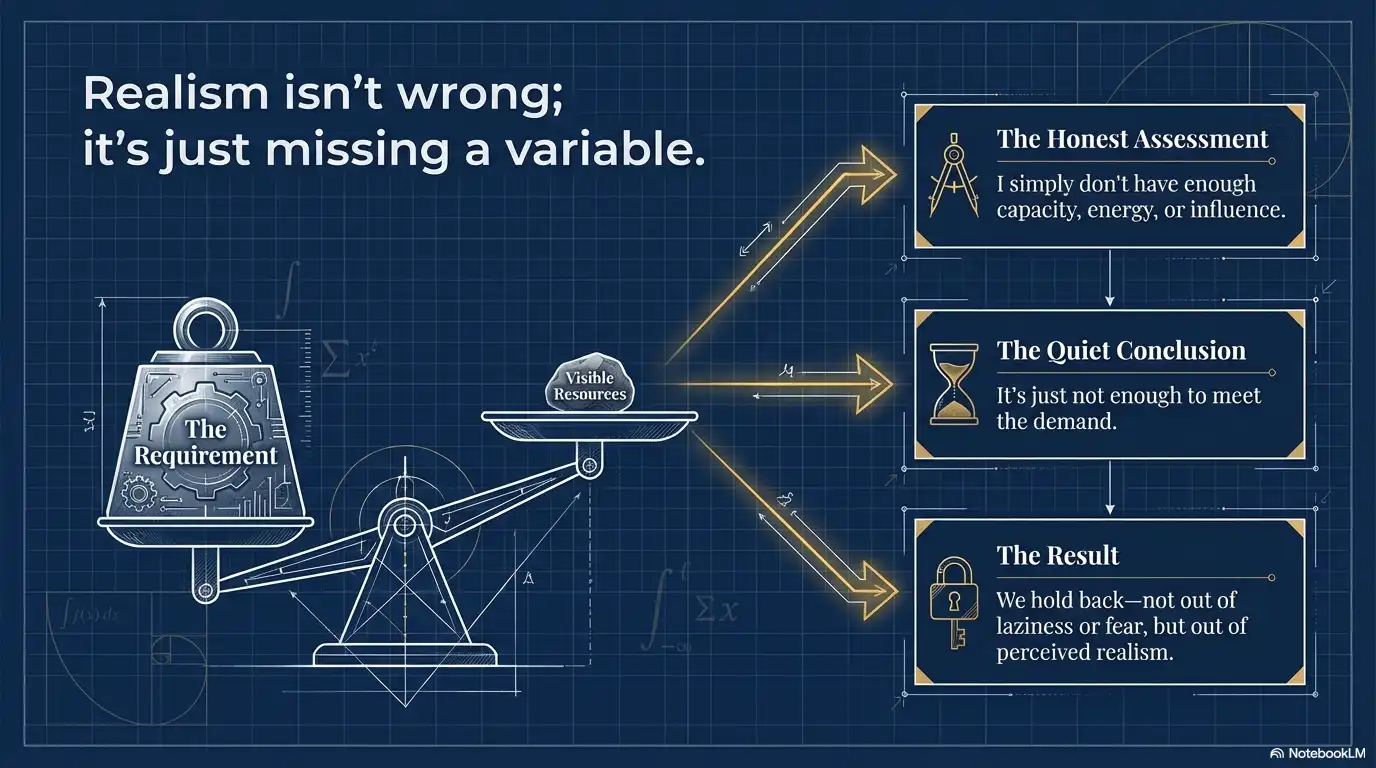
Let’s be honest about something that quietly undermines confidence in ways that don’t always get named directly. It’s not always fear of failure. It’s not always comparison or shame. Sometimes the thing that holds us back is simply an honest assessment of our own limitations — a clear-eyed look at what we have to offer and a quiet conclusion that it’s just not enough.
The capacity isn’t there. The resources aren’t there. The influence, the platform, the energy, the talent — whatever the specific currency the situation seems to require — it’s not there in sufficient quantity. And so we hold back. Not out of laziness or fear exactly, but out of what feels like simple realism.
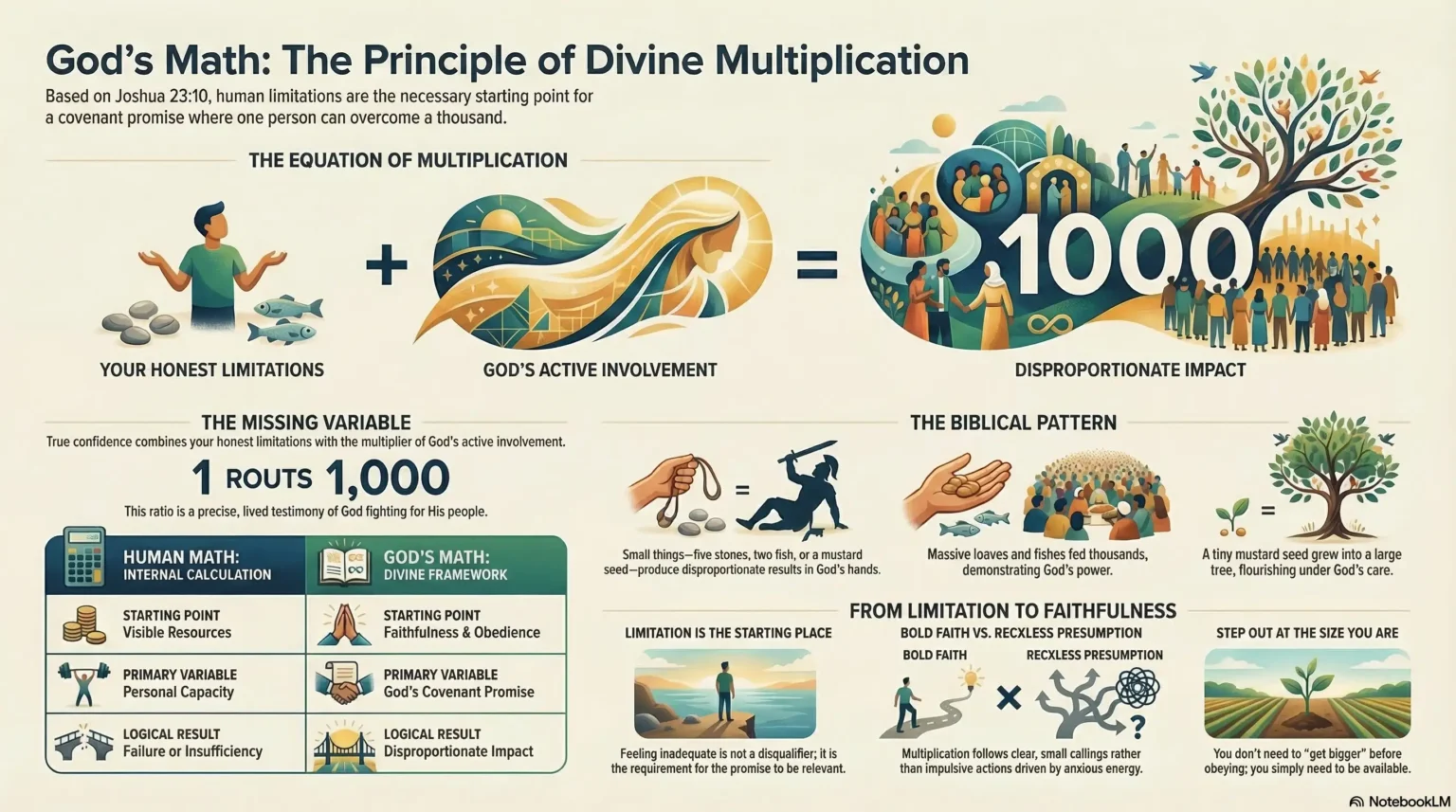
Joshua 23:10 doesn’t argue with your realistic assessment. It introduces a variable you weren’t including in the calculation.
1. Joshua Is an Old Man Speaking His Final Words — and He Chooses This
Context, as always, changes everything. Joshua 23 is Joshua’s farewell address to the people of Israel. He’s at the end of his life, looking back across decades of leading a nation through conquest, settlement, failure, and renewal. He has seen more than almost anyone alive of what God actually does in real situations with real people who have real limitations.
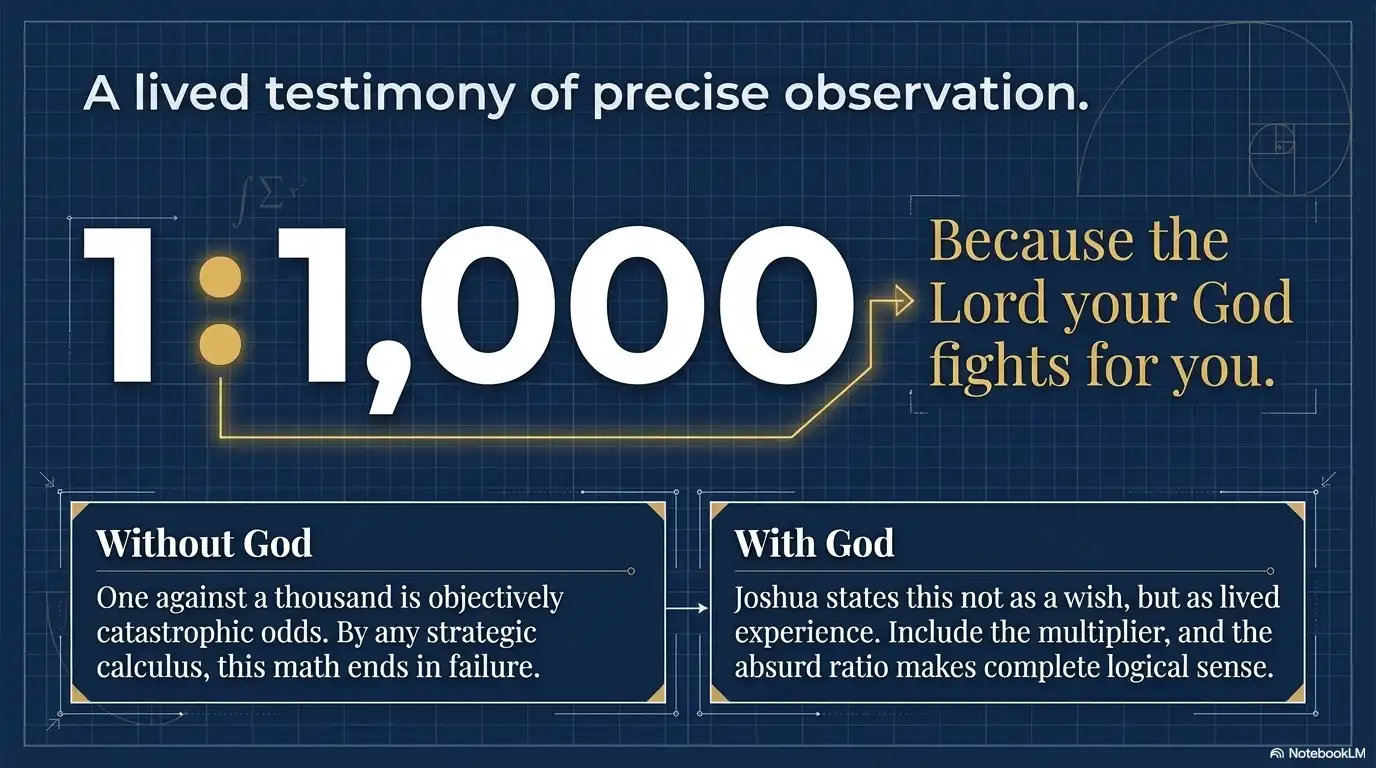
And out of everything he could have chosen to leave them with — all the wisdom accumulated across a remarkable life — he chooses this. One routs a thousand, because the LORD your God fights for you.
This isn’t theoretical encouragement from someone who hasn’t tested it. This is the testimony of someone who watched it happen, repeatedly, across a lifetime. The ratio wasn’t his invention or his wishful thinking. It was his lived experience, reported faithfully so the next generation would have evidence to build on.
When Joshua says one routs a thousand, he’s not being poetic. He’s being precise. He watched it. He knows.
2. The Math Only Makes Sense When You Include the Right Variables
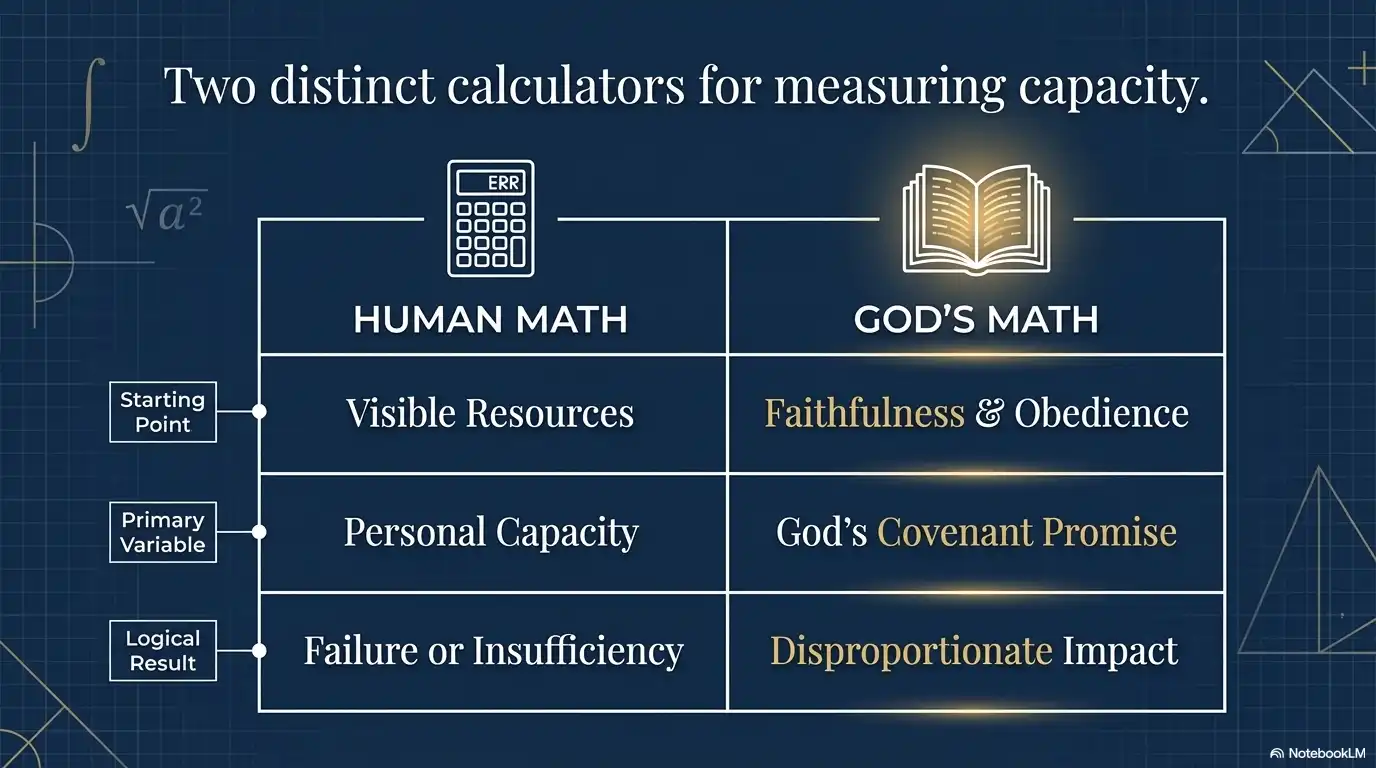
One against a thousand is, objectively, catastrophic odds. By any reasonable military or strategic calculus, that situation ends one way. The math is simple and unambiguous — if you’re working only with visible variables.
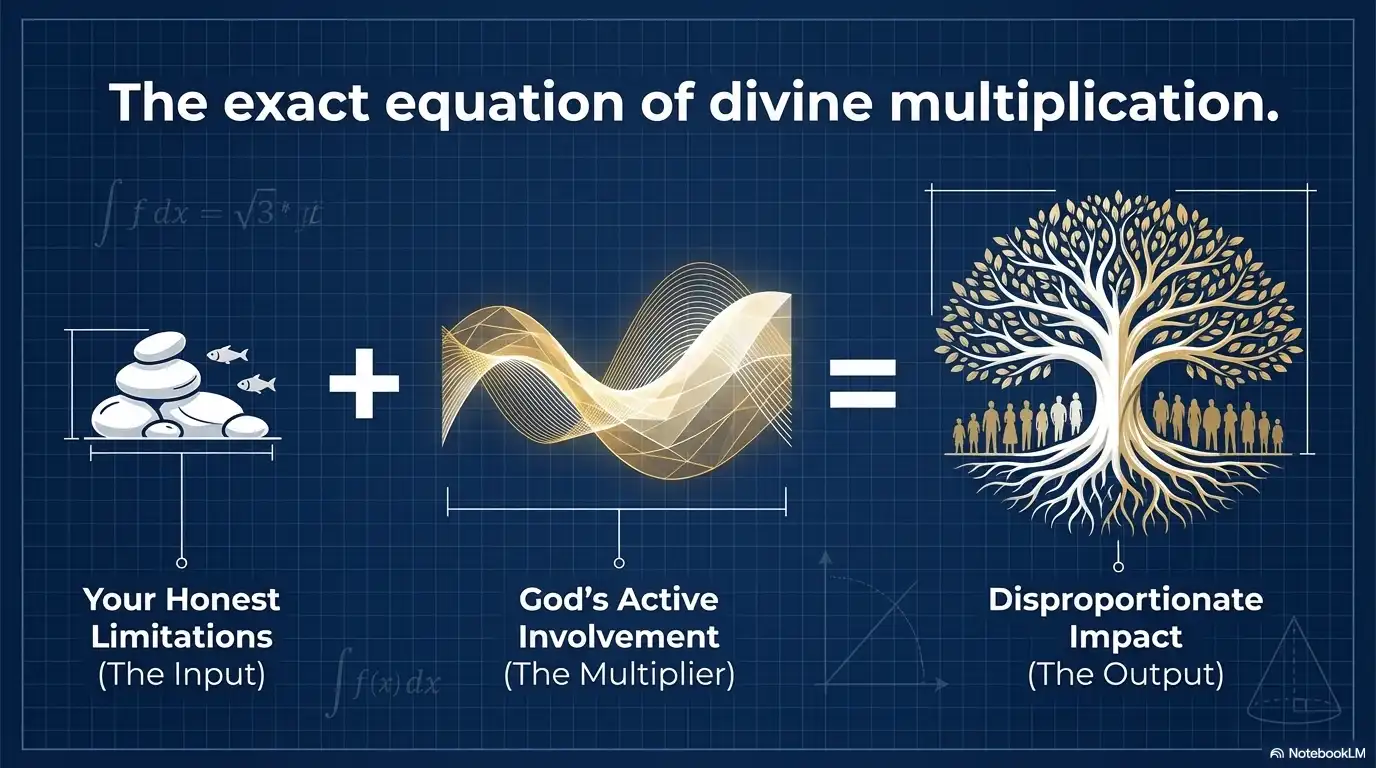
But Joshua’s equation includes a variable that changes everything: because the LORD your God fights for you. That phrase is not a footnote or a spiritual addendum tacked onto an otherwise rational statement. It’s the entire explanation for why the math comes out the way it does. Remove that variable and the ratio is absurd. Include it and the ratio makes complete sense.
This is, honestly, one of the more clarifying frameworks for confidence available anywhere in Scripture. Your capacity — real, measurable, honestly assessed — is one variable. God’s involvement is another. And the second variable doesn’t just add to the first. It multiplies it in ways that produce results that are categorically beyond what the first variable alone could explain.
The mistake most of us make when we feel limited is that we run the calculation without that second variable. We look at what we have, compare it to what the situation seems to require, find it insufficient, and conclude that we can’t. But that conclusion is only valid for the equation without God in it. It tells you nothing about what’s actually possible when He is.
3. “Small Obedience, Big Impact” Is a Pattern Woven Throughout All of Scripture
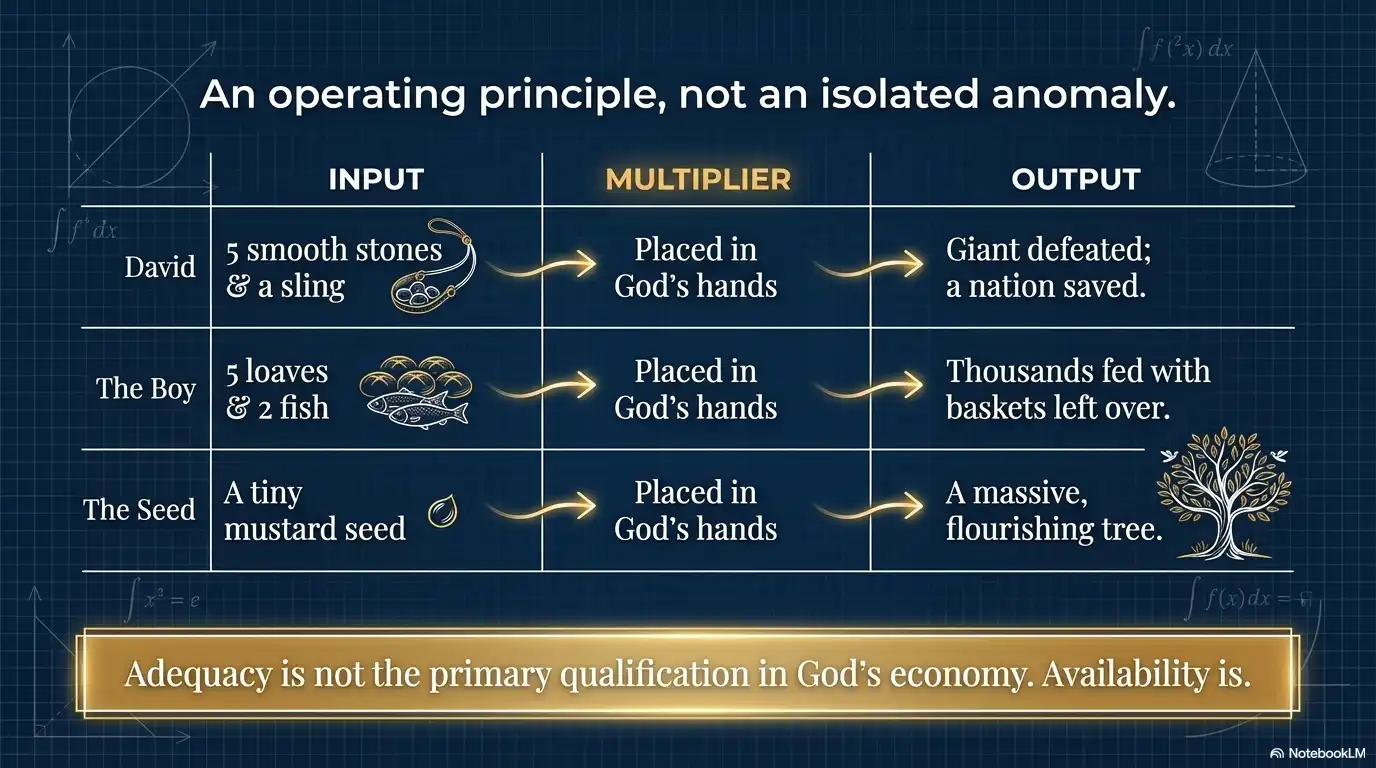
Joshua 23:10 is not an isolated anomaly. It’s a named instance of a pattern that runs through essentially the entire biblical narrative. A shepherd boy with a sling and five stones. A widow’s last handful of flour. A boy’s five loaves and two fish. A mustard seed. A lost coin. A small, overlooked, apparently insufficient thing — placed in obedience into God’s hands — that produces results wildly disproportionate to its apparent size.
The pattern is so consistent that it starts to look less like miraculous exception and more like operating principle. Like this is actually how God tends to work — not primarily through the impressive and the well-resourced and the obviously capable, but through the willing and the small and the obedient. Through people who, by their own honest assessment, don’t have enough — and who take the step anyway.
That’s worth sitting with if you’ve been holding back because what you have to offer doesn’t feel adequate. Adequacy, in God’s economy, is apparently not the primary qualification. Availability and obedience seem to be.
4. This Is Not a License for Recklessness — It’s an Invitation to Faithfulness
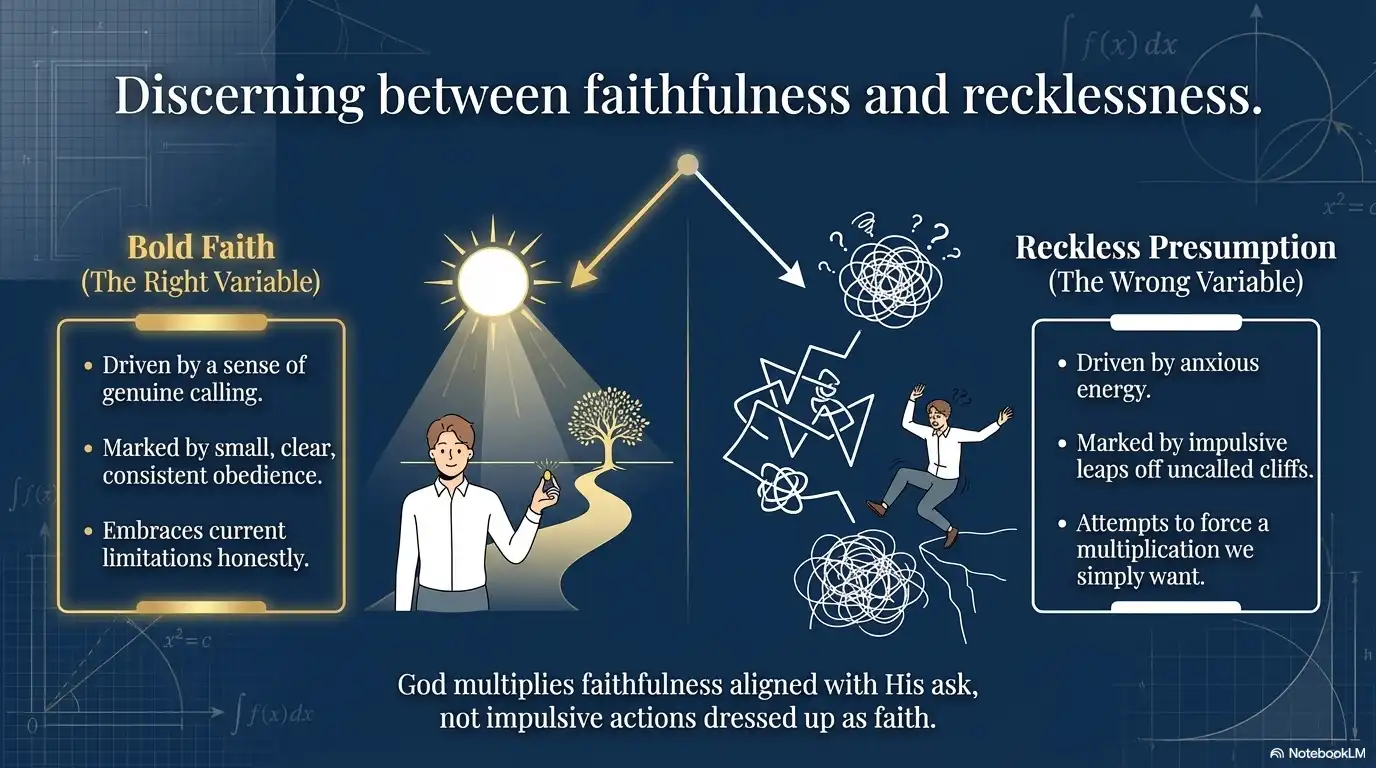
A verse like this one can be misread in ways worth addressing directly. “One routs a thousand” is not a blank check for impulsive, unwise action dressed up as faith. It’s not an invitation to leap off any cliff labeled “obedience” and expect miraculous rescue. The multiplication described here is specifically connected to faithfulness — to the small, consistent, sometimes unglamorous acts of obedience that align with what God is actually asking rather than what we’ve decided to do in His name.
The distinction is worth holding. Bold faith and reckless presumption can look similar from certain angles, but they feel different from the inside. Bold faith tends to be accompanied by a sense of genuine calling or clear direction — a specific thing that God is actually asking, however small or inadequate it seems. Reckless presumption tends to be accompanied by the anxious energy of someone trying to force a multiplication that they’ve decided they want, regardless of whether it’s been asked of them.
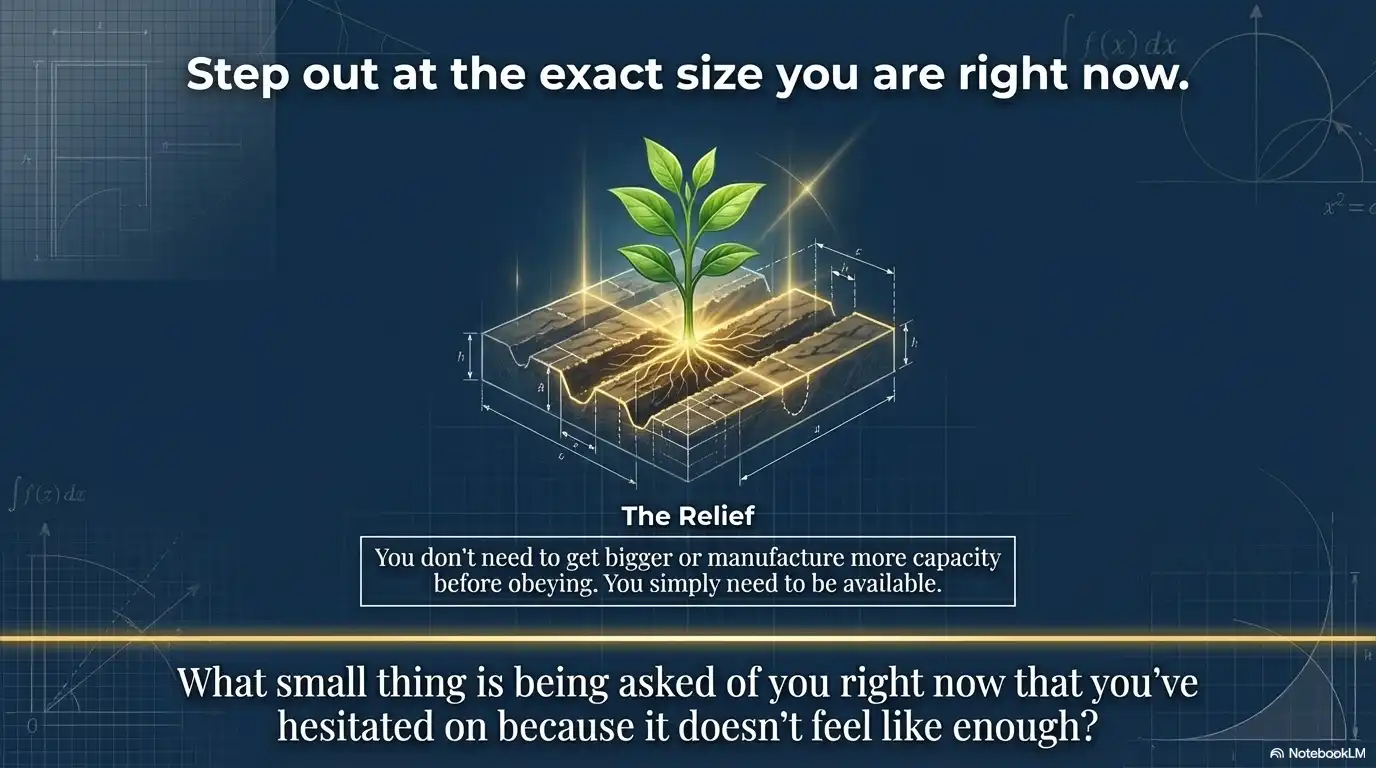
The question worth sitting with in today’s practice is not what dramatic thing can I do to see God multiply my efforts? It’s simpler and more honest than that: what small thing is He actually asking of me right now, that I’ve been hesitating on because it doesn’t feel like enough? That’s where the multiplication tends to show up.
5. “Just As He Promised You” — The Multiplication Is Covenant, Not Coincidence
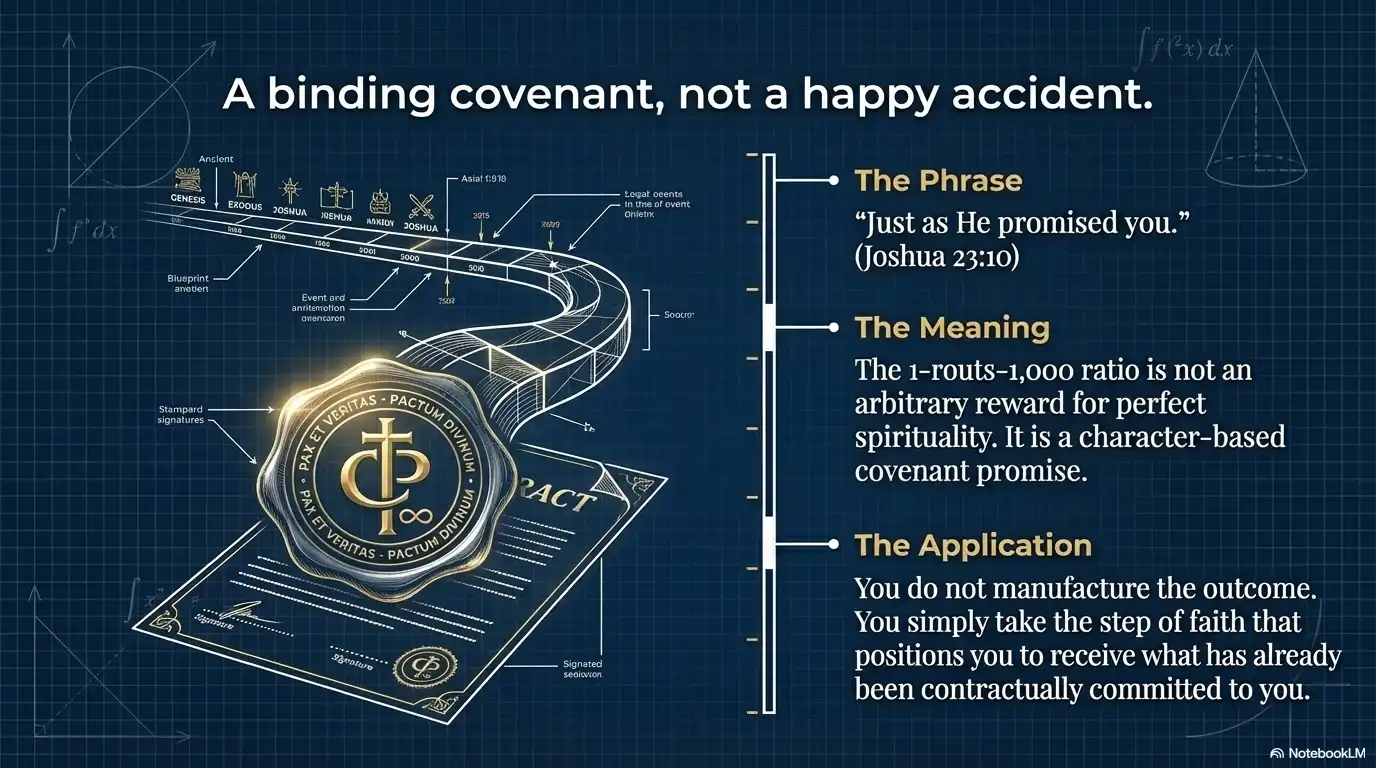
That final phrase in Joshua 23:10 is quietly doing important work. Just as he promised you. The one-routs-a-thousand ratio isn’t arbitrary. It isn’t occasional. It isn’t a happy accident that happened to favor certain particularly spiritual people. It’s a covenant promise — the same kind of binding, character-based commitment we’ve been encountering throughout this entire challenge.
Which means it’s not something you have to try to earn or perfectly position yourself to access. It’s an established promise made to God’s people, available to you the same way every other covenant promise in this challenge has been available to you — not based on your merit but based on His commitment.
The multiplication is already promised. Your part, as throughout all of these verses, is not to manufacture the outcome. It’s to take the step of faith that positions you to receive what’s already been committed.
6. Feeling Limited Is Actually the Starting Place, Not the Disqualifier
Here’s something worth really receiving today. The people in Joshua’s audience who were hearing this promise weren’t, for the most part, the powerful and the impressive. They were ordinary people — farmers, families, the newly settled residents of a land they were still figuring out how to inhabit. The promise wasn’t made to the extraordinary among them. It was made to all of them.
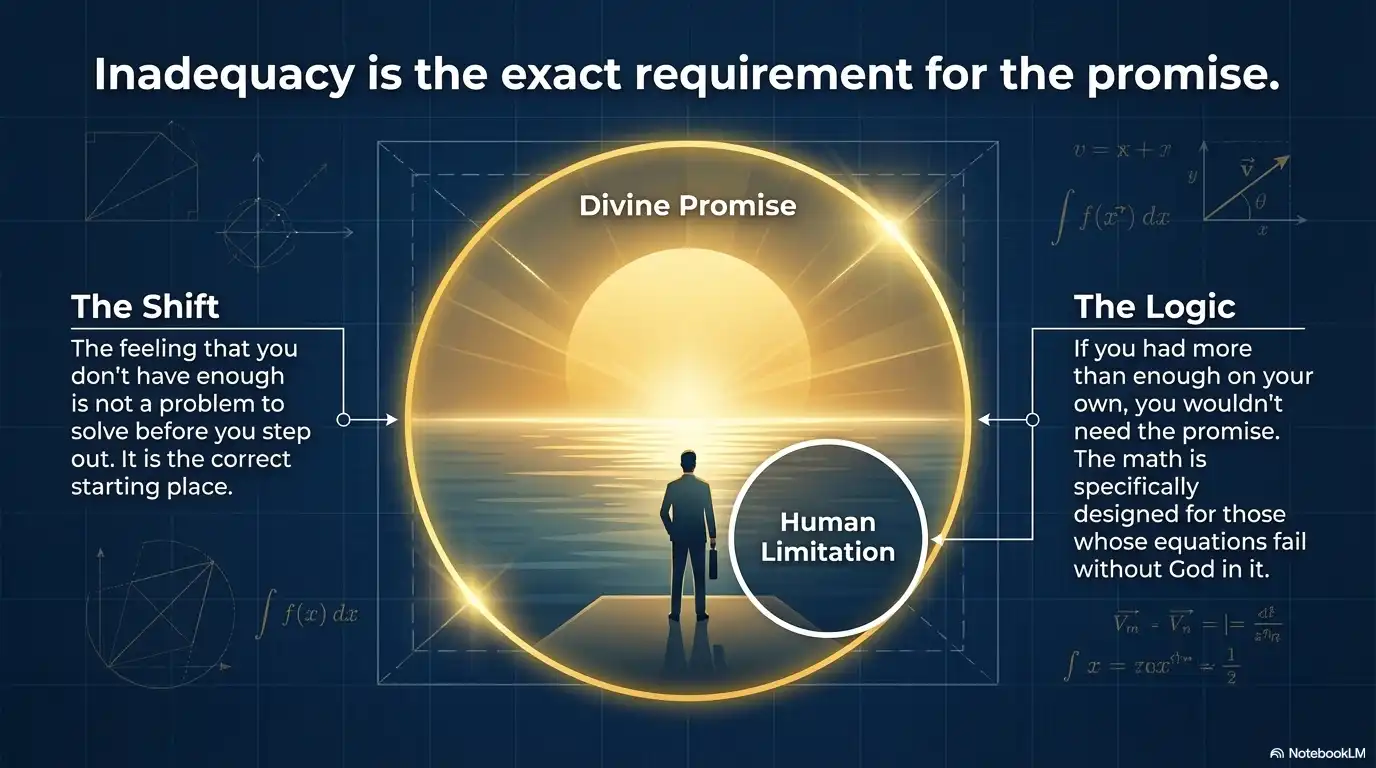
And that means the feeling of limitation you bring to today’s practice — the honest sense that what you have isn’t enough for what the situation requires — is not a problem to solve before you step out. It’s actually the right starting place. Because the multiplication this verse promises is specifically for the people whose math doesn’t work without God in it. If you had more than enough on your own, you wouldn’t need the promise. The limitation is, in a quiet way, the very thing that makes the promise relevant to you today.
You don’t have to get bigger before you step out. You just have to step out as the size you actually are, trusting the One who makes the math work.
7. Twelve Days of Foundation-Building Is Its Own Form of Multiplication
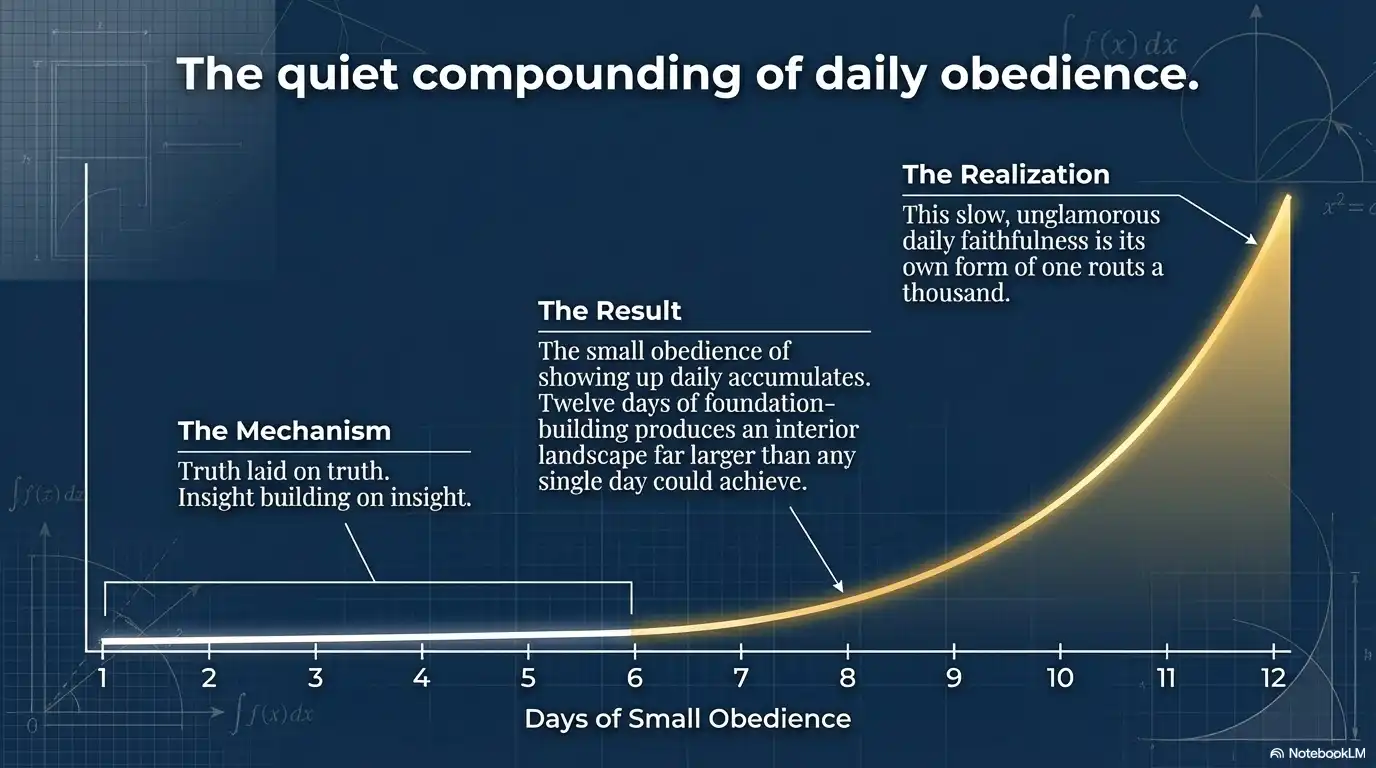
Here’s something worth naming at this point in the challenge. Twelve days ago, you started with a single verse and a journal prompt. And over these twelve days, something has been accumulating — slowly, sometimes imperceptibly, but genuinely. Truth laid on truth. Insight building on insight. Small practices, returned to faithfully, producing something in your interior landscape that is larger than any single day’s content could have produced alone.
That’s multiplication. The small obedience of showing up daily has been producing something larger than what showing up once could have created. You’ve been living the principle of today’s verse even as you’ve been working toward it. That’s not nothing. That’s actually, genuinely, one routs a thousand — in the quiet, unglamorous, daily-faithfulness version that most transformation actually looks like.
✦ FAQ: Real Questions, Real Answers
Q: I’m really struggling to believe God will multiply my small efforts. It feels more like wishful thinking than faith. What do I do with that?
That tension is worth sitting with rather than rushing to resolve, because it’s actually a pretty honest place to be standing. The difference between faith and wishful thinking is, genuinely, one of the harder distinctions to maintain in practice — especially when you’re in the middle of feeling limited and uncertain. Here’s one way to think about it: wishful thinking is hoping for a particular outcome without any evidential basis. Faith is extending trust forward based on a track record. And at this point — twelve days in, having walked through eleven other biblical promises that point to the same consistent character — you have a track record to build on. The question isn’t whether you can summon enough enthusiasm to believe. It’s whether the evidence you’ve been accumulating is sufficient to take one small step. Usually, it is.
Q: What counts as “small obedience”? I’m not sure how to identify what God is actually asking of me.
Small obedience tends to live in the space between what you know you should probably do and what fear or a sense of inadequacy has been keeping you from doing. It’s usually less mysterious than we make it. It’s the email you’ve been putting off sending because you’re not sure you’re qualified enough to send it. The conversation you’ve been avoiding because you’re not sure you can handle how it might go. The creative thing you’ve been sitting on because it doesn’t feel polished enough to offer yet. The service or generosity you’ve been deferring until you have more to give. The quiet, specific nudge that keeps returning — that one that you keep setting aside because it doesn’t seem like enough. That’s usually it. It’s rarely dramatic. It’s almost always the thing you already know, if you’re honest.
Q: I stepped out in faith before and the multiplication didn’t happen. The small thing stayed small. How do I trust this promise after that experience?
That’s a genuinely fair and important experience to bring to this verse. A few things worth holding alongside it. First — multiplication doesn’t always look the way we expect or on the timeline we expect. Some of what gets multiplied isn’t visible to you in real time, or isn’t measured in the currency you were watching for. Second — not every act of obedience is connected to a specific promise of numerical multiplication. The one-routs-a-thousand promise is connected to God fighting for His people in the context of covenant faithfulness, not a guarantee that every small effort will produce dramatic visible results. Third — and this is worth being honest about — sometimes the multiplication is happening in you rather than in the visible outcome. The act of stepping out in faith, even when the external results are modest, does something to your capacity for faith over time. That’s real growth, even if it’s not the impact story you hoped for.
Q: I tend to compare my “multiplication” to other people’s — their ministry impact, their visible influence, their dramatic testimonies. How do I stop doing that?
This is, honestly, one of the more subtle ways comparison sneaks back into the confidence conversation even after we’ve addressed it directly. And it tends to be particularly insidious in faith communities where impact stories get shared and celebrated. Here’s the reframe worth practicing: God’s multiplication of your specific obedience is calibrated to your specific calling, your specific season, and the specific people your life touches — not to a universal standard of impressive impact that belongs to someone else’s story. The widow who gave her last two coins wasn’t measured against Solomon’s offering. The boy with the loaves wasn’t measured against a commercial fishing operation. The measure of multiplication that matters is: did what you offered, faithfully given, go further in the specific context God placed it in than it could have on its own? That’s the only comparison that counts.
Q: I chose “bold step” as my practice but I’m genuinely terrified. Should I wait until I feel more ready?
Here’s the honest truth about readiness: for genuinely bold steps, the feeling of readiness almost never fully arrives before the step is taken. It tends to arrive — partially, imperfectly — during or after the step. Waiting to feel ready before acting in faith is, in a very real sense, waiting to not need faith anymore. Which means the terror you’re feeling right now is not a signal to wait. It’s actually confirmation that what you’re considering is the right size of step for where you are. Small steps don’t tend to terrify us. The ones that do are usually the ones that require us to trust something beyond our own capacity — which is precisely the condition under which the one-routs-a-thousand math applies. Take the step terrified. That’s allowed. That might actually be the whole point.
Q: I feel like my life is too ordinary for God to multiply anything significant. I’m not in ministry or doing anything impressive. Does this verse apply to regular life?
Not just apply — it was primarily written for regular life. Joshua’s audience was, as mentioned above, mostly ordinary people living ordinary settled lives after years of wandering. The promise wasn’t given to the priests and the generals exclusively. It was given to the people who were going to go home to their fields and their families and their daily, unglamorous faithfulness. Your regular life — your workplace, your family, your neighborhood, the specific relationships and contexts you inhabit every ordinary day — is exactly the terrain this promise was designed for. God doesn’t need you to have an impressive platform for multiplication to happen. He needs you to take the small, faithful step that’s in front of you in the ordinary place you actually are. That’s where most of the real multiplication in the world happens — quietly, undramatically, in ways that often aren’t recognized as supernatural until much later, if ever.
Q: We’re almost at Day 14. I’m starting to feel anxious about the challenge ending and losing this structure. Is that normal?
Completely normal — and actually, it’s a sign that something real has been built here. The structure has been serving you, and it makes sense to feel some uncertainty about what happens when it ends. A couple of things worth holding as you approach the final two days: first, the practices you’ve developed don’t expire on Day 14. The journaling, the returning to truth, the small steps of faith — those are portable. They belong to you now. Second, pay attention in these final two days to which specific practices have been most genuinely helpful, because those are the ones worth intentionally carrying forward. The challenge ends. The foundation it’s been building doesn’t have to.
Twelve days. The math on what you’ve done here — showing up consistently, honestly, day after day — is already adding up to something larger than any single day’s effort. Two more. See you tomorrow.