

The Promise That Holds When Everything Else Lets Go
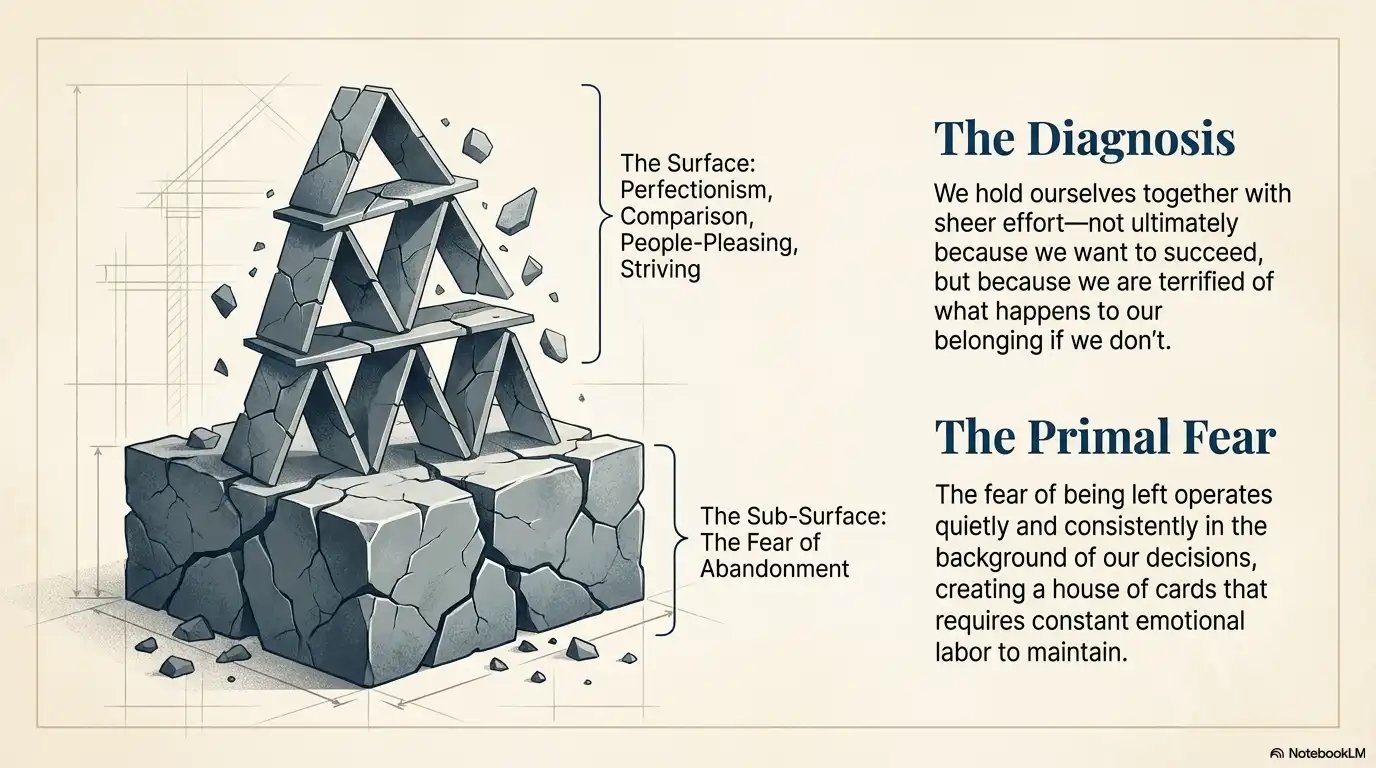
If you want to understand what’s really driving most confidence problems — underneath the comparison, the perfectionism, the people-pleasing, the striving — you’ll almost always find the same thing waiting at the bottom.
The fear of being left.
It’s one of the most primal human fears there is. And it’s worth naming honestly, because it operates so quietly and so consistently in the background of so many decisions. We don’t apply for the thing because if we fail, we’ll be humiliated and alone in it. We don’t let people in too far because if they really knew us, they’d go. We perform, and polish, and hold ourselves together with sheer effort — not ultimately because we want to succeed, but because we’re terrified of what happens to our belonging if we don’t.
Deuteronomy 31:6 walks directly into the middle of that fear and says something that is, honestly, almost too good to absorb in a single sitting.
1. Moses Is Speaking to People Who Know Exactly What Abandonment Feels Like
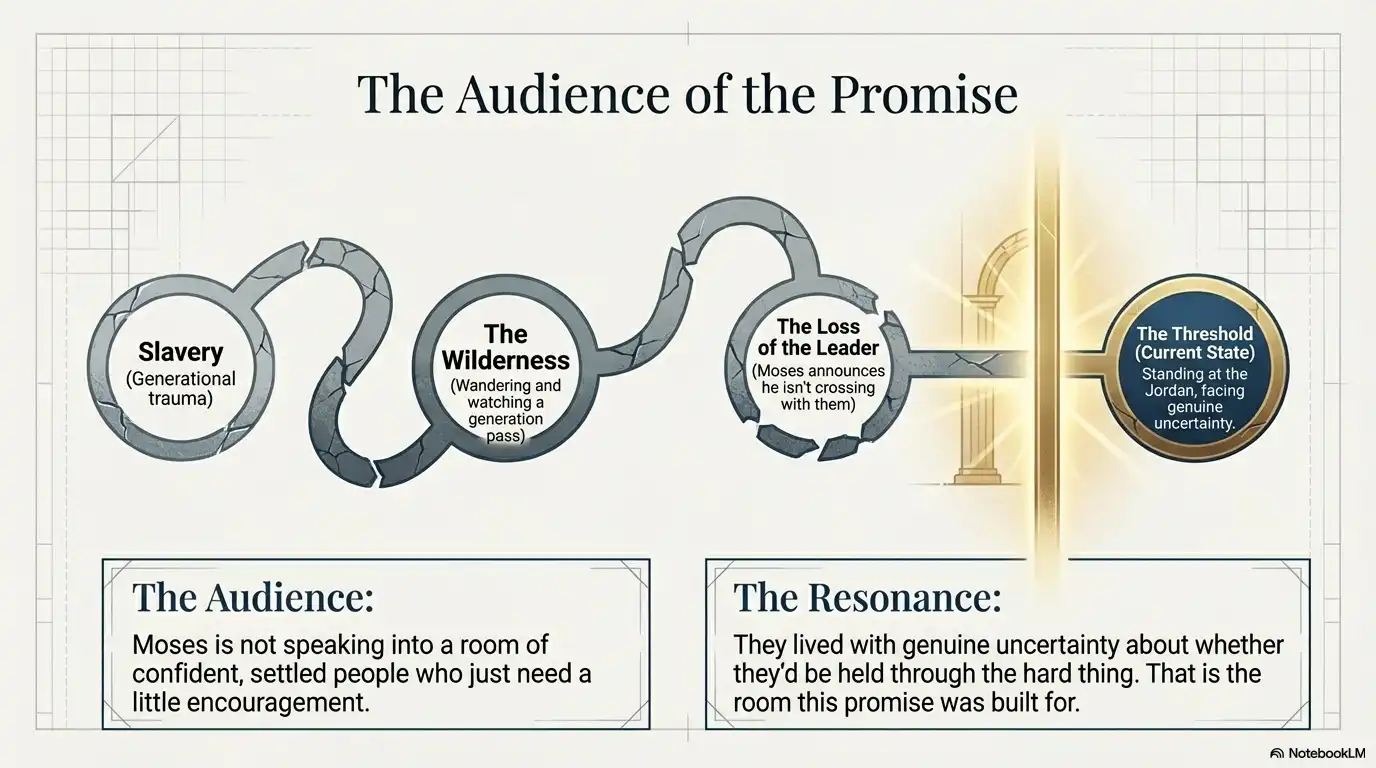
Again, context is everything here. The Israelites receiving this word were a people with a complicated, painful history with abandonment and uncertainty. They’d been slaves. They’d wandered. They’d watched a whole generation die in the wilderness without reaching the destination. And now Moses — the only leader most of them had ever known — is telling them he won’t be crossing the Jordan with them.
So when he stands up and says be strong and courageous, God will never leave you nor forsake you — he’s not speaking into a room of confident, settled people who just needed a little encouragement. He’s speaking into a room of people who have lived with genuine uncertainty about whether they’d be held through the hard thing.
That’s the room this promise was built for. If that sounds like your room too, it was written for you.
2. “Never Leave” and “Never Forsake” Are Two Different Promises
It’s easy to read these two phrases as simple repetition for emphasis — and while the repetition is intentional, each word carries its own distinct weight.
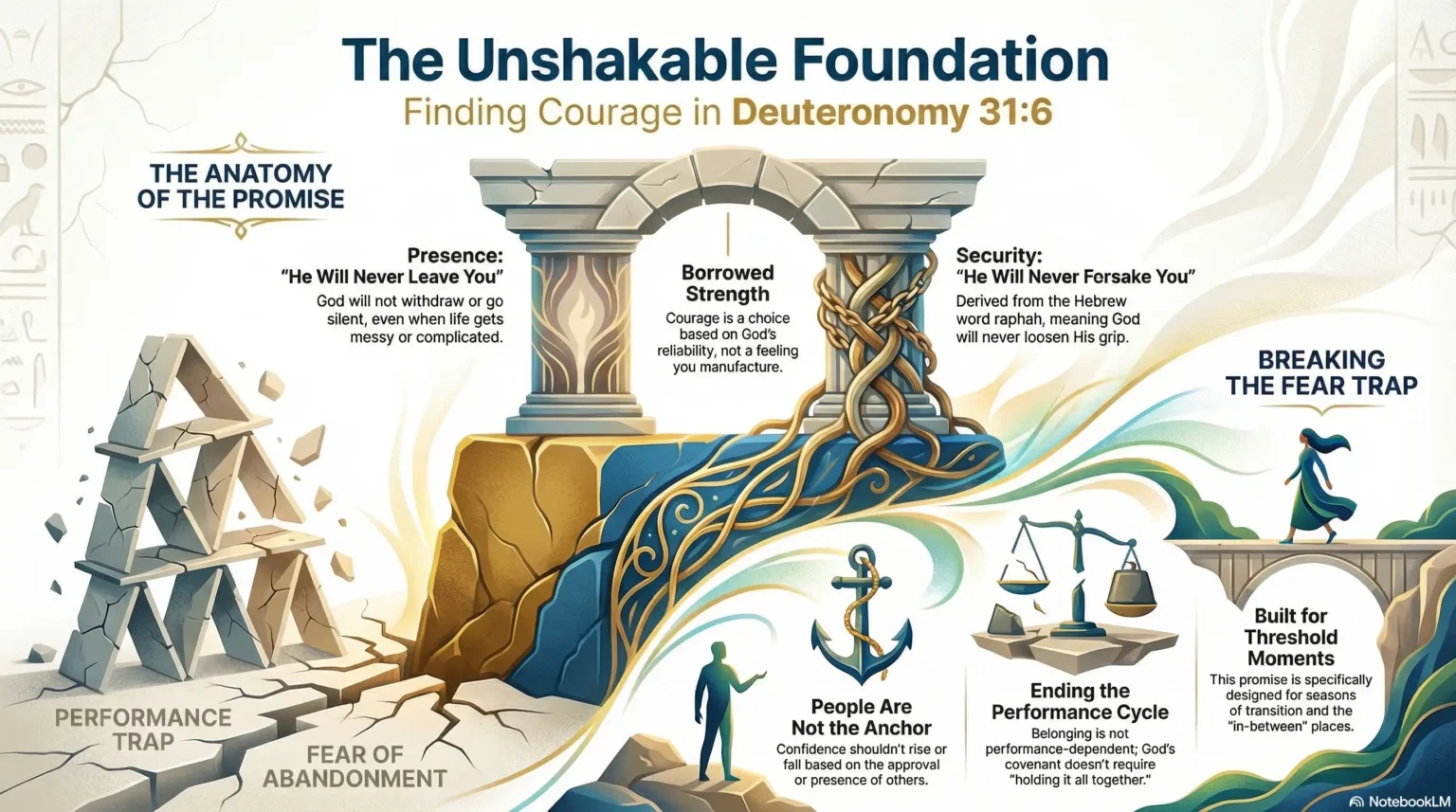
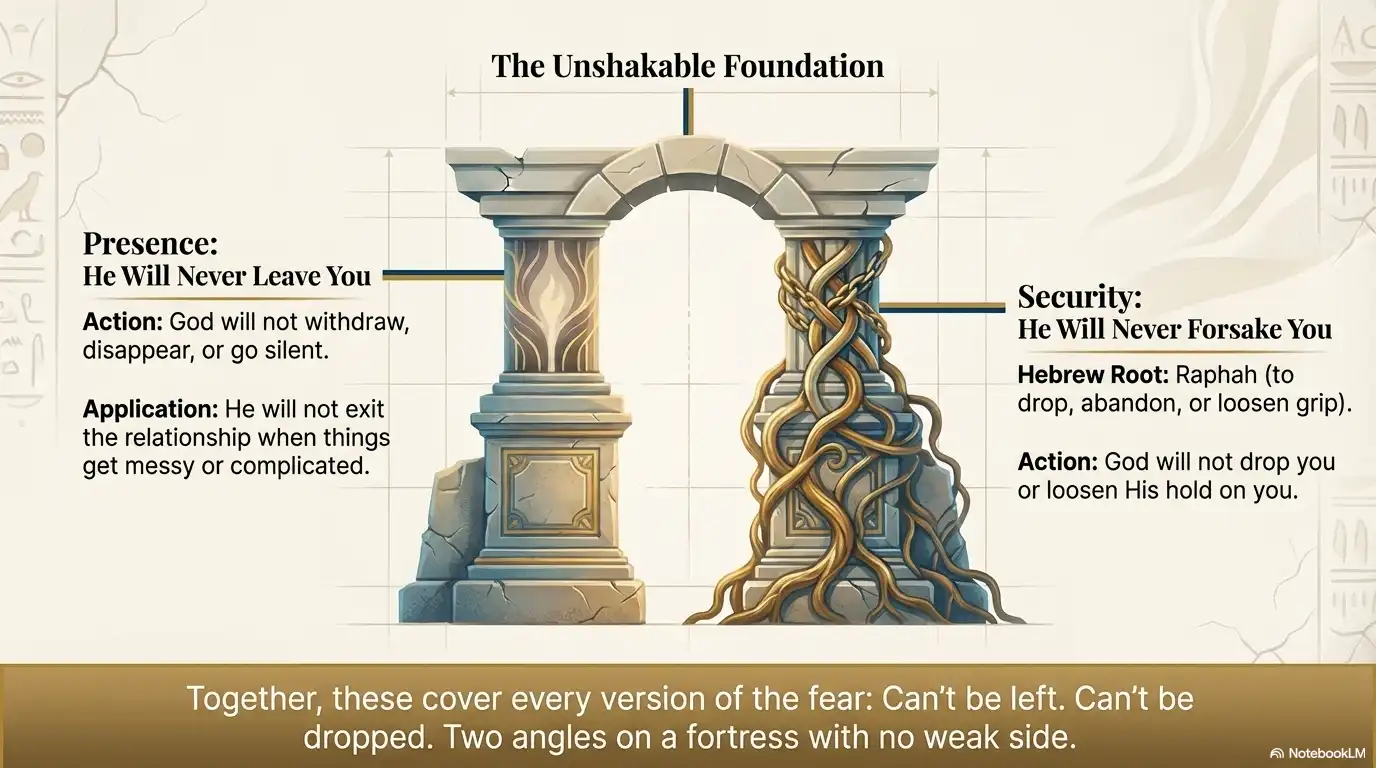
Never leave speaks to presence. God will not withdraw, disappear, or go silent. He will not exit the relationship when things get messy or complicated. Whatever season you’re in — loud and triumphant or quiet and desperate — He is still there.
Never forsake speaks to something deeper still. The Hebrew word behind forsake — raphah — carries the sense of dropping, abandoning, letting go of what you’re holding. It’s the word for what happens when someone releases their grip on you. God is saying: I will not drop you. I will not loosen My hold on you. I will not let go.
Together, these two promises cover every version of the fear. Can’t be left. Can’t be dropped. Can’t be released from His grip. That’s not two ways of saying the same thing — it’s two different angles on a fortress that has no weak side.
3. “Be Strong and Courageous” Is a Command That Only Makes Sense Alongside the Promise
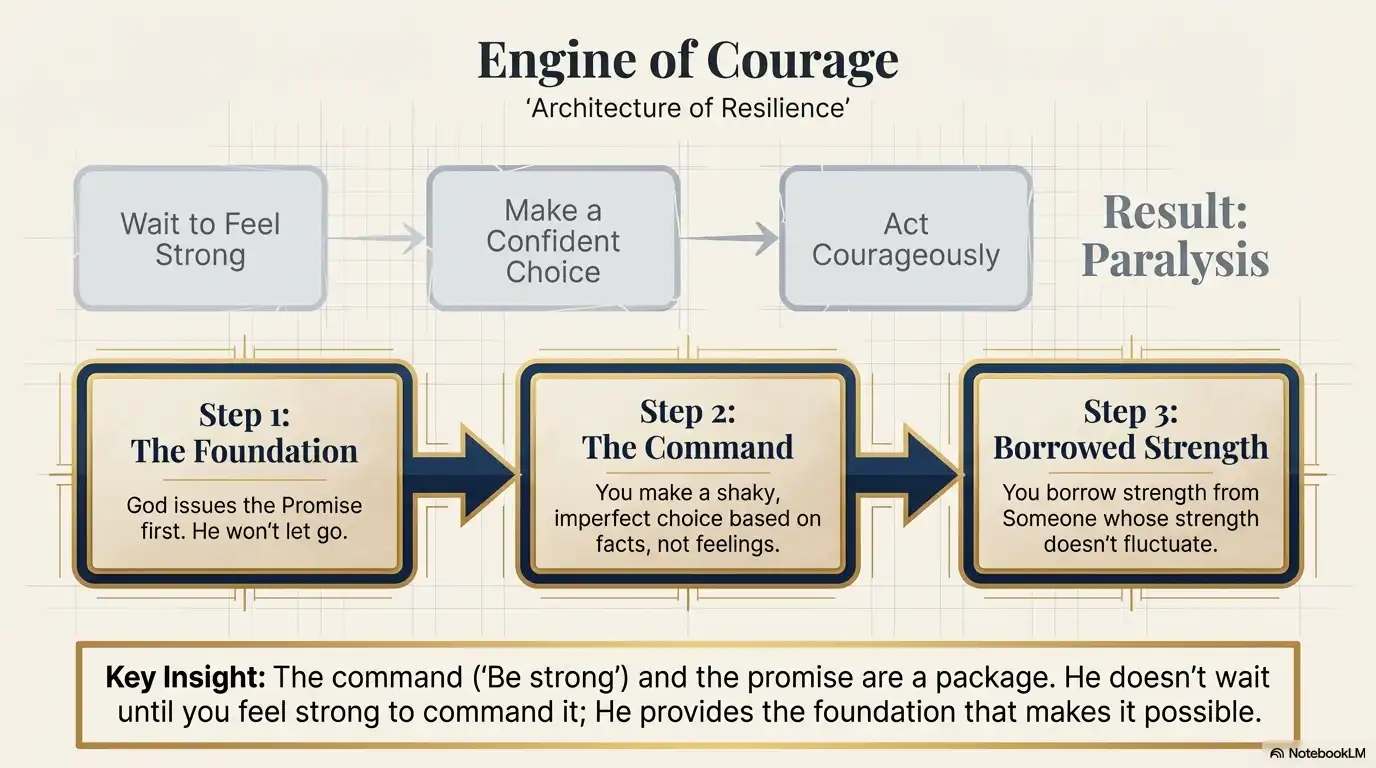
Here’s something worth noticing structurally: the command comes before the explanation. Be strong and courageous — and then — here’s why you can be. God doesn’t wait until you feel strong to command it. He issues the invitation, and then immediately provides the foundation that makes it possible.
This is actually a pretty important pattern for confidence. Confidence, genuinely, is not a feeling you wait to have before you act. It’s a choice you make — often a shaky, uncertain, imperfect choice — based on what you know to be true rather than what you currently feel. “Be strong” isn’t telling you that you won’t feel afraid. It’s telling you that fear doesn’t get to be the deciding factor, because the ground underneath you is more reliable than the feeling on top of you.
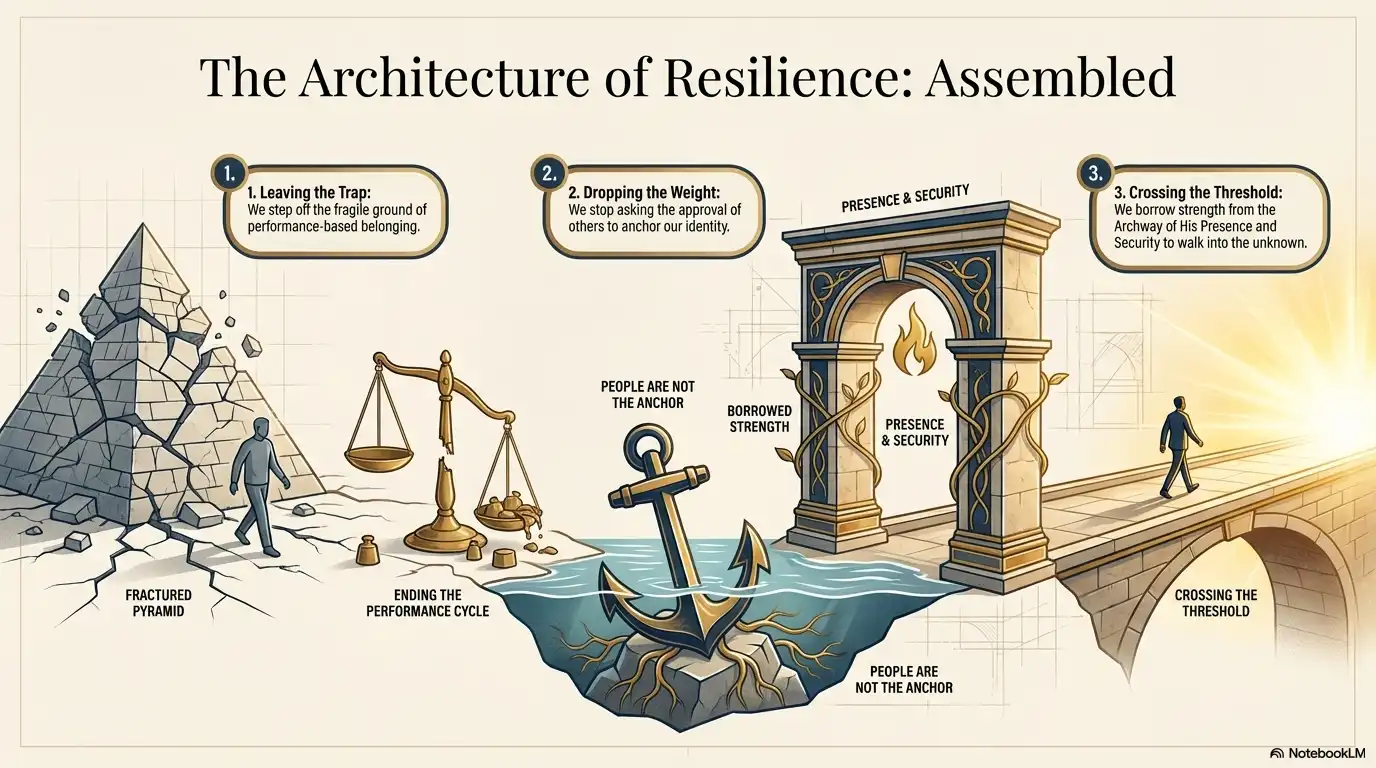
The command and the promise are a package. You don’t have to manufacture the strength from inside yourself. You’re borrowing it from Someone whose strength doesn’t fluctuate.
4. The Fear of Abandonment and the Performance Trap Are Deeply Connected
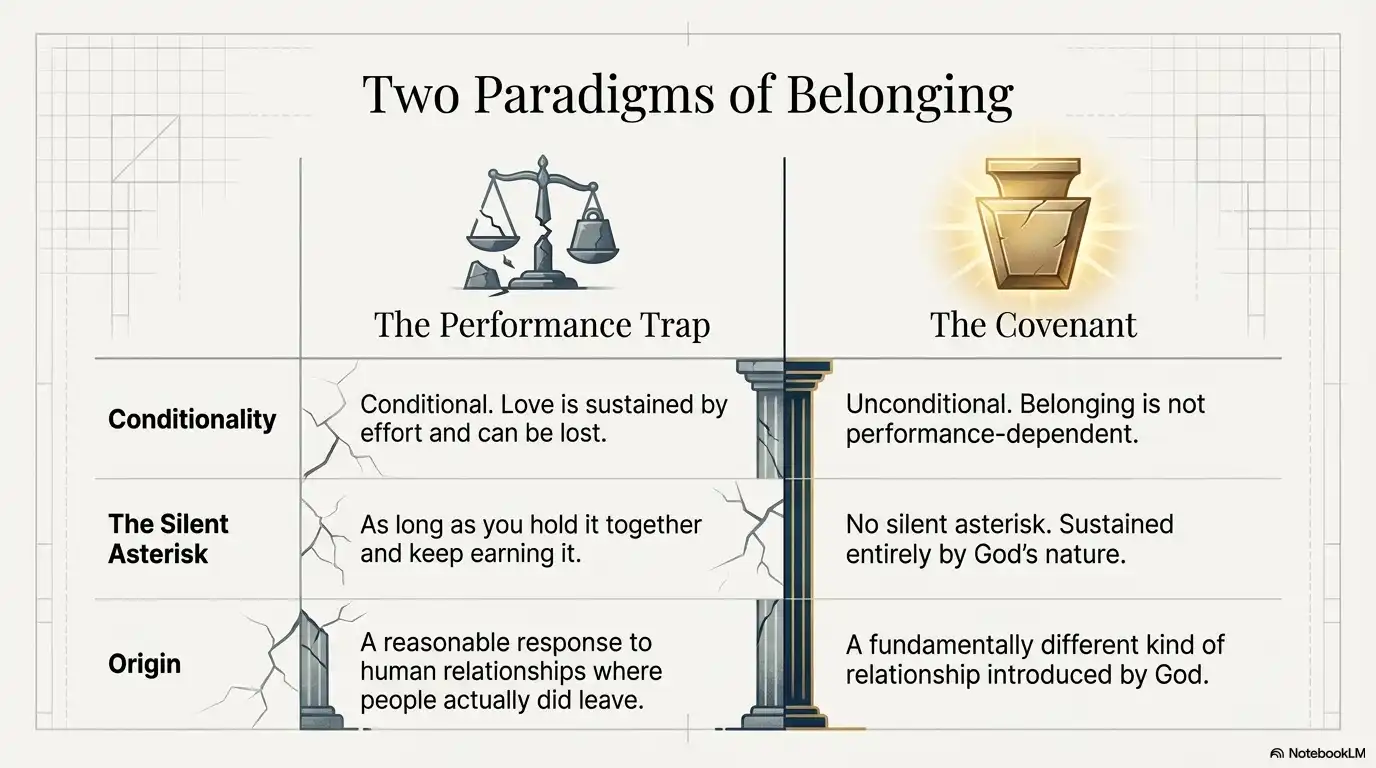
It’s worth drawing a line here that often goes undrawn. So much of what this challenge has been addressing — striving, people-pleasing, perfectionism, the need to earn approval — is downstream of abandonment fear. We perform because we’ve learned, somewhere along the way, that love and belonging are conditional. That they can be lost. That the way to keep people is to keep being good enough for them.
And here’s the thing — for a lot of us, that wasn’t an irrational conclusion. It was learned from real experiences. People did leave. Belonging was conditional in certain relationships or environments. The fear is not a character defect. It was a reasonable response to something that actually happened.
But what Deuteronomy 31:6 introduces is a fundamentally different kind of relationship. One where the belonging is not performance-dependent. Where the covenant isn’t sustained by your ability to keep earning it. Where the promise doesn’t contain a silent asterisk reading “as long as you hold it together.”
Learning to trust that — genuinely, not just intellectually — is some of the most important work a person can do. And yeah, it takes time. But this is what the work looks like.
5. “Because of Them” — Your Confidence Isn’t Supposed to Rise and Fall With People
The original context of do not be afraid or terrified because of them referred to the nations the Israelites would encounter. But the principle carries forward with remarkable precision into our present lives. The them in your life might be critics, or people whose approval you’ve been chasing, or relationships where you’ve never quite felt fully secure.
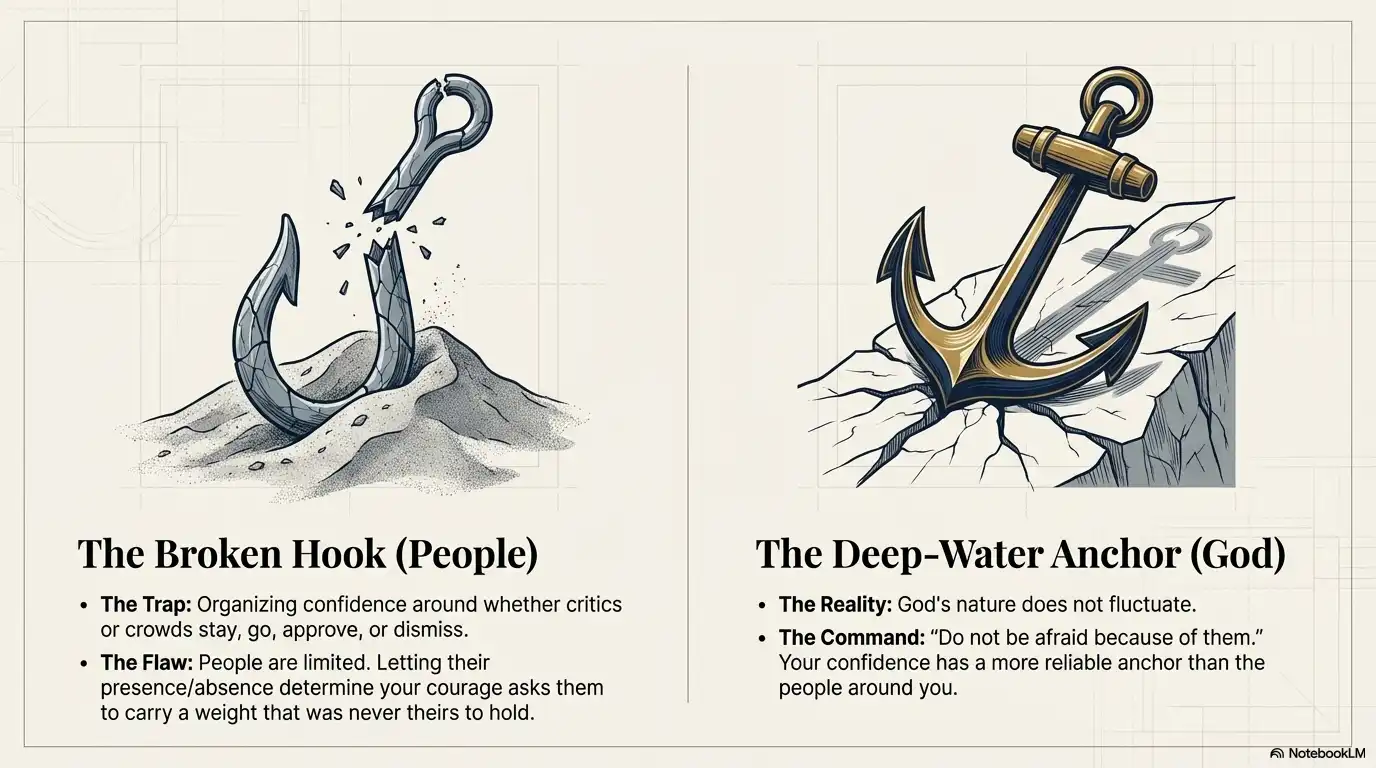
God is essentially saying: don’t let them set the terms of your courage. Don’t organize your confidence around whether they stay or go, approve or disapprove, affirm or dismiss. Because that’s, frankly, too unstable a foundation for a life — and God knows it better than anyone.
Your confidence has a more reliable anchor than the people around you. Not because people don’t matter — they do. But because people, even the best and most well-intentioned ones, are limited in what they can promise and hold. God is not. Letting people’s presence or absence determine your confidence is, in a sense, asking them to carry something that was never theirs to hold.
6. This Promise Was Given in a Moment of Transition — Which Is Exactly When You Need It Most
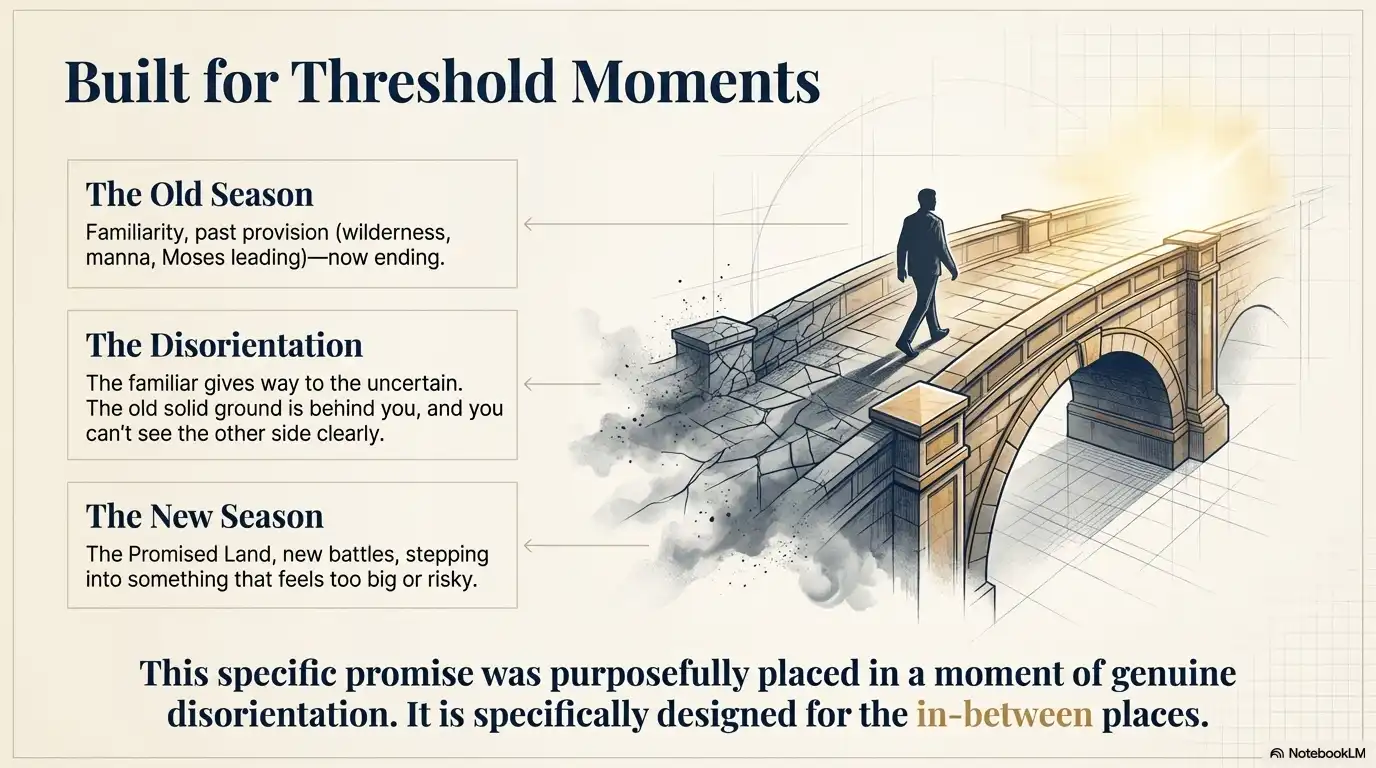
The Israelites were standing at the edge of something new and uncertain. The old season — wilderness, manna, Moses leading — was ending. The new season — Promised Land, battles, learning to govern themselves — was beginning. It was a genuinely disorienting moment of threshold.
And that’s precisely when God chose to speak this particular promise.
If you’re in a threshold moment right now — if something is shifting, if the familiar is giving way to the uncertain, if you’re being asked to step into something that feels too big or too risky — this promise was placed here, in this moment of transition, for exactly that context. The promise of never being left or forsaken is specifically designed for the in-between places. For the moments when you can’t yet see the other side clearly and the old solid ground is already behind you.
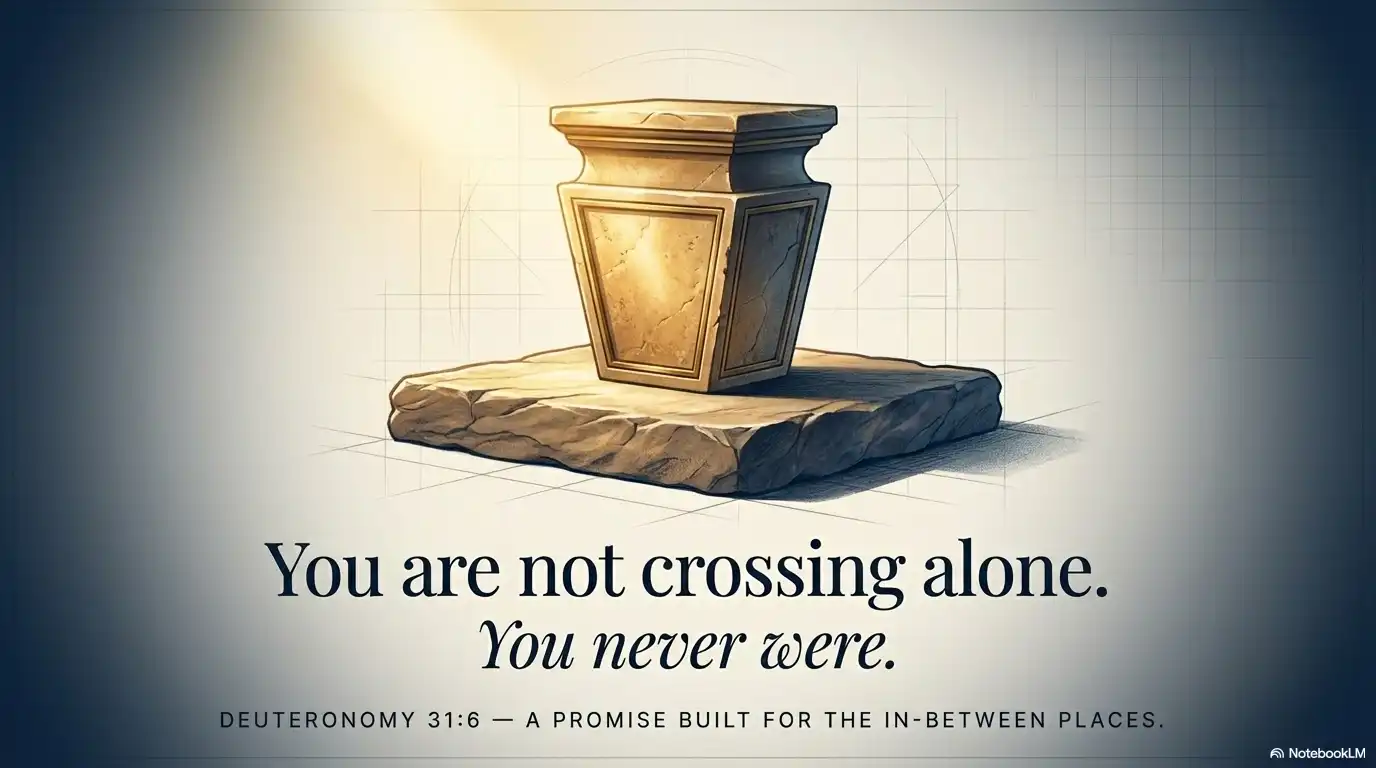
You’re not crossing alone. You never were.
✦ FAQ: Real Questions, Real Answers
Q: I’ve been told God is always with me my whole life, and it still doesn’t touch the abandonment fear. Why isn’t it working?
Because intellectual knowledge and deep emotional healing are genuinely two different things — and they don’t automatically travel together, no matter how many times you hear the truth. Abandonment fear lives in the body and the nervous system, not just the mind. It was often formed through experiences that happened long before you had the capacity to think your way through them. So when a truth like this one doesn’t seem to land, it’s not because your faith is insufficient. It’s because the wound underneath the fear needs more than information — it needs repeated encounters with trustworthiness over time. That’s actually what this 14-day process is designed to facilitate: not a one-time revelation, but a slow, accumulated experience of coming back to truth again and again until it starts to feel more real than the fear. Keep coming back. It’s working even when it doesn’t feel like it.
Q: What if I feel like God HAS been distant or silent in a season where I really needed Him? How do I reconcile that with “never leave”?
That tension is real and deserves to be honored rather than quickly explained away. Seasons of felt absence are one of the most disorienting spiritual experiences a person can have — and they’re also one of the most commonly reported across the entire history of faith. Mystics, saints, and ordinary believers throughout history have described exactly what you’re describing. What’s worth distinguishing is this: the promise is about God’s actual presence, not always about a felt presence. Those two things can diverge — significantly, and for extended seasons. The silence doesn’t necessarily mean withdrawal. Some of the deepest formations in a person’s faith happen in seasons that felt, from the inside, like absence. That doesn’t make it less painful. But it does mean the silence isn’t the final word.
Q: The abandonment fear I carry is mostly from people, not from God. Can this verse really help with that?
Genuinely, yes — though maybe not in the most direct way. The verse doesn’t erase the pain of human abandonment, and it doesn’t promise that people will stay. What it does is address the deepest layer of what makes human abandonment so destabilizing. When our entire sense of security rests on whether people stay, each departure — or potential departure — becomes existentially threatening. When there’s a foundation beneath the human relationships that cannot leave, the stakes of human loss, while still real and painful, change character. You can grieve someone leaving without it unraveling your sense of whether you’re okay. That’s not nothing. That shift, over time, is actually one of the most healing things this truth can do in a life.
Q: I identified the relationship category as my biggest abandonment fear. I hold back from letting people in because I’m afraid they’ll leave once they really know me. How do I start to change that?
Slowly and in small steps — because trust, once it’s been injured, rebuilds incrementally and that’s exactly how it should. A few things worth considering: first, notice that the pattern of holding back, while protective, also guarantees a version of the abandonment you fear — because no one can stay close to someone they’ve never really been allowed to know. Second, rather than trying to be fully known all at once, practice small moments of genuine transparency — one real thought, one honest feeling — and observe what actually happens. Often the catastrophe doesn’t materialize. Third, let this verse do its work underneath the relational risk: even if this person responds badly, I am held by Someone who won’t. That foundation doesn’t make vulnerability painless. But it makes it survivable. And survivable is where courage starts.
Q: I’m afraid that if God really saw my worst moments and deepest struggles, He’d give up on me. How do I address that?
Here’s what’s worth sitting with: God is not discovering your worst moments as you confess them. He already knows. Every version of you — the polished one and the deeply struggling one — is already fully visible to Him. And the promise of never leaving was made with complete knowledge of what that promise would have to hold. He’s not working with a sanitized version of you that might change His mind if He saw the rest. He’s already seen the rest. He made the promise anyway. The fear that more honesty will cost you His presence is actually, in a quiet way, a form of underestimating both His knowledge and His commitment. He knew. He stayed. He promises to keep staying.
Q: I avoid new ventures specifically because I’m terrified of failing alone. What does “never forsake” actually look like in a practical failure scenario?
It looks like this: the moment after the thing doesn’t work — when the embarrassment is fresh and the doubt is loudest and the inner voice is saying see, you shouldn’t have tried — you are not in that moment alone. The raphah, the loosening of grip, does not happen. You are still held. What that means practically is that the recovery from failure, while still genuinely hard, has a different quality when you’re not white-knuckling it solo. There’s a Presence in the aftermath that is oriented toward you rather than away from you. Failure stops being the worst possible outcome, because the worst possible outcome — being dropped, being alone in it — has already been ruled out by covenant promise. You can afford to try, because you already know what the landing zone looks like.
Q: “Be strong and courageous” sounds like pressure to me, not encouragement. What if I’m just not a naturally courageous person?
Then you’re in good company with essentially every person in Scripture who was ever told that. Joshua, who received this same command directly, had every human reason to feel the opposite of strong and courageous. Gideon called himself the least in his family. Jeremiah said he didn’t know how to speak. Moses argued with God about his inadequacy for several chapters. The command be strong and courageous was almost exclusively given to people who weren’t naturally feeling those things — because the point was never about temperament. It was about a choice to act in alignment with a promise rather than in alignment with a feeling. Courage in Scripture is rarely described as fearlessness. It’s described as moving forward despite the fear, because the ground underneath you is more reliable than the feeling inside you. That’s available to every temperament. Including yours.
Six days in. You’re further along than you know. The ground you’ve covered is real. See you tomorrow.