



The Rest That Produces Real Confidence
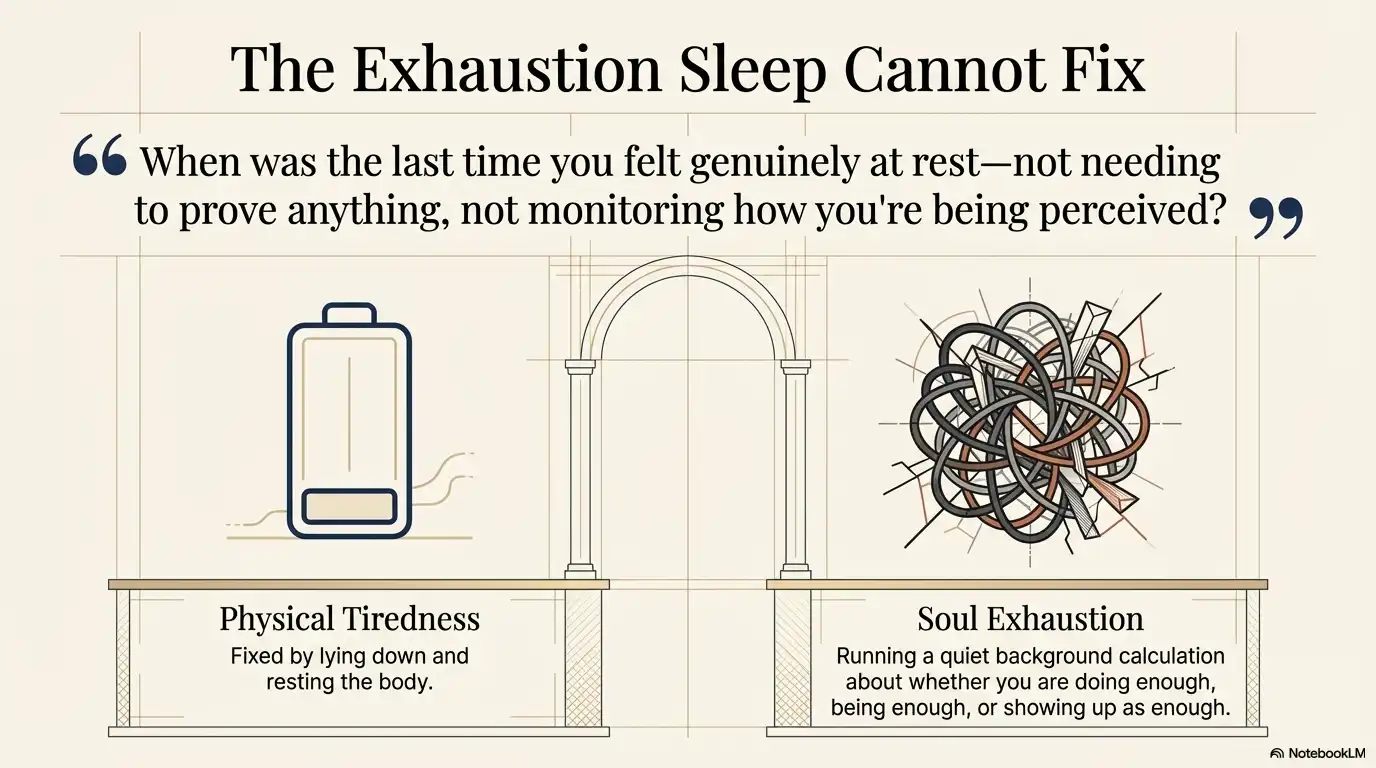
Here’s a question worth sitting with honestly: when was the last time you felt genuinely at rest? Not just physically tired and lying down, but actually at rest — not needing to prove anything, not monitoring how you’re being perceived, not running some quiet background calculation about whether you’re doing enough, being enough, or showing up as enough?
For a lot of people, that feeling is either rare or entirely unfamiliar. And the reason, more often than not, is striving.
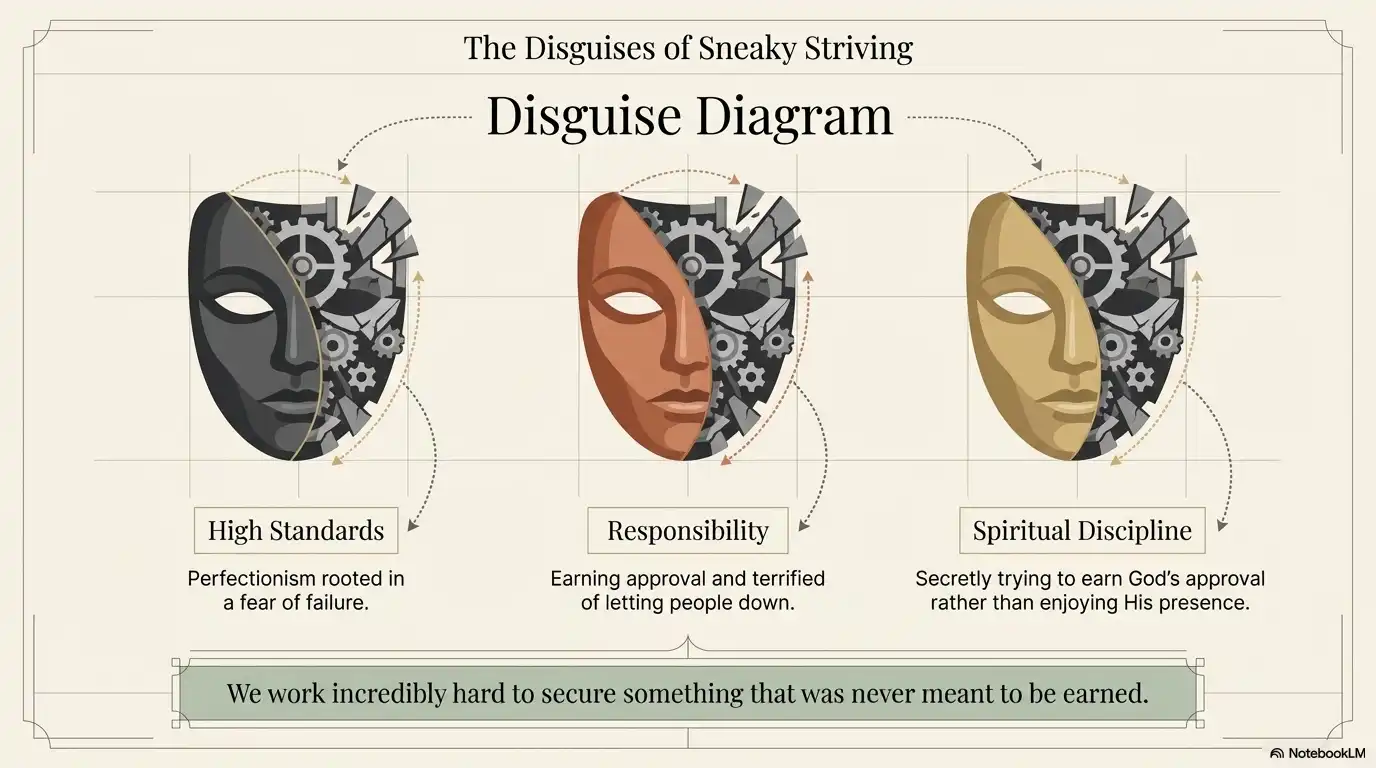
Striving is sneaky. It doesn’t always look like overwork or obvious people-pleasing. Sometimes it looks like perfectionism dressed up as high standards. Sometimes it looks like spiritual discipline that’s secretly about earning God’s approval rather than enjoying His presence. Sometimes it just looks like exhaustion you can’t quite explain — the kind that sleep doesn’t fix, because it’s not physical tiredness. It’s the tiredness of a person who has been working very hard to secure something that was never meant to be earned.
Exodus 33:14 steps directly into the middle of all of that.
1. The Context Here Is a Person in Crisis — Not a Person in Triumph
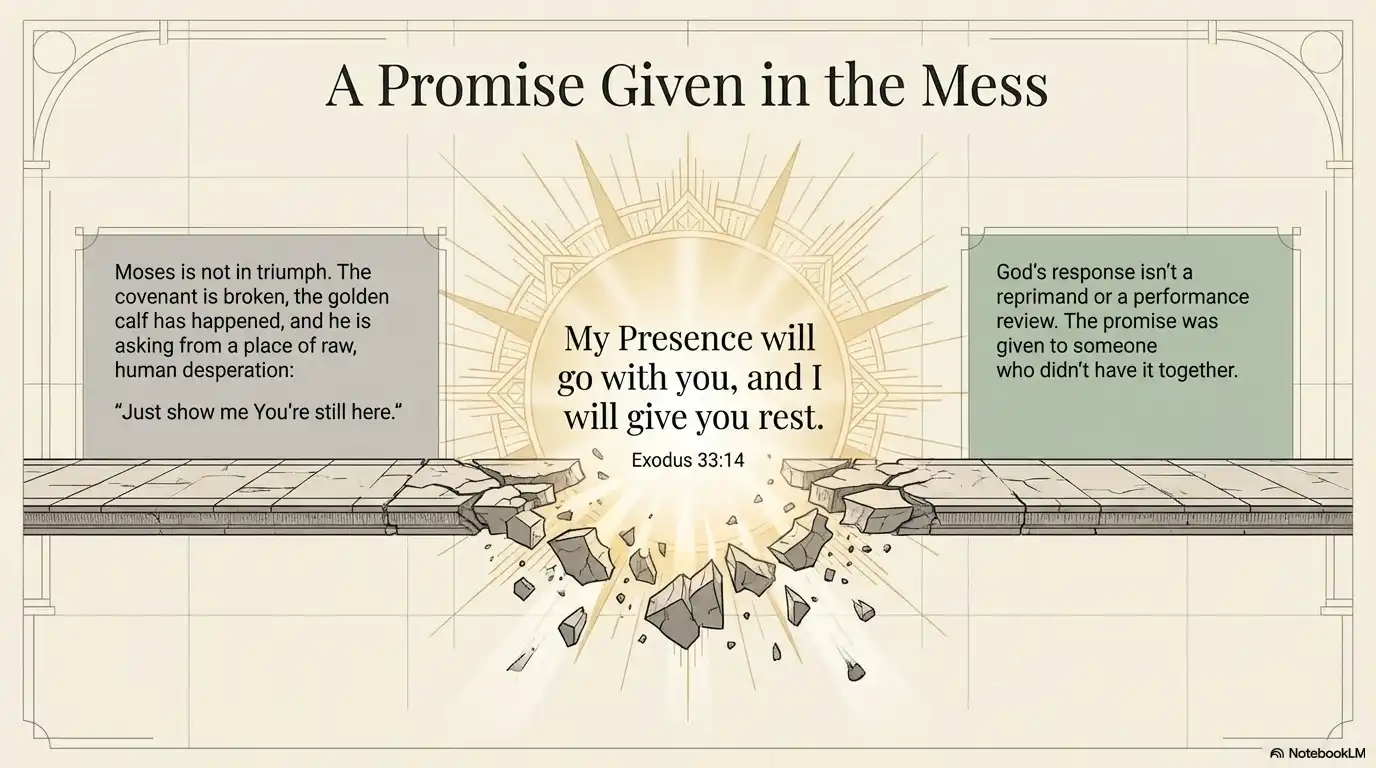
Moses isn’t receiving this promise from a place of spiritual ease. He’s just come through one of the most devastating moments in Israelite history — the golden calf, the broken covenant, the shattered tablets. The people he’s been leading have spectacularly failed, and Moses himself is in a raw, uncertain, deeply human moment of wondering whether God is still in this with him.
His actual request, just a few verses earlier, is essentially: please — just show me You’re still here. He’s not confident. He’s not composed. He’s asking from a place of genuine need and, honestly, a little desperation.
And God’s response isn’t a reprimand or a performance review. It’s a promise: My Presence will go with you, and I will give you rest.
That timing is not accidental. This promise wasn’t given to someone who had it together. It was given to someone in the middle of the mess. Which means, for what it’s worth, it was given for people like us.
2. Presence Before Performance — Always
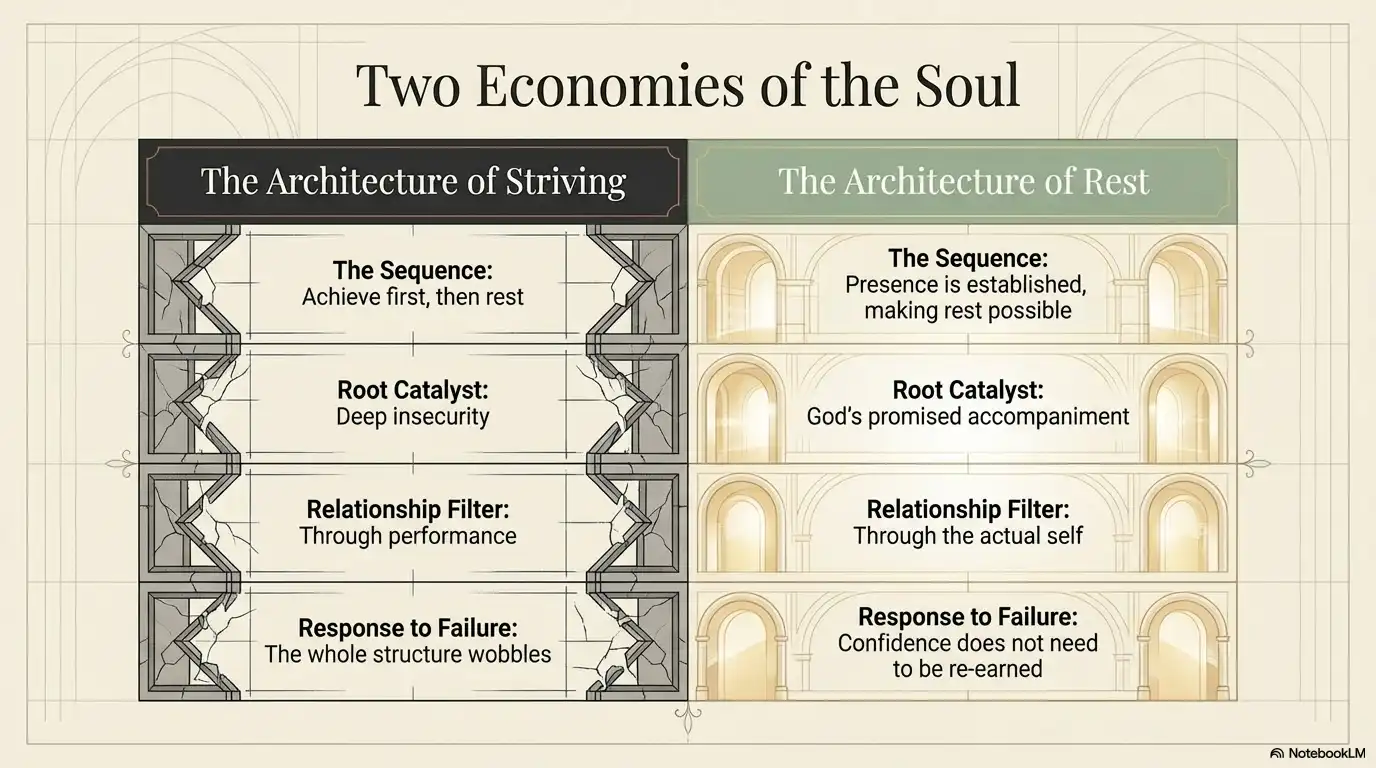
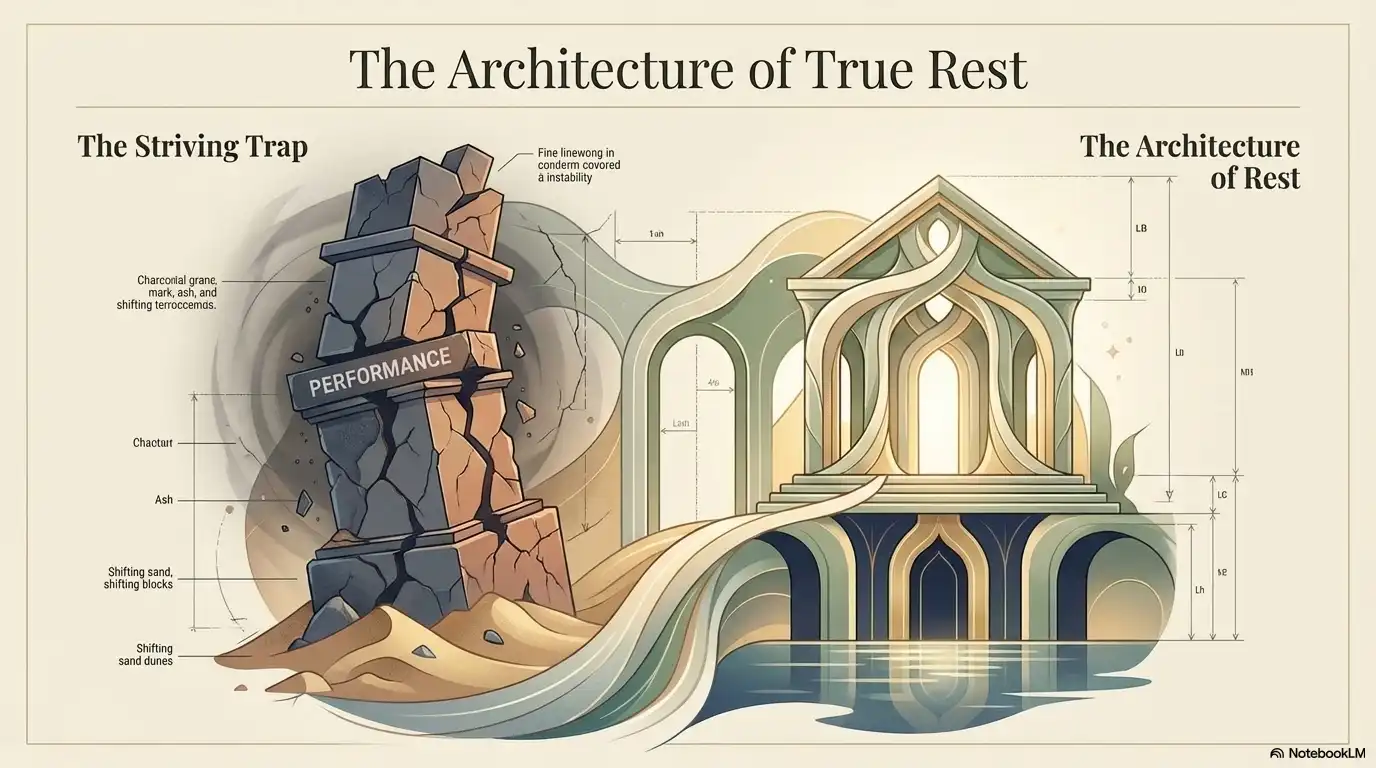
The architecture of this verse is worth examining carefully. God doesn’t say “perform well, and I’ll show up” or “get your striving under control, and then you’ll find rest.” The sequence runs the other direction entirely: My Presence goes with you — and because of that presence, rest becomes possible.
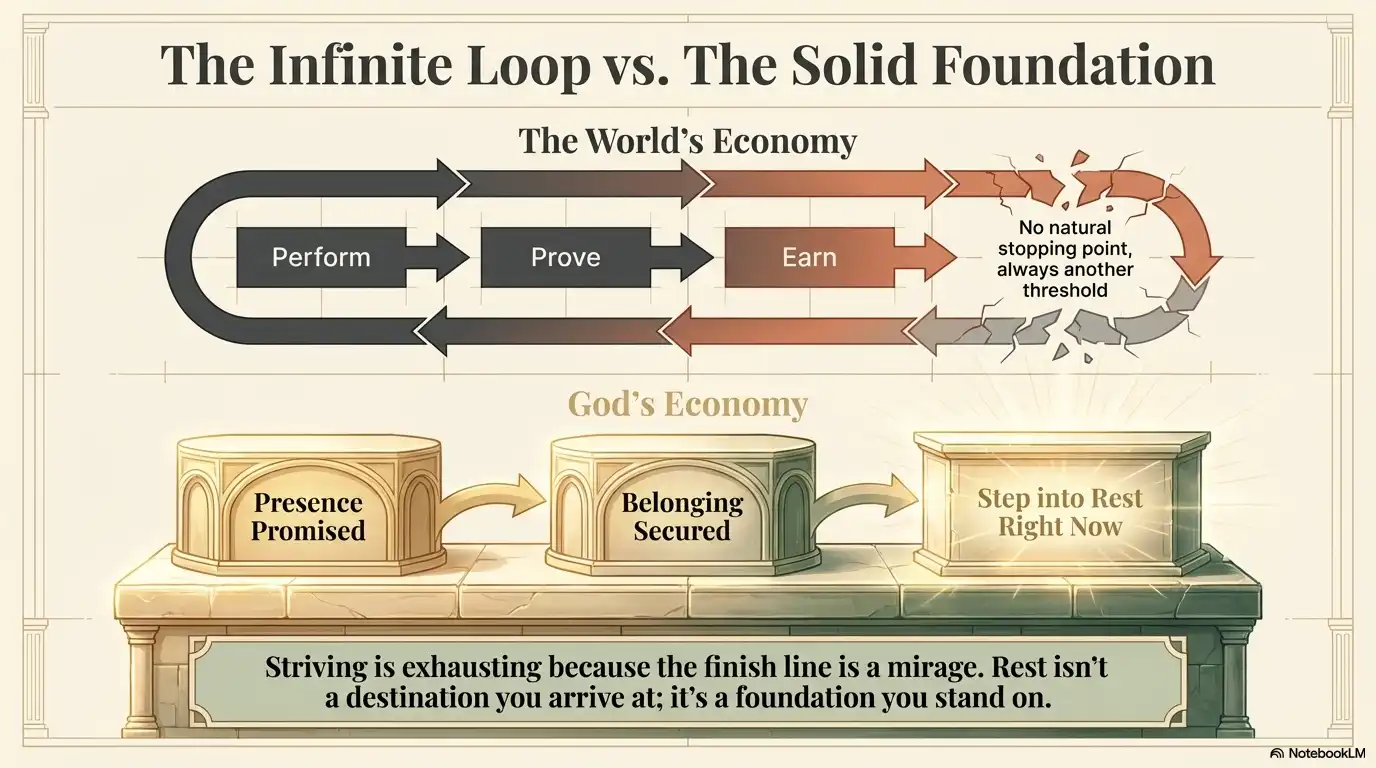
This completely inverts the striving logic most of us operate on. Striving says: achieve first, then rest. Earn first, then belong. Prove first, then be accepted. It’s exhausting precisely because there’s no natural stopping point — there’s always another threshold to clear before the rest feels justified.
God’s economy works the opposite way. The Presence is already promised. The accompaniment is already committed. Which means the rest isn’t something you eventually arrive at after proving yourself — it’s something you can step into right now, exactly as you are, because the foundation for it has already been laid.
That’s, honestly, one of the more countercultural ideas in all of Scripture. And it’s the specific thing that makes God-rooted confidence different from every other kind.
3. What Striving Actually Costs You
It’s worth being honest about this, because striving tends to dress itself up as virtue. We tell ourselves we’re just being responsible, just caring about quality, just making sure we don’t let anyone down. And yeah — some of that is genuinely good and worth keeping.
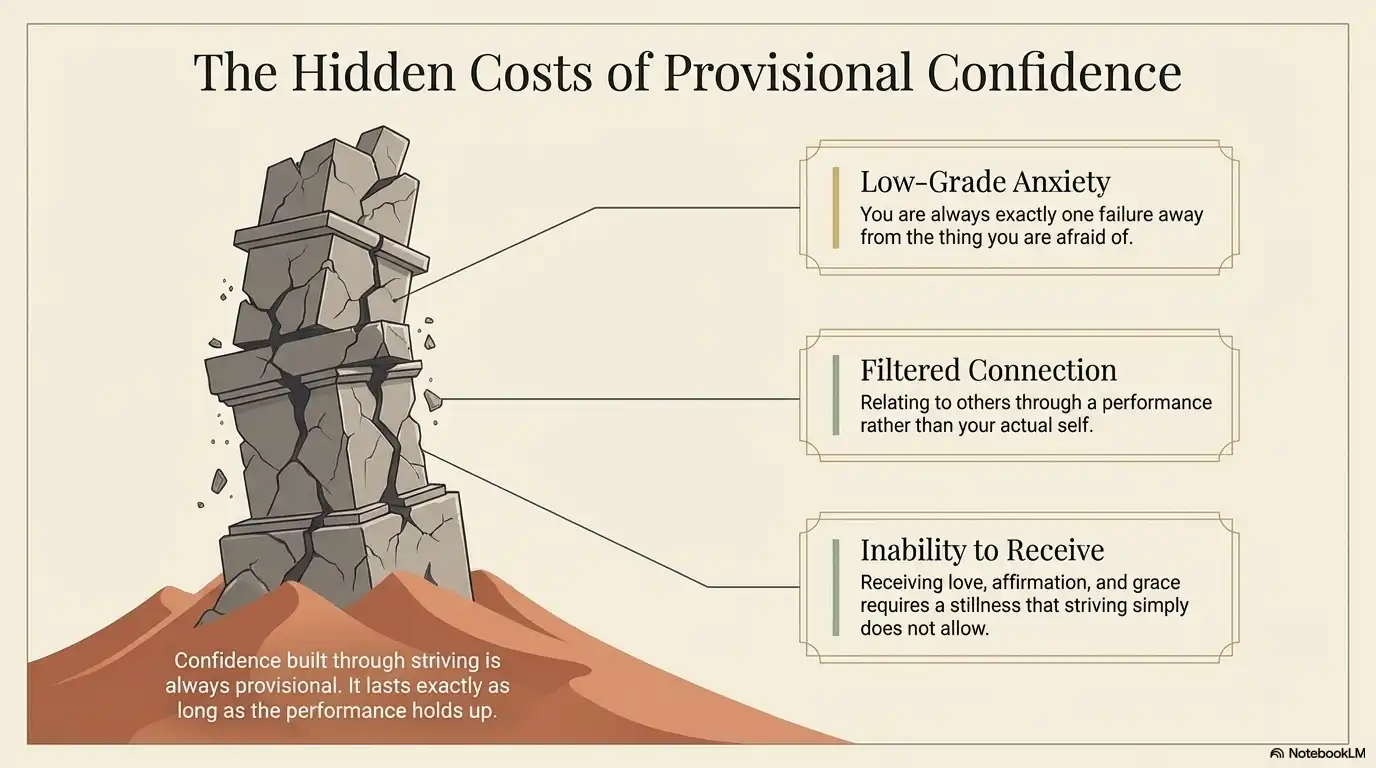
But chronic striving — the kind rooted in insecurity rather than purpose — has real costs that are worth naming. It keeps you in a constant state of low-grade anxiety, because you’re always one failure away from the thing you’re afraid of. It makes genuine connection harder, because you’re relating to people through the performance rather than through your actual self. It crowds out the ability to receive — love, affirmation, grace — because receiving requires a kind of stillness that striving doesn’t allow.
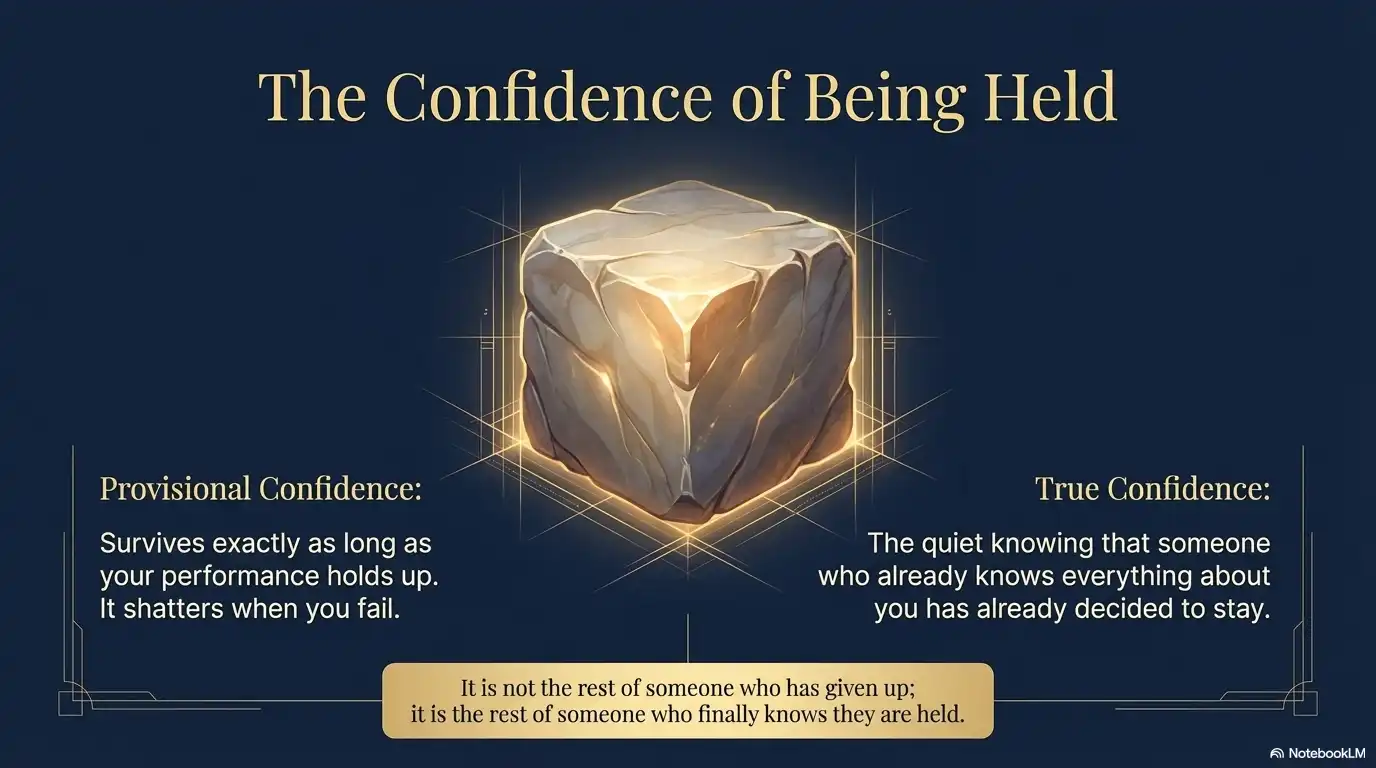
And maybe most relevantly for this challenge: it prevents real confidence from ever taking root. Because confidence built through striving is always provisional. It lasts exactly as long as the performance holds up. The moment something goes wrong — and something always eventually goes wrong — the whole structure wobbles.
Rest, by contrast, is confidence that doesn’t need to be continually re-earned. It’s stable in a way that striving can never quite manufacture.
4. “I Will Give You Rest” — This Is an Active Promise
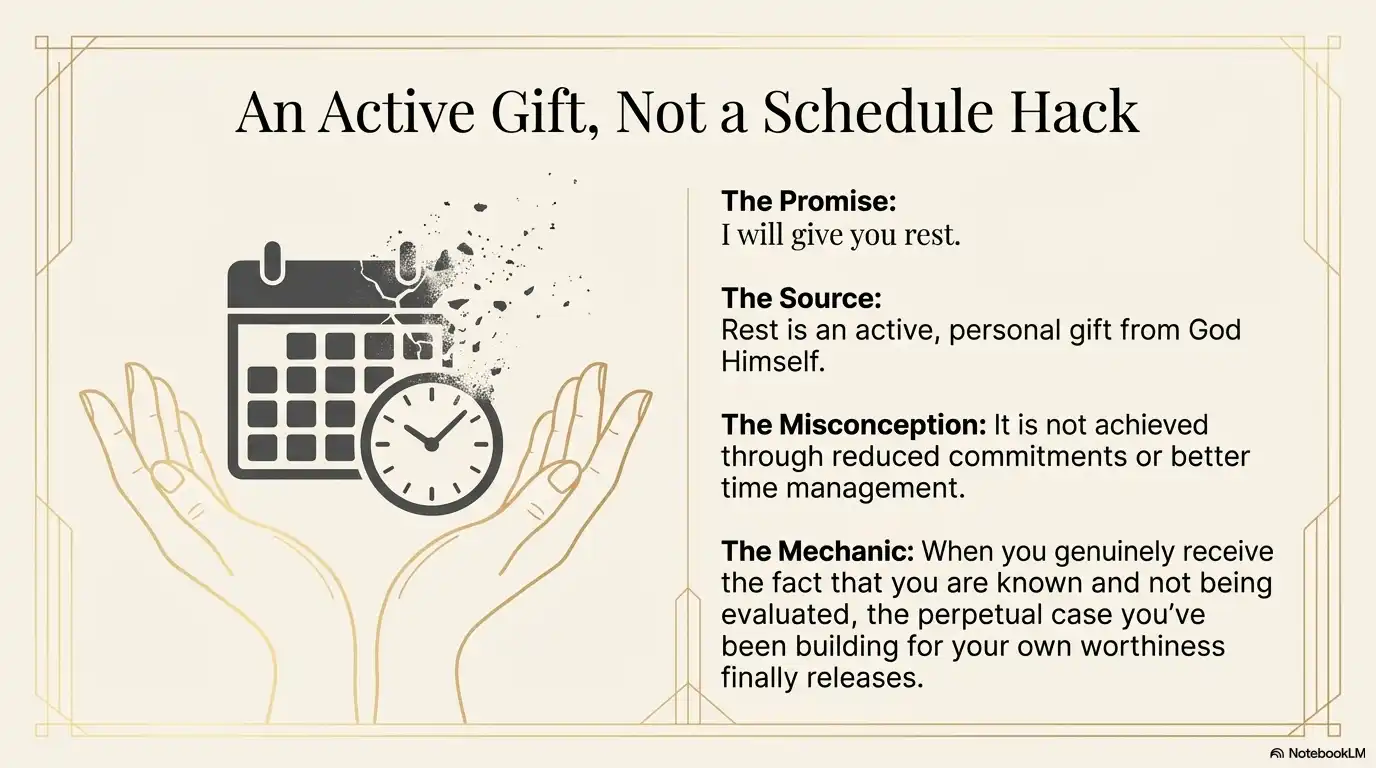
The phrasing here is worth pausing on. God doesn’t say “rest is available if you manage to slow down enough to find it” or “you can earn rest once you’ve finished striving.” He says I will give you rest. Active. Personal. God Himself as the source and the giver.
Rest, in this framework, is not primarily something you achieve through better time management or reduced commitments — though those things can help. It’s something that comes with His Presence. When you genuinely receive the fact that He is with you — not monitoring you, not evaluating your performance, but with you — something in the system starts to release. The perpetual case you’ve been building for your own worthiness starts to feel less urgent. Because someone who already knows everything about you has already decided to stay.
That’s the kind of rest that actually produces confidence. Not the rest of someone who’s given up, but the rest of someone who finally knows they’re held.
5. Resting in Presence Is a Practice, Not a Personality Type
This one is important, because some people hear “rest in God’s presence” and immediately think: that sounds like something for naturally contemplative, spiritually serene people — not for me. And look, that’s a fair assumption to examine. But rest in this sense isn’t about personality or temperament. It’s not reserved for the naturally quiet or the mystically inclined.
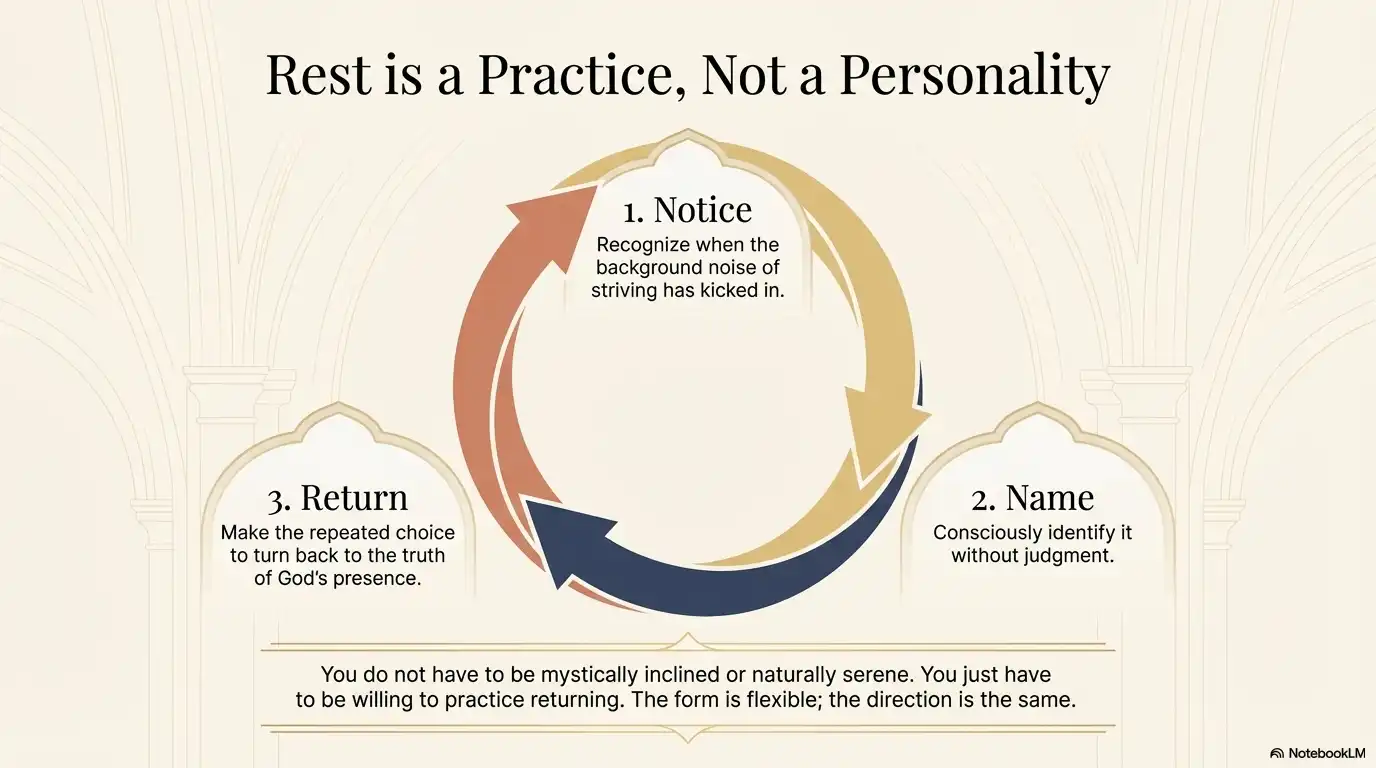
It’s a practice. A repeated choice to return to the truth of God’s presence rather than the noise of your own striving. It looks different for different people — for some it’s a few minutes of stillness in the morning, for others it’s a phrase they return to throughout the day, for others it’s the simple act of noticing when the striving has kicked in and consciously naming it. The form is flexible. The direction is the same: back toward presence, back toward the place where rest is actually available.
You don’t have to be a certain kind of person to access this. You just have to be willing to practice returning.
6. The Area Where You’re Striving Most Is Probably Also Your Greatest Area of Growth
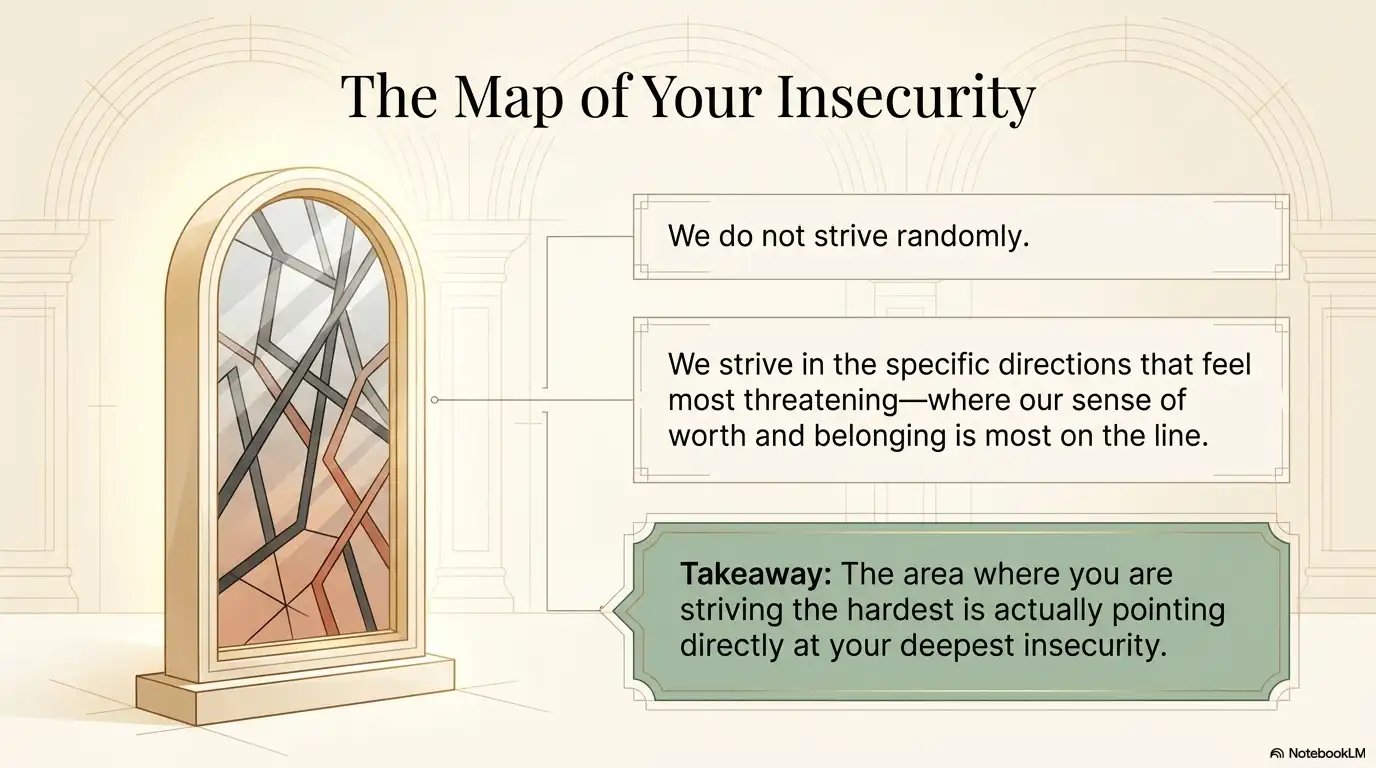
Here’s something worth noticing about today’s practice: the place you identify as your biggest striving arena is almost certainly the place where your deepest insecurity lives. We don’t strive randomly — we strive in the directions that feel most threatening, most tied to our sense of worth and belonging.
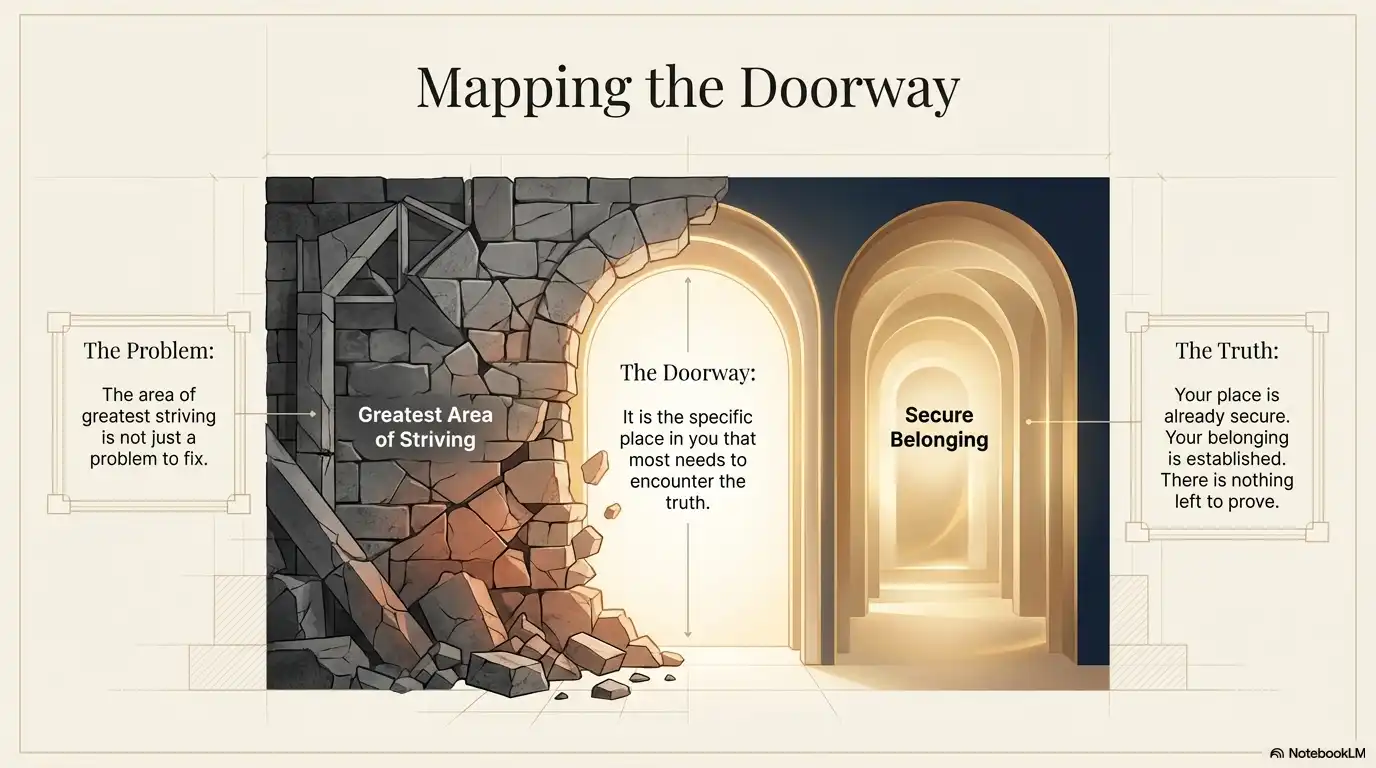
Which means the area you write down today isn’t just a problem to fix. It’s a doorway. It’s pointing toward the specific place in you that most needs to encounter the truth that your place is already secure, your belonging is already established, and there is nothing left to prove. Treat it with curiosity rather than judgment. That striving has been trying to protect you. You can thank it for that, and then gently set it down.
✦ FAQ: Real Questions, Real Answers
Q: I want to rest in God’s presence, but my life genuinely requires a lot of effort and hustle right now. Am I supposed to just stop trying?
Not at all — and this is such an important distinction to make clearly. Rest in the biblical sense is not the absence of effort. It’s the absence of striving for worth. You can work incredibly hard, carry real responsibility, and give enormous effort to the things in your life — all from a place of rest. The difference is the interior posture behind the action. Are you working because you’re secure and purposeful? Or are you working to earn a sense of okayness that keeps slipping away? Both can look identical from the outside. Internally, they feel completely different. The goal isn’t to do less. It’s to do what you do from a different place.
Q: I’ve been striving for so long that I genuinely don’t know what resting in God’s presence would even feel like. How do I start?
Start small and start honest. You don’t need to manufacture a feeling of rest — that would just be another form of performance, ironically. Begin with something simple: acknowledge the striving out loud, even just to yourself or in your journal. Name the area. Name what you’re afraid will happen if you stop performing in that space. Then bring the verse to that specific place. His presence is with me here. He is giving me rest here. You probably won’t feel it immediately — and that’s okay. You’re essentially introducing a new truth to a deeply held pattern. Give it time, and give yourself grace in the process.
Q: What’s the difference between striving and just having high standards or caring about doing good work?
The diagnostic question is: what happens in you when you fall short? Someone with high standards who is resting in God’s presence will feel disappointment at a mistake — maybe significant disappointment — but they won’t feel like their worth is on trial. They can acknowledge the shortcoming, learn from it, and keep moving without a collapse of identity. Someone striving will feel something closer to devastation, because the mistake isn’t just an error — it’s evidence of the thing they fear is true about themselves. The standard isn’t the problem. The foundation under the standard is what matters.
Q: God’s presence being with me sounds abstract. How do I actually receive that in a real, practical way?
Honestly, this is where practice matters more than perfect understanding. A few things tend to help: one is simply pausing, even briefly, before a situation where you know striving kicks in hardest, and saying something like — You are with me here. Not as a magic formula, but as a deliberate act of orientation. Another is noticing, throughout the day, moments where things go quietly well, where you feel unexpectedly supported, where something works out in a way that required more than your own effort — and choosing to attribute those moments consciously to His presence rather than letting them pass unnoticed. Receiving, like most things, becomes more natural the more you practice the actual movement of it.
Q: I identified my striving area and honestly felt shame writing it down. Is that part of the process?
Yeah — it can be. Seeing clearly where we’ve been performing for worth often comes with a kind of tenderness, and sometimes shame is part of that initial clarity. But here’s what’s worth holding onto: the fact that you can see it is not cause for shame. It’s cause for compassion toward yourself. You didn’t start striving because something was wrong with you. You started striving because, somewhere along the way, you learned that performance was the safest path to belonging. That was a reasonable response to whatever you experienced. It just doesn’t happen to be true. The striving came from a wound, not a character flaw. Treat it accordingly.
Q: Can I really stop people-pleasing if I care about other people? Won’t I just become selfish?
This is such a common fear, and it makes sense that it comes up. But people-pleasing and genuinely caring for others are actually quite different things, even though they can look similar. People-pleasing is ultimately about you — specifically, about managing your anxiety around rejection and disapproval. Genuine care is oriented outward — toward what actually serves the other person, even when that isn’t what they want to hear. Here’s the thing: when you stop people-pleasing, you don’t stop caring. You start caring more honestly. You can disagree with someone and stay in relationship with them. You can set a boundary and still love the person it protects both of you from. Real love is actually more possible from a place of rest than from a place of striving to be liked.
Q: I keep coming back to spiritual striving specifically — performing for God’s approval. How do I break that pattern?
Slowly, gently, and with a lot of grace toward yourself — because spiritual striving is one of the trickiest patterns to unwind, precisely because it’s dressed in the language of devotion. The key reframe is this: God is not more present when your spiritual performance is better. His presence, as this verse makes clear, is a gift — not a reward. Your quiet time, your giving, your serving — these are meant to be responses to a relationship that already exists, not attempts to create or maintain one. When you notice yourself performing spiritually, try to pause and ask: what am I afraid will happen if I bring my actual self here instead of my best self? That question tends to get at the root more quickly than almost anything else.
Five days in. You’ve covered real ground — more than you probably realize. Rest in that for a moment. See you tomorrow.