

The Midpoint That’s Actually a Milestone
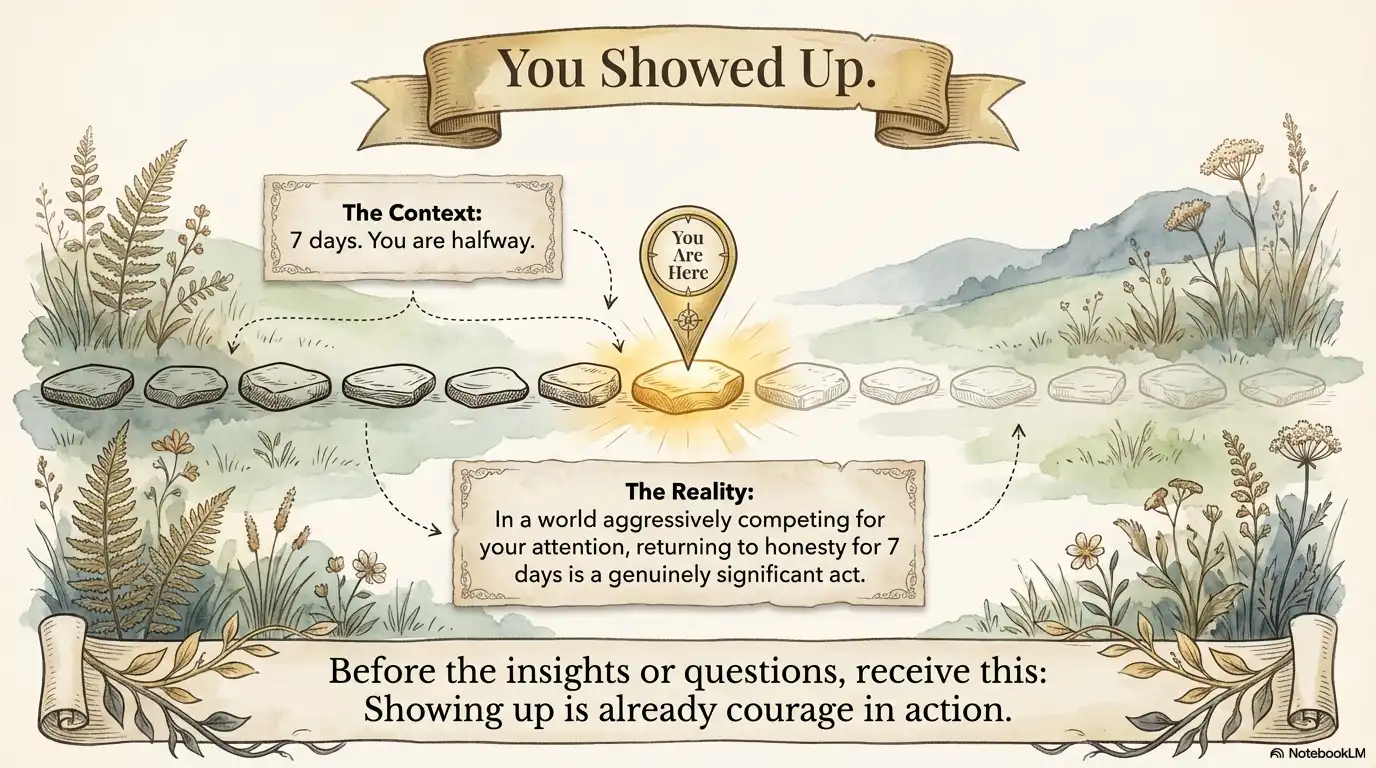
Seven days. You’re halfway.
And before we go any further into today’s verse — which, honestly, deserves a full and unhurried look — can we just take a moment to acknowledge something? You showed up. Seven days in a row, you came back. That is not nothing. In a world that competes aggressively for your attention and energy, returning to something this consistently, especially something that asks you to be honest with yourself, is a genuinely significant act.
So before the insights, before the FAQ, before the reflection questions — just receive that for a second. You came back. That’s already courage in action.
Now. Joshua 1:9. Let’s talk about why this verse is the perfect midpoint anchor.
1. Joshua Is Standing at the Most Daunting Threshold of His Life — and God Gives Him This
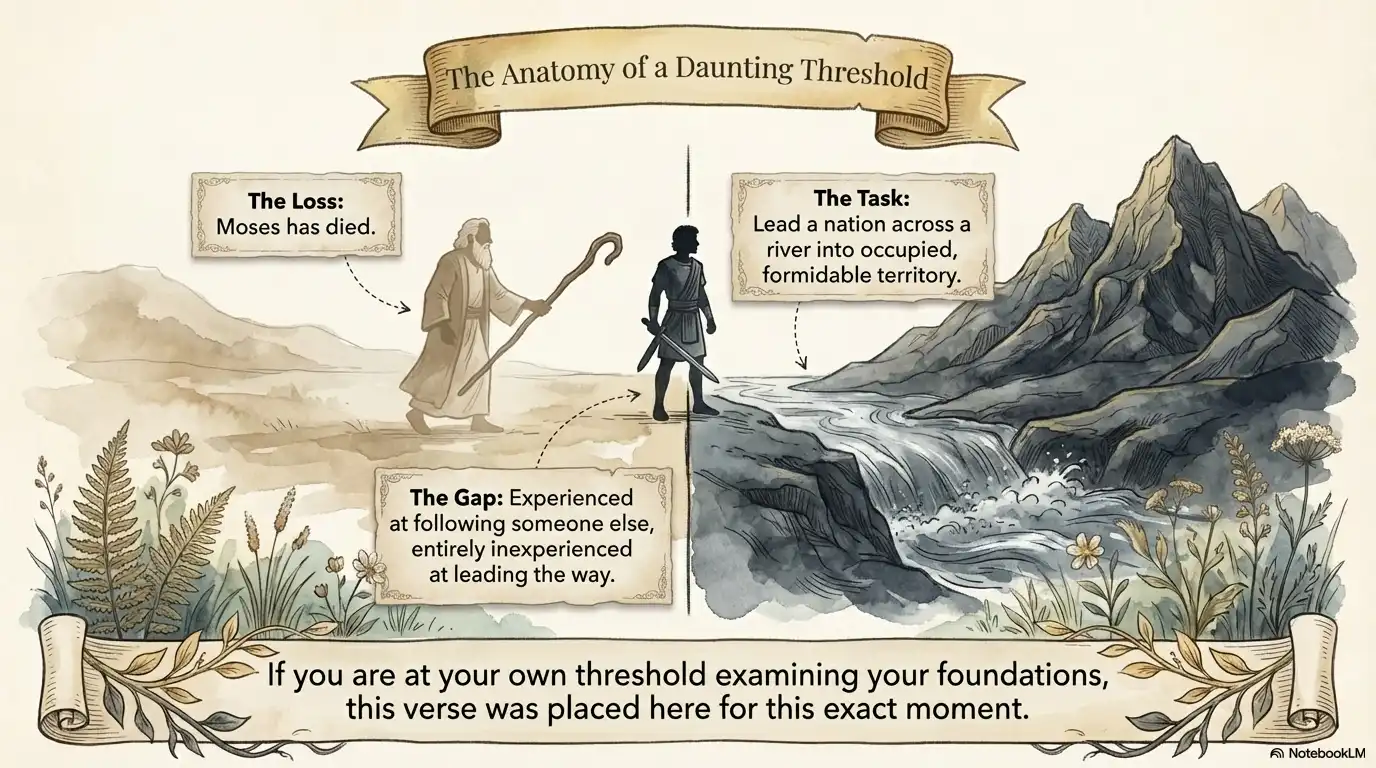
The timing of this verse is everything. Moses has just died. Joshua has just been handed leadership of an entire nation. He’s being asked to lead people across a river into a land occupied by people who will not welcome them — people who are, by all reports, formidable. And Joshua, for all his years of faithful service alongside Moses, has never done this before.
He’s not experienced at being the one in front. He’s experienced at following someone who was.
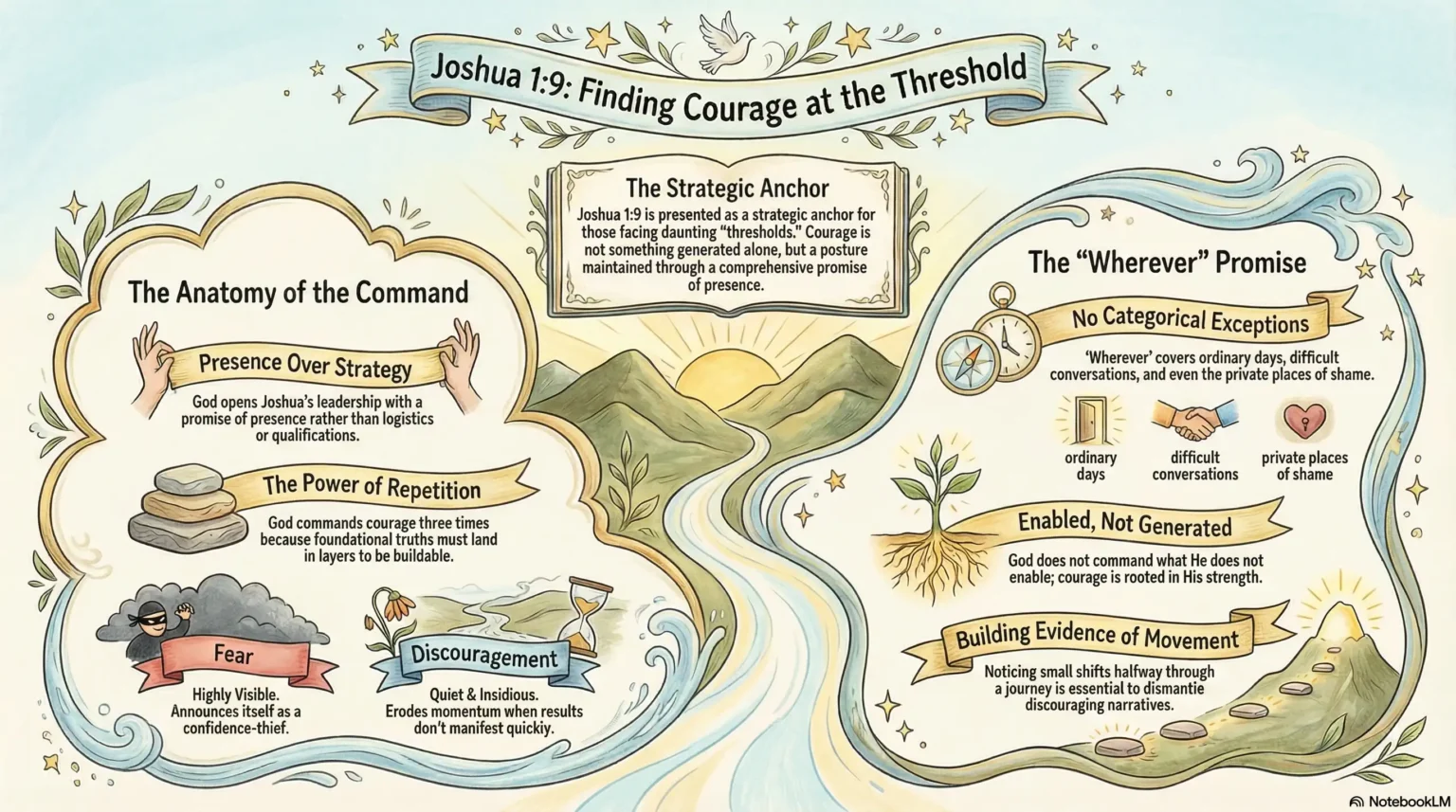
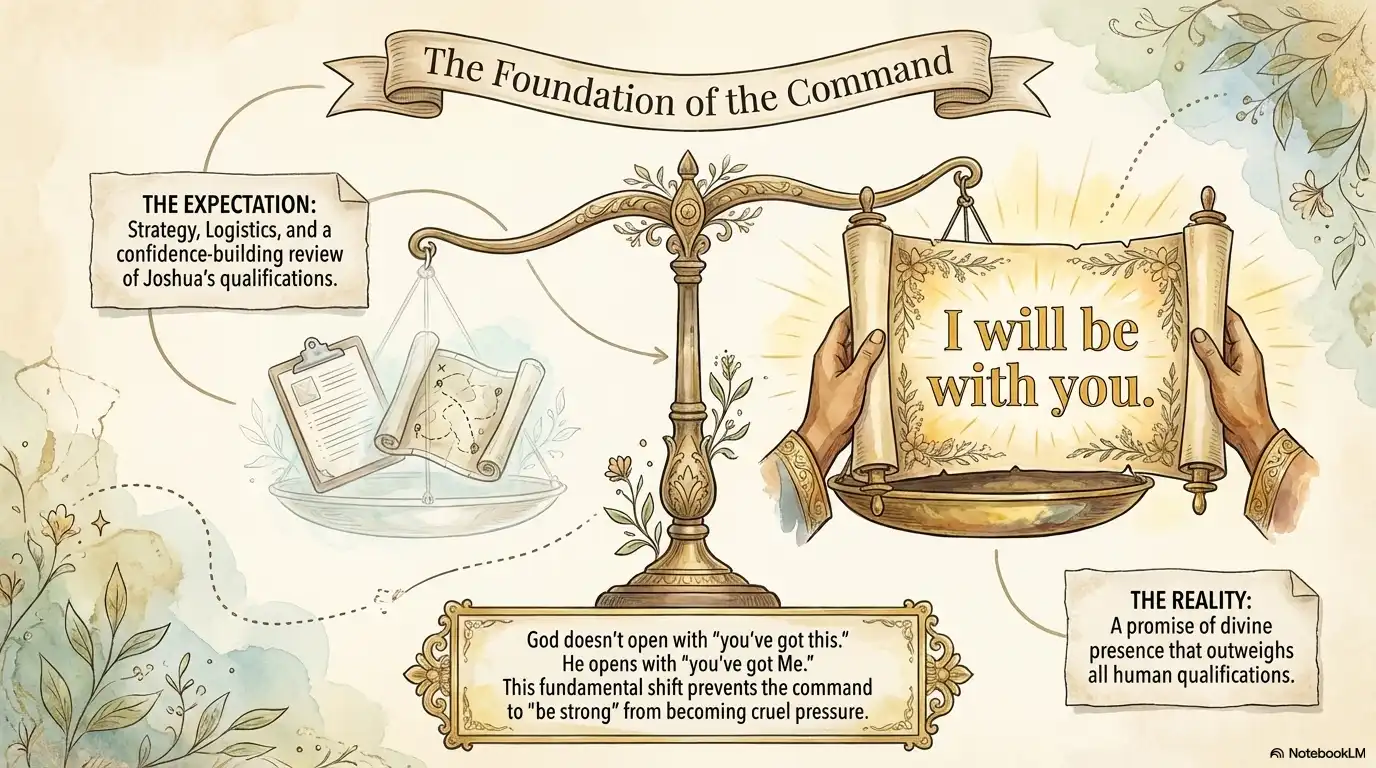
And God, who knows all of this completely, doesn’t open with strategy or logistics or a confidence-building review of Joshua’s qualifications. He opens with presence. I will be with you wherever you go. Not “you’ve got this” — but “you’ve got Me.” That’s the foundation the entire command rests on, and it’s the foundation that makes the command something other than cruel pressure.
If you’re at your own kind of threshold — which, seven days into a challenge that’s been asking you to honestly examine your foundations, you almost certainly are — this verse was placed here for exactly this moment.
2. This Is the Third Time God Has Said Something Like This in Three Chapters
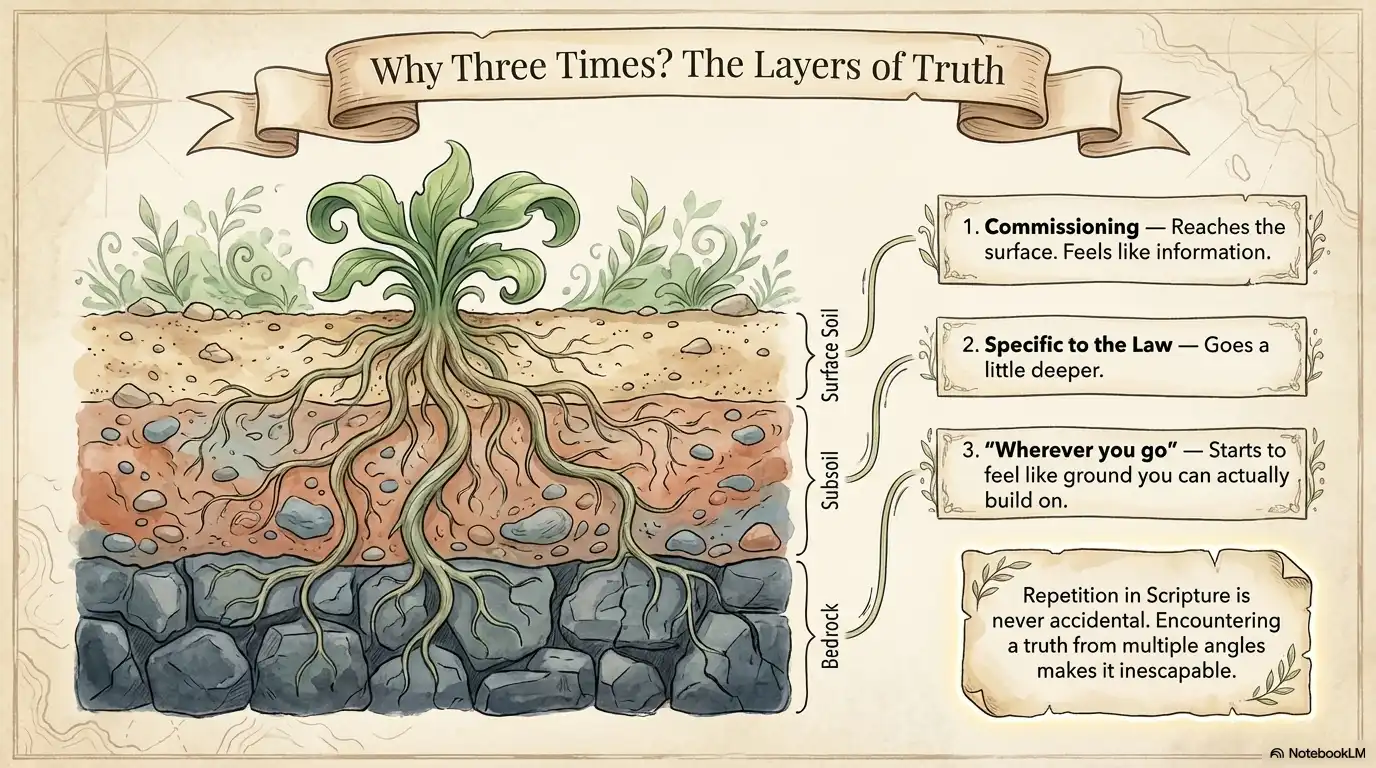
It’s worth knowing that Joshua 1:9 isn’t an isolated encouragement. In the span of just a few verses, God tells Joshua to be strong and courageous three times. The first time when commissioning him. The second time with specific reference to the law. And here, a third time, with the most personal and comprehensive foundation: wherever you go.
Repetition in Scripture is almost never accidental. When something is said three times in quick succession, it’s because the writer — and the God behind the writer — knows that once is rarely enough. The truth needs to land in layers. The first time you hear something, it reaches the surface. The second time, it goes a little deeper. The third time, it starts to feel less like information and more like something you can actually build on.
That’s also, not coincidentally, what these seven days have been doing. You’ve heard versions of this same foundational truth — God is with you, you are held, your worth is established, you are not abandoned — from multiple angles, in multiple contexts. That’s by design. Something that’s true once is true always, but something that’s been encountered seven times from seven different directions starts to feel like ground you can actually stand on.
3. “Wherever You Go” Is a Remarkably Comprehensive Promise
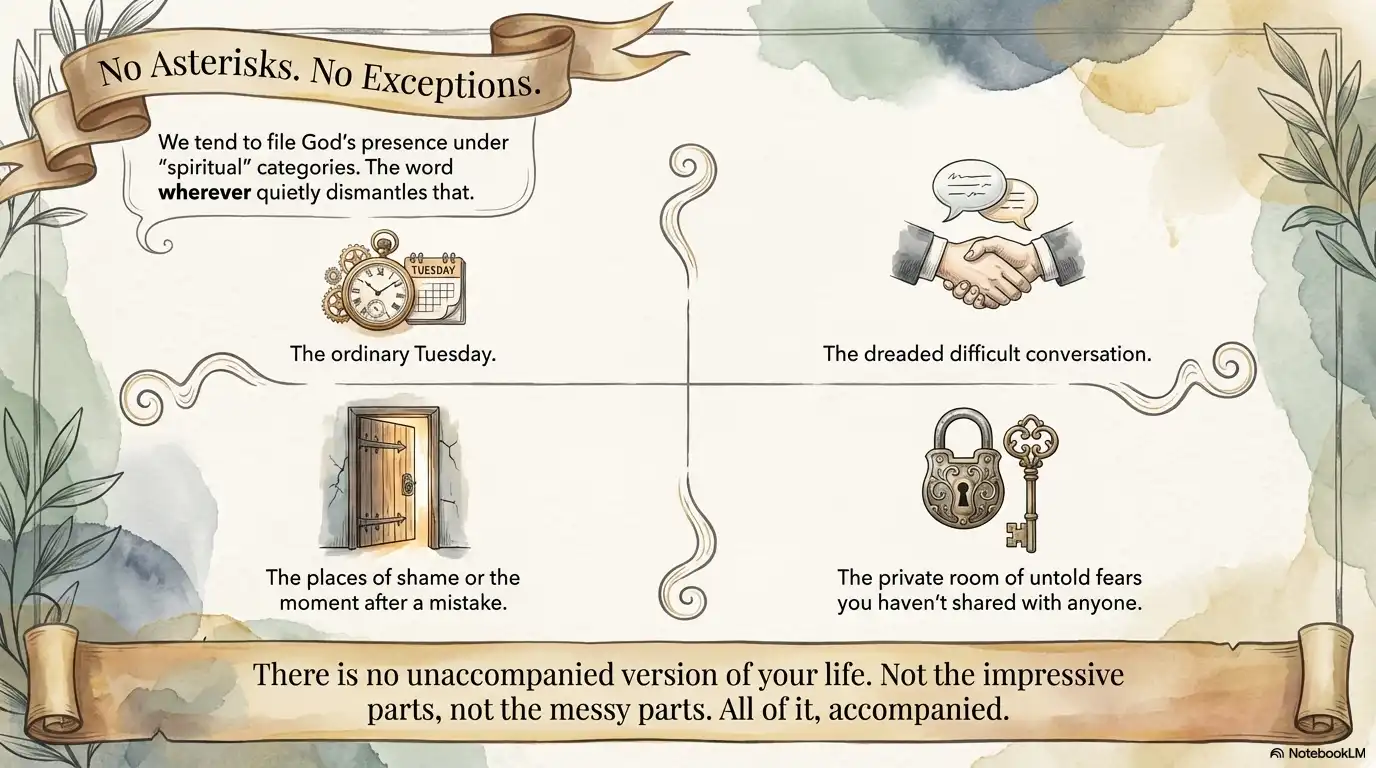
There’s a temptation — and it’s a subtle one — to mentally file God’s presence under specific categories. He’s with me when I’m praying. He’s with me when I’m doing something important or spiritually significant. He’s with me in the big moments.
The wherever in this verse quietly dismantles that categorization. Wherever you go. The ordinary Tuesday. The difficult conversation you’ve been dreading. The moment after the mistake. The place where you feel least like yourself. The room full of people whose approval you’ve been quietly trying to earn. The private place where the fears you haven’t told anyone about live.
Wherever. No asterisks. No categorical exceptions. No “except for that place you keep going back to that you’re ashamed of.” Wherever.
That kind of comprehensive presence is, honestly, one of the most stabilizing things you can internalize — because it means there is no version of your life that you’re navigating unaccompanied. Not the impressive parts. Not the messy parts. Not the in-between parts that don’t feel particularly significant. All of it, accompanied.
4. “Do Not Be Discouraged” — This Part Deserves Its Own Moment
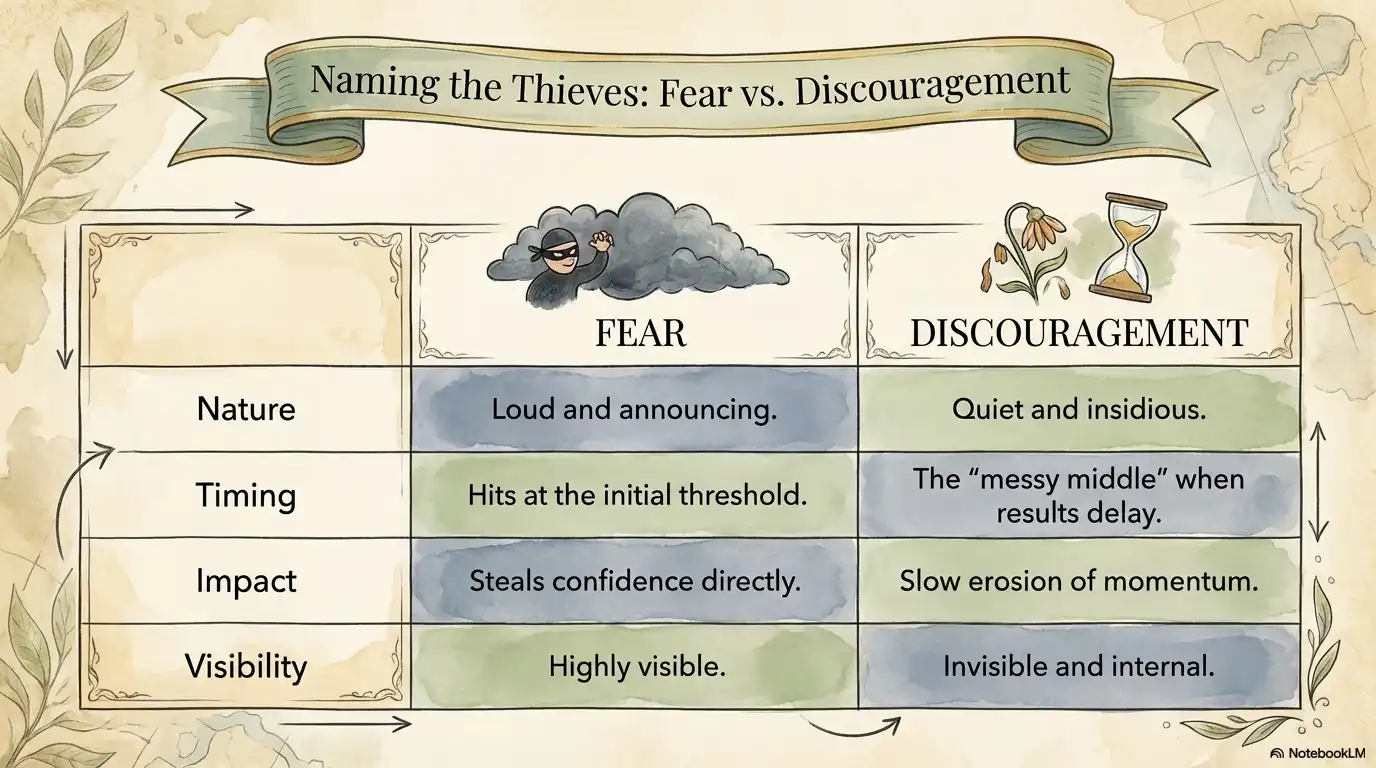
We talk a lot about fear. Fear is the more visible confidence-thief, the one that announces itself. But discouragement is the quieter one — and in some ways, the more insidious.
Discouragement is what sets in after the initial fear has faded and you’ve been trying for a while and things haven’t shifted as dramatically as you hoped. It’s the slow erosion of momentum. The quiet voice that says maybe this isn’t working, maybe you’re not changing, maybe the gap between who you are and who you want to be is just too wide.
God specifically names it here alongside fear — do not be afraid; do not be discouraged — as if He knows that these two things travel together, and that the second one often shows up when the first one hasn’t fully materialized but the desired result hasn’t either.
At the midpoint of a 14-day challenge, discouragement is worth naming directly. If you were expecting to feel dramatically different by now and you don’t — that’s okay. If the shifts feel smaller than you hoped — that’s okay. Small shifts are real shifts. And God’s command against discouragement, just like His command against fear, comes packaged with the same provision: I am with you. That’s enough to keep going.
5. The Midpoint Reflection Is Not Optional Sentiment — It’s Strategic
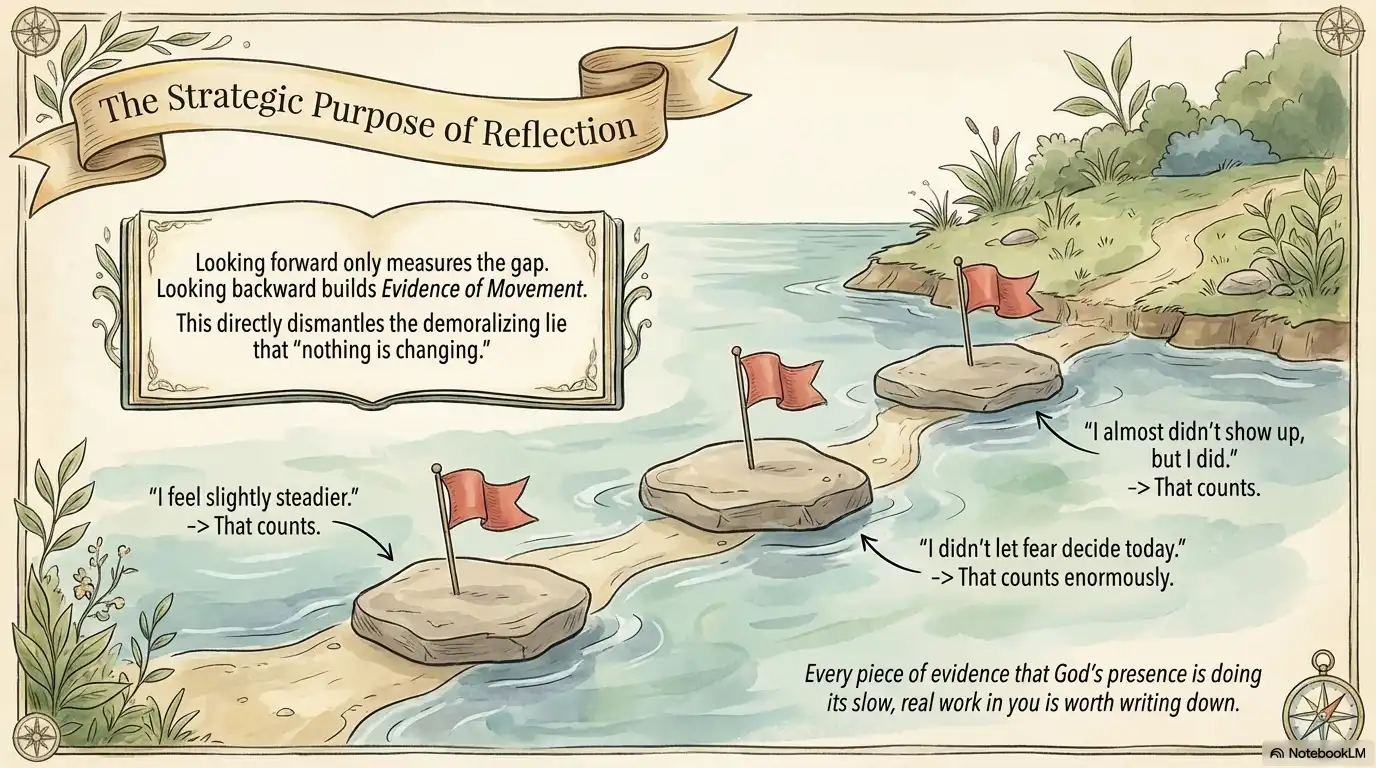
There’s a reason today’s practice asks you to look back rather than forward. In the middle of a journey, the tendency is to look at how far you still have to go and use that as the primary measure of progress. That’s, frankly, one of the most demoralizing ways to navigate growth.
Looking back — specifically noticing what has shifted, even in small ways — does something different. It builds what researchers call evidence of movement. And evidence of movement matters because it directly challenges the discouraging narrative that nothing is changing. Something usually has changed. But if you don’t stop to look for it, you’ll miss it entirely, and the journey forward will feel harder than it needs to.
So when you answer today’s reflection questions, resist the temptation to be dismissive of small shifts. I feel slightly steadier. That counts. I noticed the fear and didn’t let it make my decision for me once this week. That counts enormously. I came back on a day when I almost didn’t. That counts. Every piece of evidence that God’s presence is doing its slow, real work in you is worth writing down and receiving.
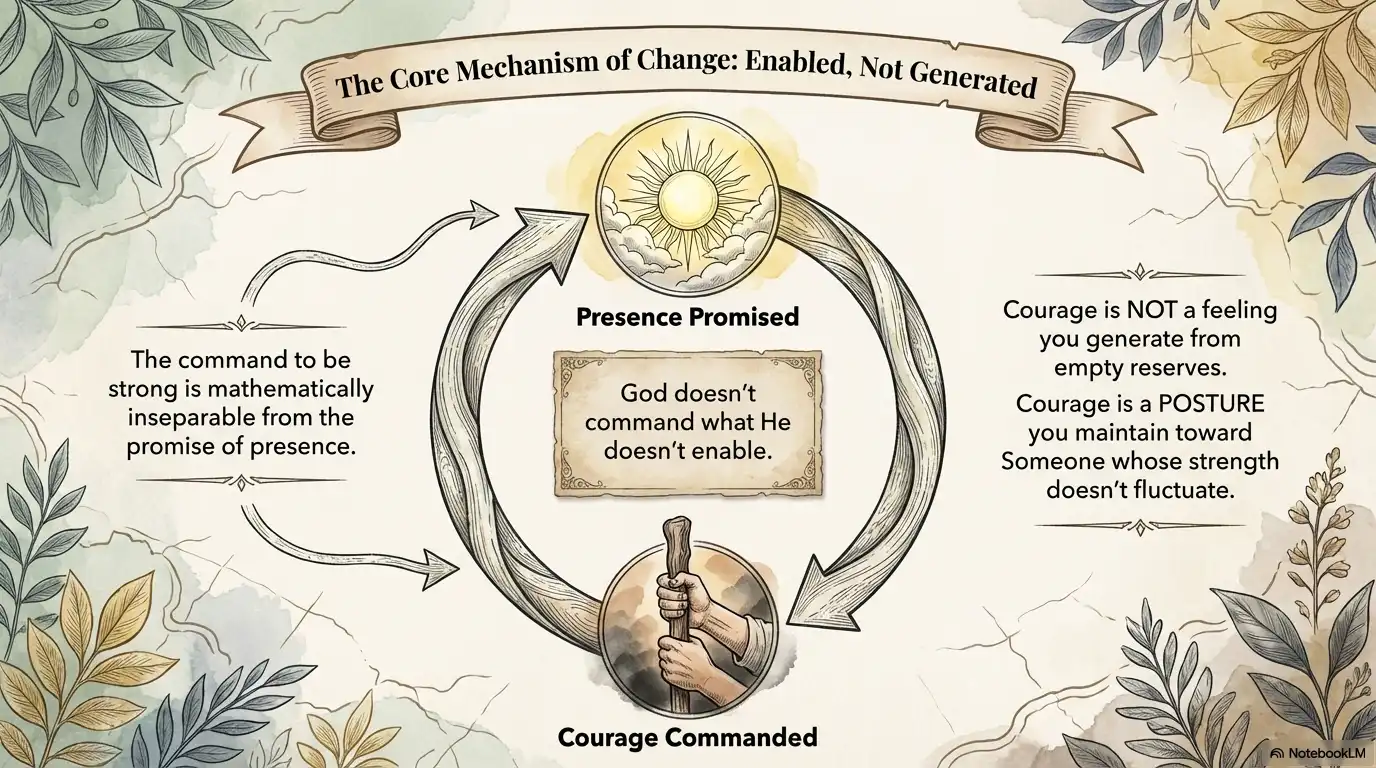
6. God Doesn’t Command What He Doesn’t Enable — This Is the Key to Everything
This might be the most important theological point in today’s content, and it’s worth landing clearly. The command to be strong and courageous is not a demand issued from a distance by a God who will then judge you on how well you performed it. The structure of this verse makes that impossible.
The courage is commanded. The presence is promised. The two are inseparable.
Which means when you feel like you don’t have enough courage — and you will feel that, probably repeatedly, in the second half of this challenge and in life beyond it — the answer isn’t to dig deeper into your own reserves. The answer is to return to the presence. Courage, in this framework, is less about a quality you generate and more about a posture you maintain toward Someone whose strength doesn’t fluctuate.
That’s not a passive position. It still requires showing up, choosing truth over fear, taking the small and large risks that faith asks of you. But you’re not doing it alone, and you’re not doing it on empty. You’re doing it accompanied, and there’s a meaningful difference.
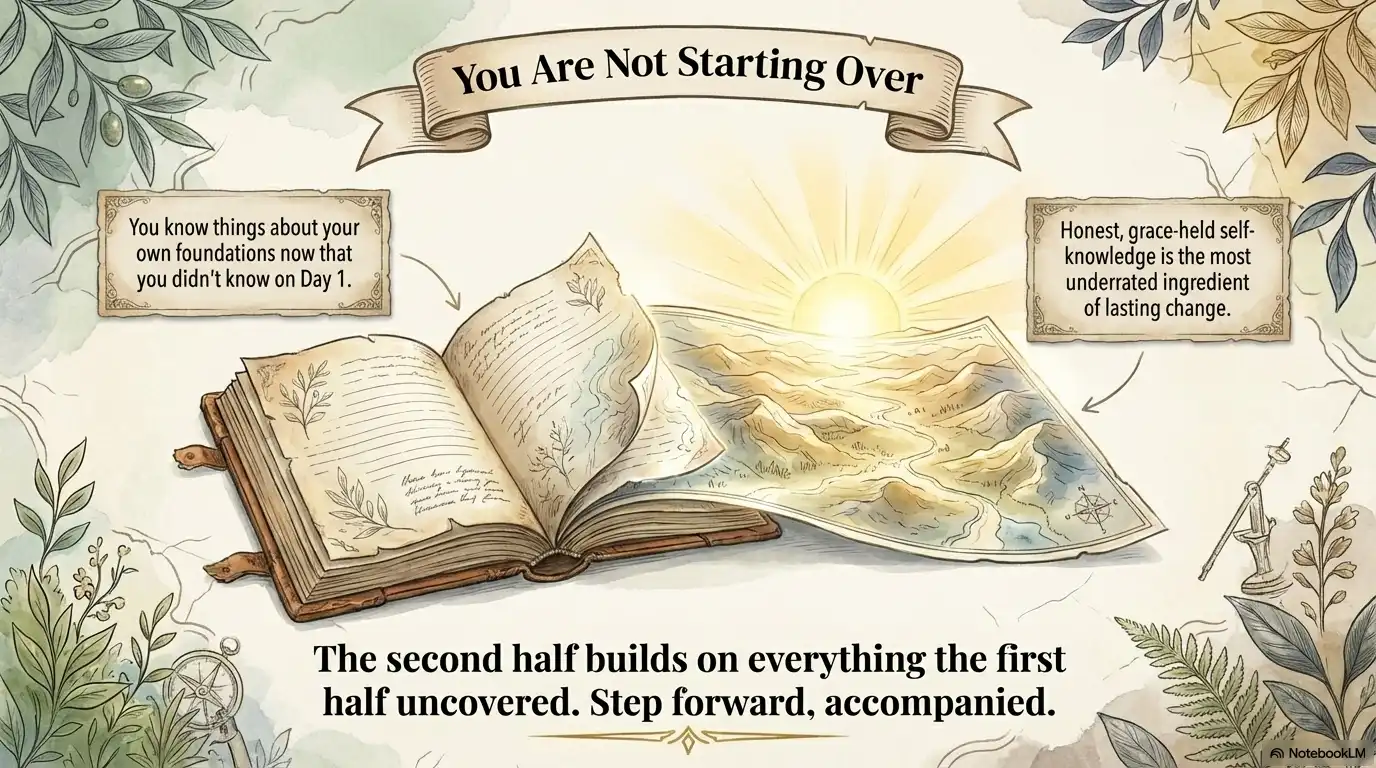
7. Halfway Through, You Know Things About Yourself That You Didn’t Know on Day 1
This is worth sitting with as you do today’s reflection. Seven days of honest journaling, honest prayer, and honest engagement with these truths has almost certainly surfaced things — about where your confidence has been rooted, about what you’re actually afraid of, about the specific places where God’s truth has started to feel more real and the specific places where it still feels distant.
That knowledge is not small. Self-knowledge — honest, grace-held self-knowledge — is one of the most underrated ingredients in lasting change. You know more about your own foundations now than you did a week ago. That’s ground you’ve actually covered, whether it feels dramatic or not.
The second half of this challenge gets to build on everything the first half has uncovered. You’re not starting over. You’re continuing from a different place than where you began.
✦ FAQ: Real Questions, Real Answers
Q: I’m at Day 7 and honestly don’t feel much different than Day 1. Should I be worried?
No — and please hear that clearly, because discouragement at the midpoint is one of the most predictable and least discussed parts of any meaningful process. Here’s the thing about internal change: it almost never looks the way we expect it to, on the timeline we expected it. What you’re looking for might be a dramatic emotional shift — a sudden settling of confidence, a clear before-and-after. What’s more likely happening is something quieter and more structural: small recalibrations in how you’re relating to fear, tiny moments where the old response didn’t fully run the show, incremental loosening of beliefs that have been tightly held for a long time. That kind of change is easy to miss if you’re only looking for the dramatic version. Go back and look at Day 1’s journal entry if you wrote one. You might be surprised by what’s different.
Q: The verse says “be strong and courageous” again. At this point it almost feels repetitive. Why does God keep saying the same thing?
Because, honestly, you keep needing to hear it — and so does everyone else. That’s not a criticism. It’s just how humans work. We don’t internalize important truths in a single encounter. We circle back to them, hear them from different angles, in different contexts, during different seasons, and each time something new tends to land. The repetition in Joshua 1 mirrors something true about the nature of transformation: it’s iterative, not instantaneous. The fact that you’re still here on Day 7, still reading this, still engaging — you’re living out the principle. You keep coming back. That’s exactly what the repetition is designed to produce.
Q: I skipped a few days. Does that mean I’ve missed too much to keep going?
Absolutely not — and please don’t let the days you missed become a reason to abandon the days that are still available to you. Perfectionism has a way of disguising itself as integrity: if I can’t do it right, I shouldn’t keep going. But that’s just the old performance pattern wearing a new outfit. The challenge is not graded. God’s presence didn’t pause on the days you weren’t showing up. You can step back in right here, right now, with whatever you have. The second half of this journey has things to offer you that the first half hasn’t covered yet. Don’t let imperfect participation become an excuse for no participation.
Q: How do I actually use God’s presence as a source of courage in real-time — like, in the middle of a scary moment?
A few things tend to work, and it’s worth finding which one resonates most with how you’re wired. Some people find a short, simple phrase that they can return to in the moment — something like He is with me here or just wherever I go — and they use it almost as an anchor, a way of quickly reorienting attention from the fear to the presence. Others find it helpful to take one deliberate breath before a difficult moment and consciously acknowledge: I’m not walking into this alone. Still others find that the practice of noticing God’s presence in ordinary moments throughout the day makes it more accessible in the harder ones — you’ve been rehearsing the awareness, so it’s more readily available when you need it. There’s no single technique here. The goal is just to make God’s presence a real, practiced point of return rather than only a theological concept you reach for in crisis.
Q: What if my midpoint reflection shows me I’ve made basically no progress? What do I do with that?
First — be gently skeptical of that conclusion, because it’s almost never as true as it feels. But if after honest reflection you genuinely can’t identify any shift, that’s actually useful information rather than a verdict. It might mean the truths have been staying primarily at the intellectual level and haven’t yet found their way into the places where you actually live. It might mean there’s a specific wound or belief that’s more entrenched than the general content of the challenge can reach on its own — and that some additional, more targeted support would serve you well. The P.S. in today’s email mentions optional paths for deeper support, and if you’re finding that nothing is landing, that might genuinely be worth exploring. Reaching for more help isn’t failure. It’s wisdom.
Q: I noticed a small shift this week but I’m afraid to acknowledge it in case it goes away. Is that normal?
So normal — and it has a name: it’s basically anticipatory grief for a good thing that hasn’t been lost yet. We sometimes hold good shifts loosely or even resist acknowledging them because acknowledging them feels like it might make us responsible for maintaining them, or like celebrating too early might invite the floor to fall out. But here’s what’s true: noticing and naming what’s good doesn’t make it more fragile. If anything, it tends to make it more durable, because you’re actually receiving it rather than holding it at arm’s length. Write the shift down. Say it out loud if you can. Receive it as real. The progress doesn’t disappear because you saw it.
Q: I feel more confident during the challenge but I’m worried it won’t stick once it’s over. What can I do about that?
That’s actually a really wise thing to be thinking about at the midpoint, and the fact that you’re asking it now gives you seven days to do something about it. A few thoughts: the practices you’ve been doing — journaling, returning to specific verses, naming fears and holding them up against truth — are not challenge-specific activities. They’re just practices. And practices become durable when they become habitual rather than event-driven. The second half of this challenge is a good time to start noticing which specific practices have been most helpful for you personally, because those are the ones worth building into your ordinary routine. The content of this challenge ends on Day 14. The practice of returning to these truths? That doesn’t have an expiration date.
Halfway. Genuinely halfway. Whatever you’re noticing today — hold it lightly, receive it honestly, and keep going. Seven more days. See you tomorrow.