

When Everything Shakes and One Thing Doesn’t
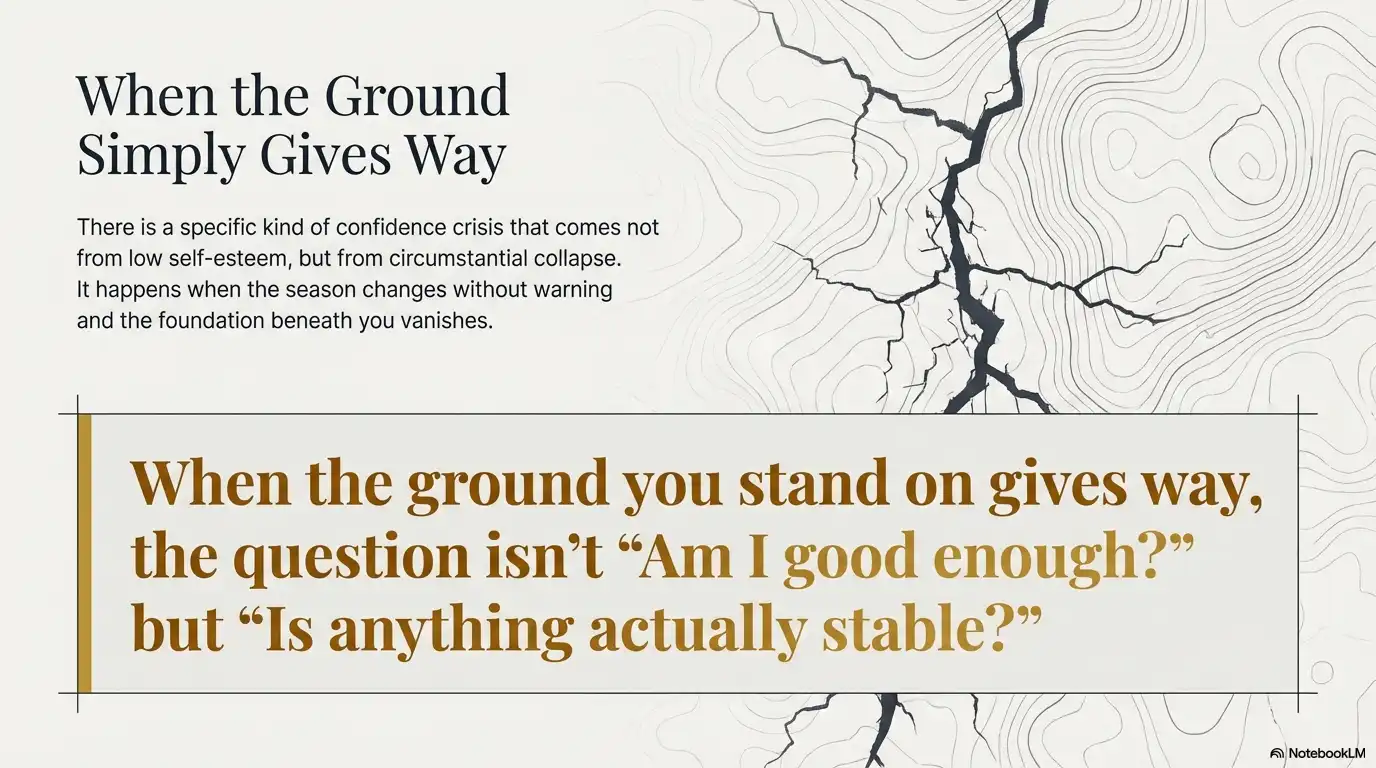
There’s a particular kind of confidence crisis that doesn’t get talked about enough — and it’s not the kind that comes from low self-esteem or comparison or perfectionism. It’s the kind that comes from circumstances. From the season when the ground you were standing on simply gives way beneath you without warning, and suddenly the question isn’t am I good enough but is anything actually stable?
That kind of shaking is different. And it deserves a different kind of answer.
2 Samuel 22:2-3 is that answer. But to really receive it, you need to know who’s saying it — and why.
1. David Wrote This After One of the Most Turbulent Lives in Scripture
This psalm isn’t a theoretical meditation on God’s stability written from a place of calm. David wrote it, according to the opening of 2 Samuel 22, after God delivered him from all his enemies — including, notably, King Saul, who had spent years trying to kill him. David knew what it was to have the most powerful person in the country hunting him. He knew what it was to lose his closest friend. To have his family fracture. To make catastrophic moral failures with consequences that rippled for years. To rule a kingdom and watch it nearly collapse through betrayal from his own son.
When David calls God his rock, he’s not speaking from abstract theology. He’s speaking from a life that had tested that claim repeatedly and found it to hold every single time.
That matters enormously for how you receive this verse. It wasn’t written by someone who had an easy life and found God to be a pleasant addition to it. It was written by someone who had almost nothing else left — and discovered that the one thing remaining was, actually, enough.
2. Notice the Accumulation of Images — Rock, Fortress, Deliverer
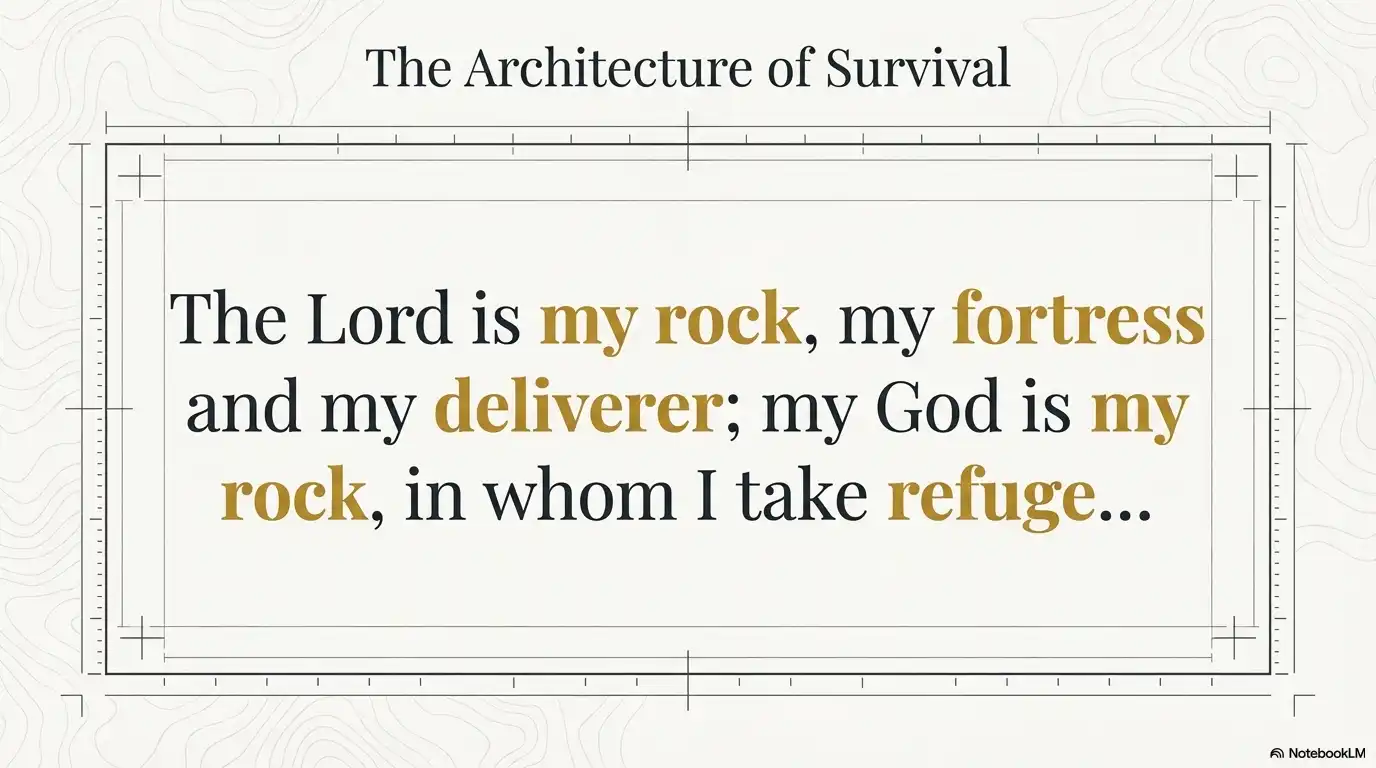
David doesn’t just say rock and move on. He piles the images: rock, fortress, deliverer. And then he says rock again, as if once wasn’t sufficient. This kind of literary accumulation in Hebrew poetry is intentional — it’s building a case, layering evidence, constructing a picture from multiple angles so that no single point of attack can bring the whole thing down.
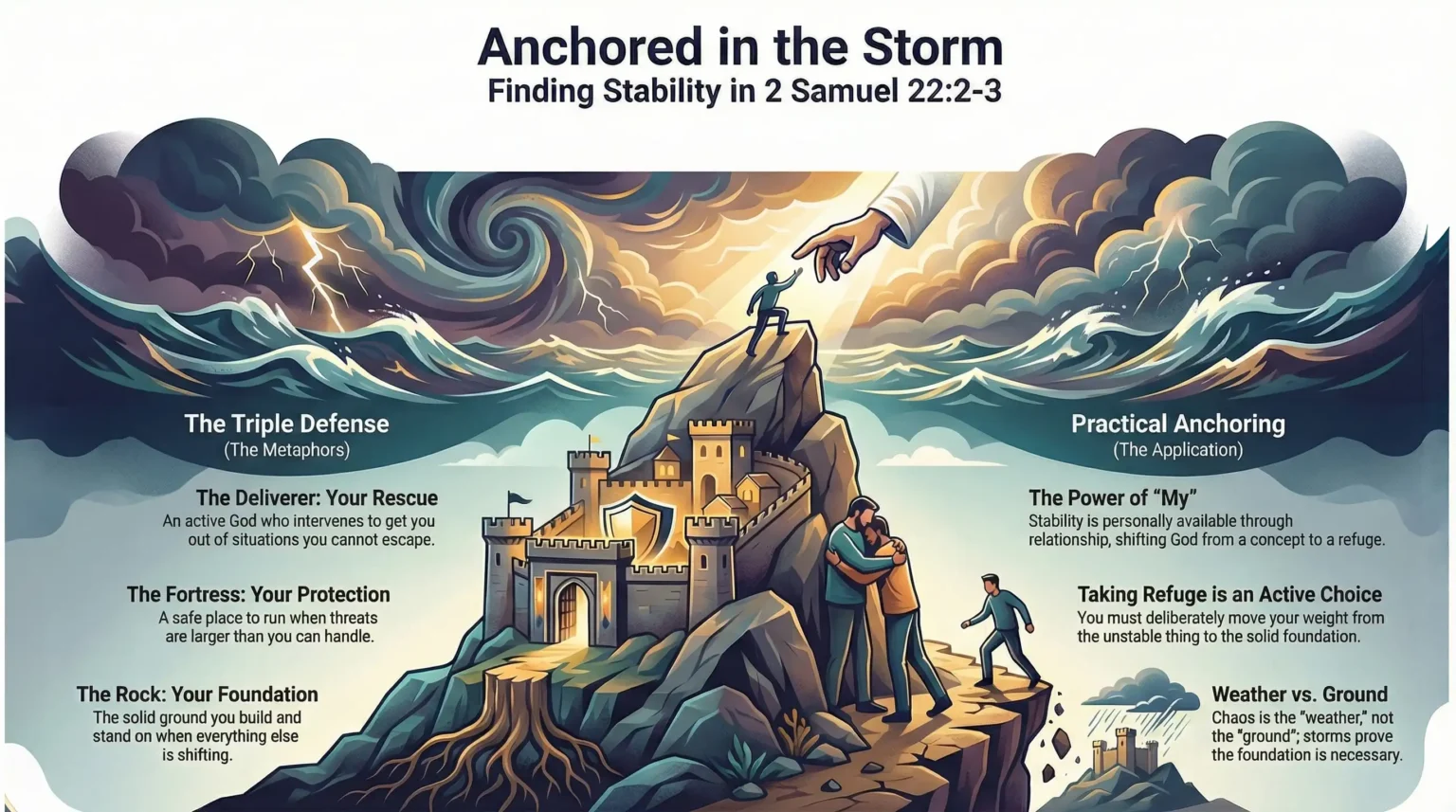
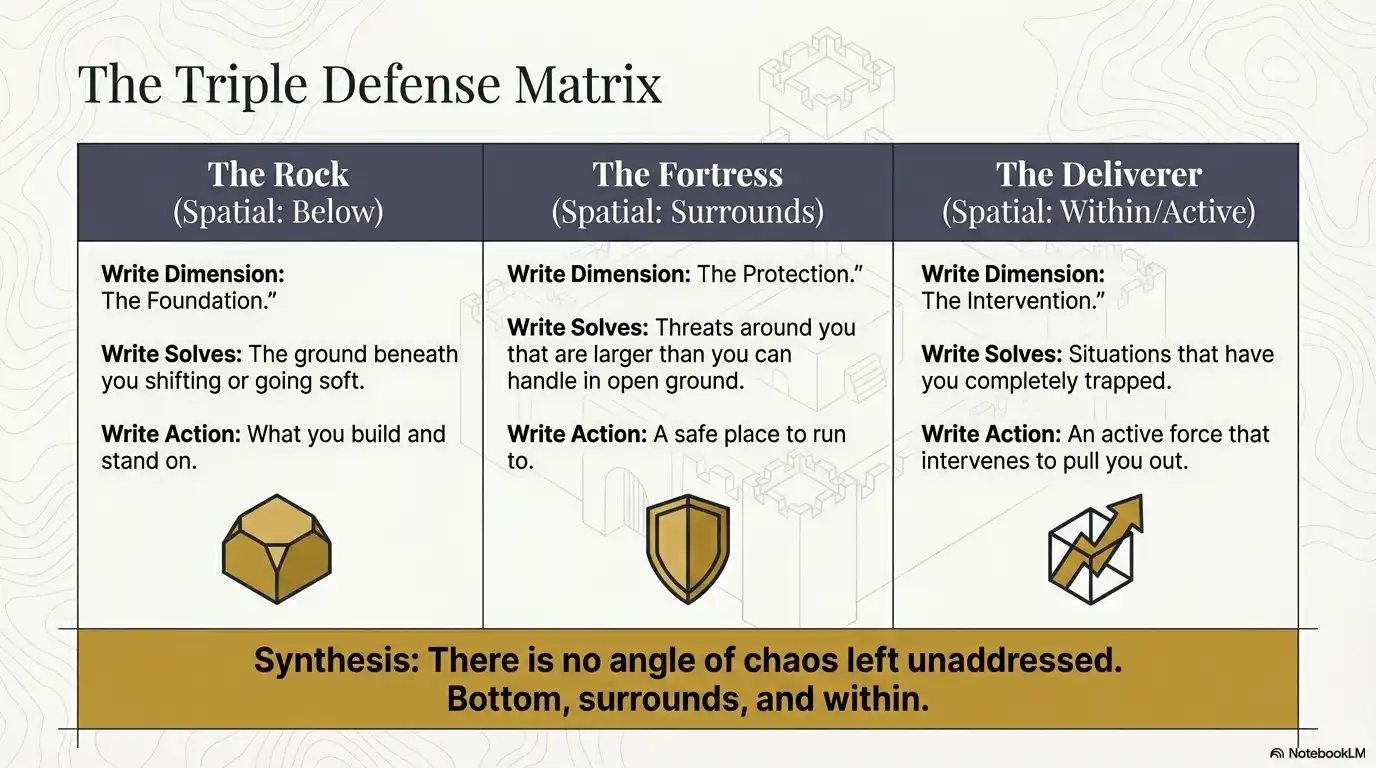
A rock is foundational — it’s what you build on, what you stand on when the ground around it is soft or shifting. A fortress is protective — it’s a place you run to when what’s coming at you is bigger than what you can handle in open ground. A deliverer is active — it’s not just a static structure but a God who moves on your behalf, who intervenes, who gets you out of what you couldn’t get yourself out of.
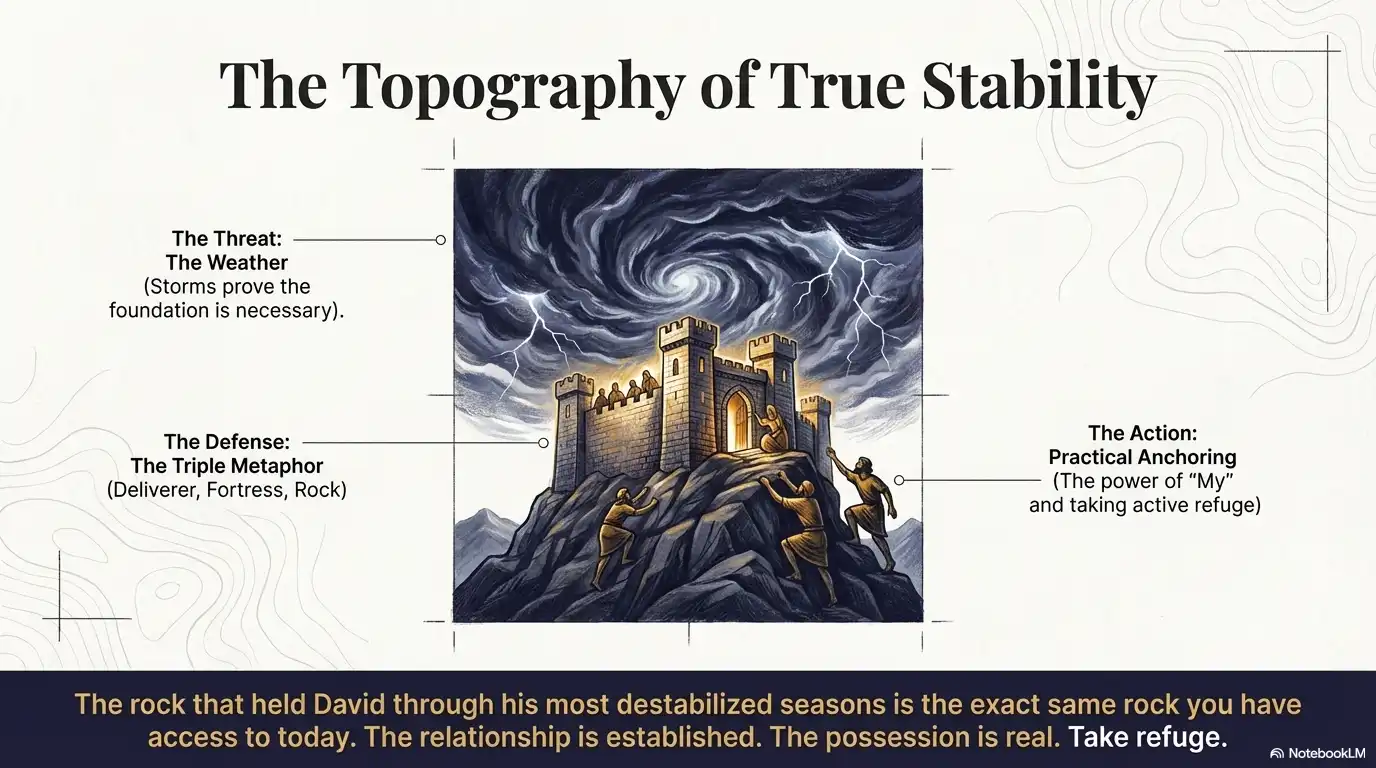
Together, these three images cover every dimension of instability. The ground beneath you? Rock. The threats around you? Fortress. The situations that have you trapped? Deliverer. There is no angle of chaos that isn’t addressed somewhere in this accumulation of images. David, it turns out, had thought very carefully about what kind of God he needed in a destabilized life. And he found that God to be exactly that.
3. “My Rock” — The Possessive Is Everything
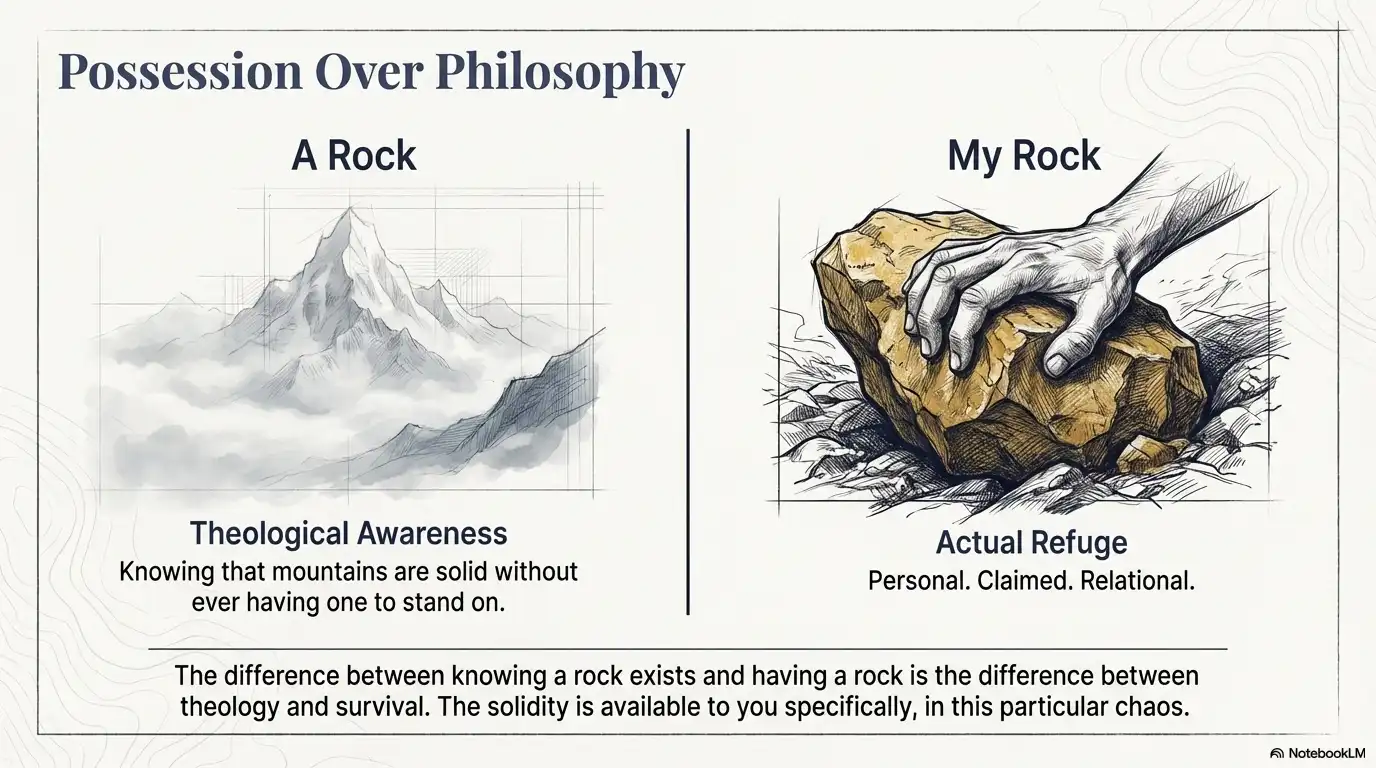
This small word — my — is doing work that’s easy to glide past. David doesn’t say the Lord is a rock. He says my rock. Personal. Claimed. Relational.
The difference between knowing that a rock exists and having a rock is the difference between theological awareness and actual refuge. You can know that mountains are solid without ever having one to stand on. David is not making a general philosophical statement about God’s attributes. He is making a declaration about a relationship — this God is mine, and therefore His solidity is available to me, specifically, in this particular chaos.
For your confidence, that possessive matters more than it might initially seem. The stability of God isn’t a resource held in common that you have to compete to access. It’s personally available to you. My rock. You can say that. Right now, in whatever is shaking in your life at this very moment. The rock that held David through his most destabilized seasons is the same rock you have access to — not because you’ve earned that access, but because the relationship has been established and the possession is real.
4. Confidence in Chaos Looks Different Than Confidence in Calm
Something worth naming honestly: the kind of confidence this verse is building is not the same as the confidence of someone whose circumstances are currently stable. And that’s actually important to understand, because if you’re in a genuinely hard season right now, being told to feel confident might ring hollow in a way that’s almost insulting.
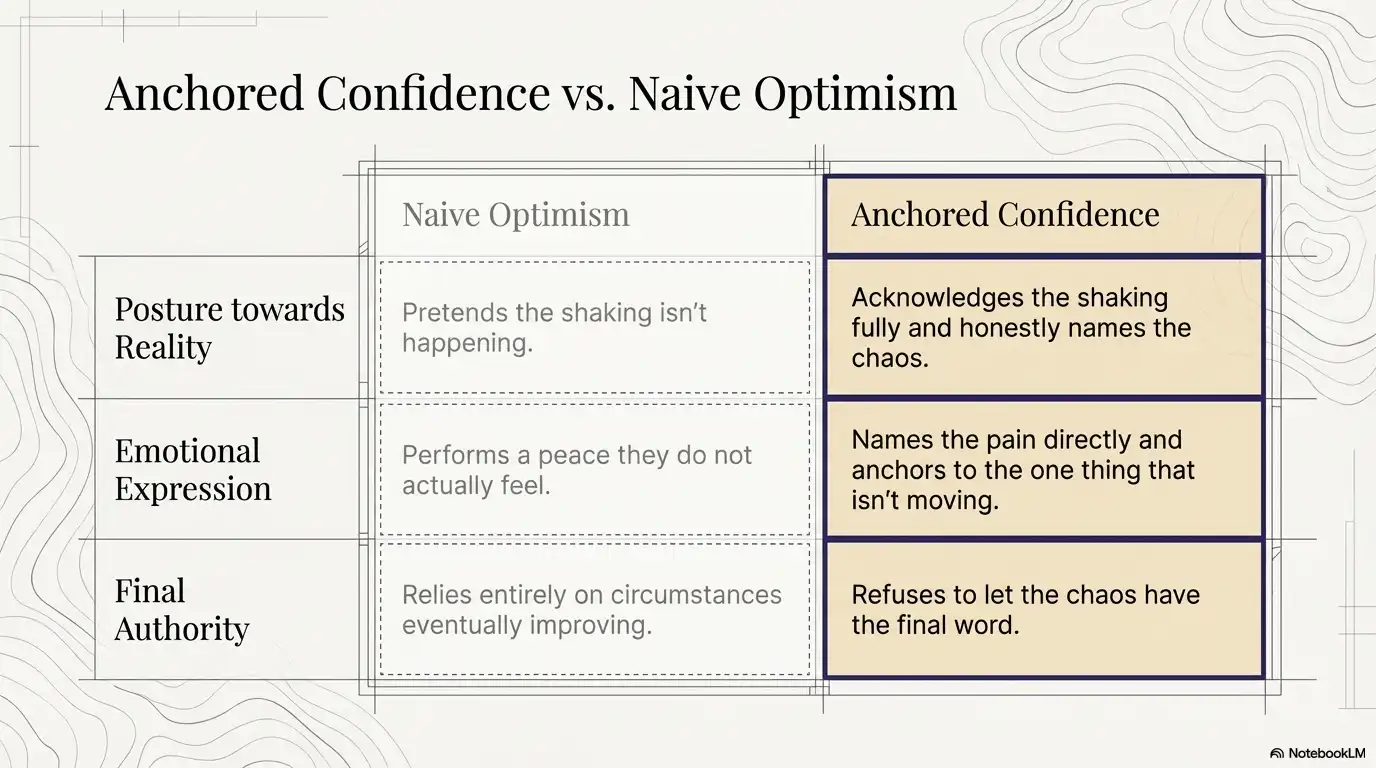
God-rooted confidence in chaos doesn’t look like cheerfulness. It doesn’t look like pretending the chaos isn’t real or that it doesn’t hurt. It doesn’t look like performing peace you don’t feel. It looks, honestly, much more like what David does in this psalm — naming the chaos directly and honestly, and then anchoring to the one thing that isn’t moving. This is shaking. That is solid. I’m going to put my weight there.
That’s not naive optimism, as today’s email rightly points out. Naive optimism pretends the shaking isn’t happening. Anchored confidence acknowledges the shaking fully — and refuses to let it be the final word. There’s a world of difference between those two postures, and it’s worth being clear about which one this verse is actually inviting you into.
5. “In Whom I Take Refuge” — Refuge Is an Active Choice, Not a Passive State
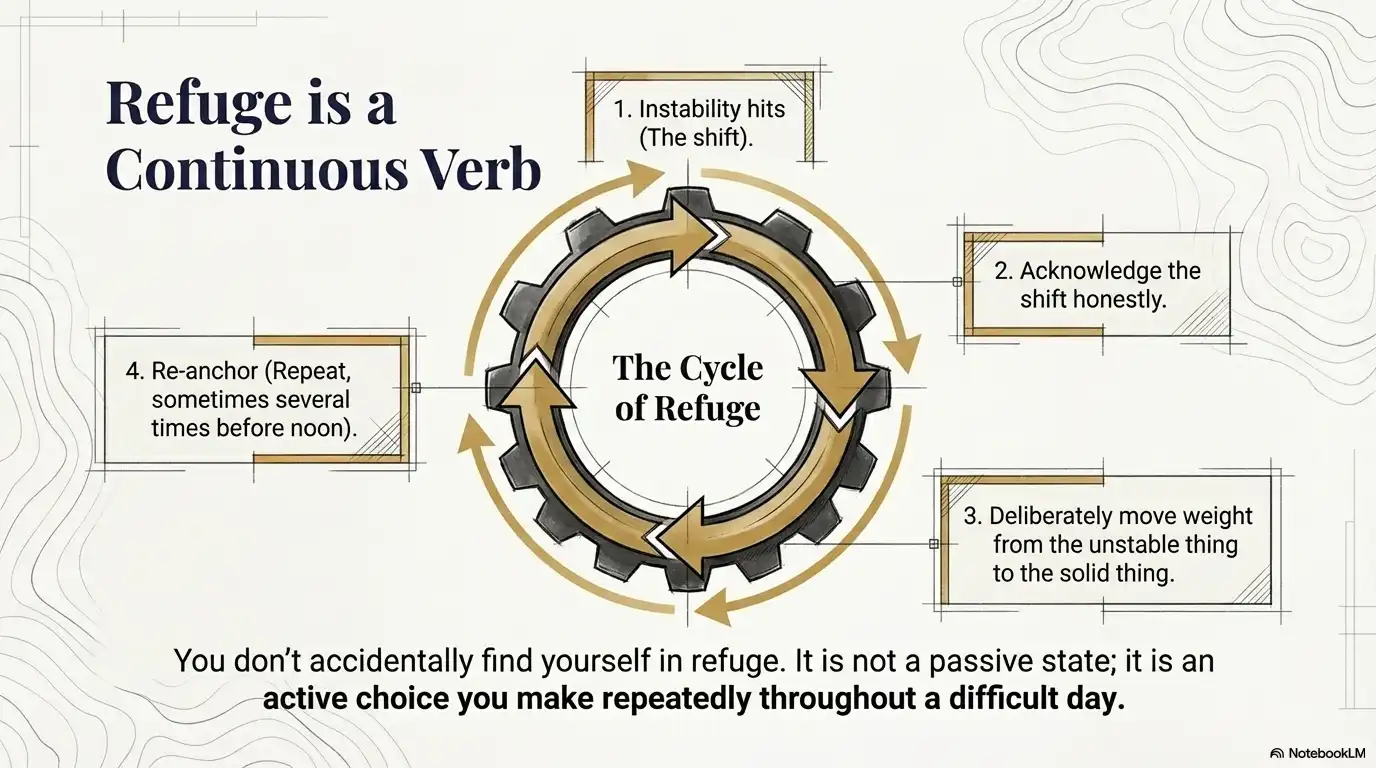
The phrase take refuge implies movement. You don’t accidentally find yourself in refuge — you choose to go there. You orient yourself toward it. You move your weight from the unstable thing to the solid thing, deliberately, sometimes repeatedly throughout a single difficult day.
This is one of the more practically significant things about this verse for daily life in chaotic seasons. The rock doesn’t automatically become your standing place just because it exists. You take refuge. You make the choice to anchor there rather than to spiral in the instability. Sometimes that choice needs to be made several times before noon.
That’s not a sign of weak faith. That’s what active faith actually looks like in the middle of real chaos. The return. The repeated reorientation. The daily — sometimes hourly — decision to put your weight back on the thing that holds rather than the thing that shifts. That’s refuge not as a destination you arrive at once, but as a practice you return to continuously.
6. The Chaos You’re In Right Now Is Not Evidence That the Rock Has Moved
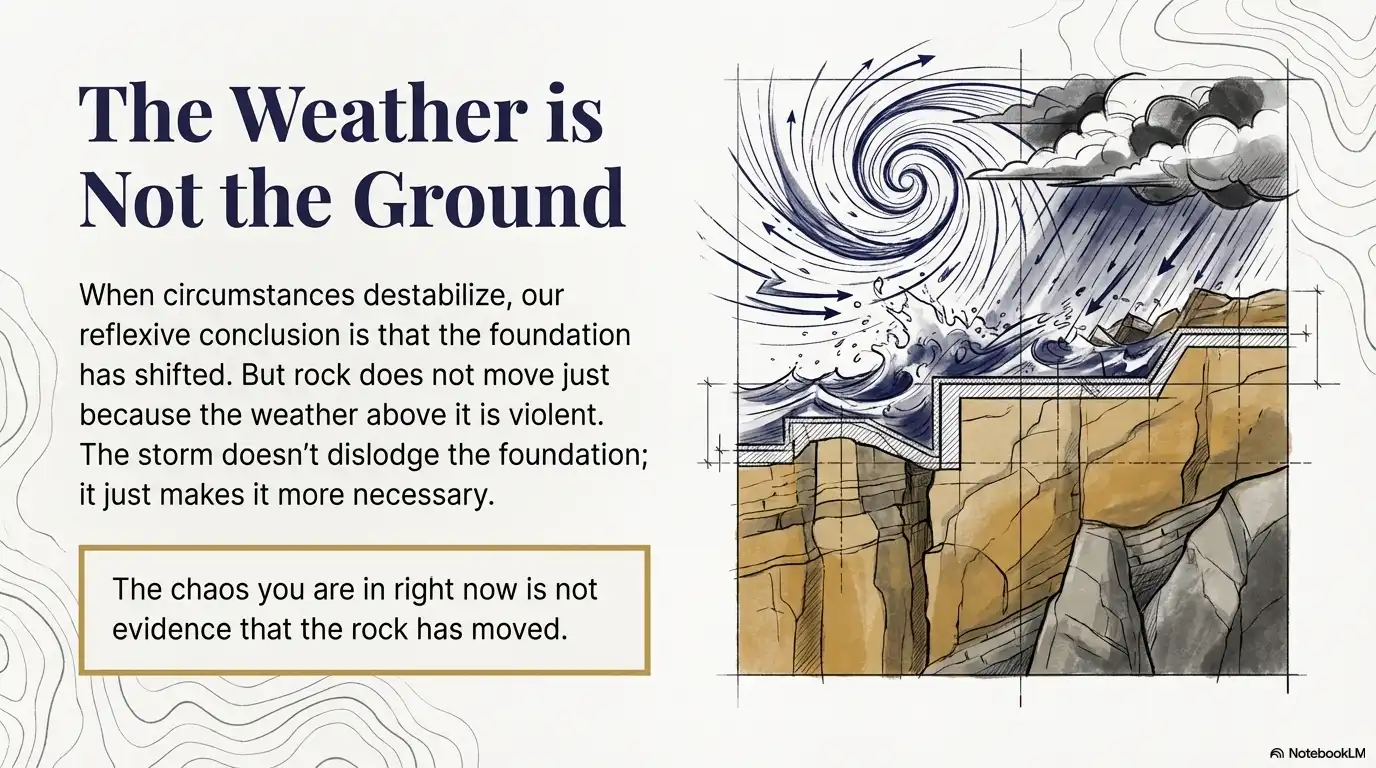
This one, honestly, might be the most important reframe in today’s content — and it’s worth sitting with carefully. When circumstances destabilize, our almost reflexive conclusion is that something foundational has shifted. That maybe God isn’t as solid as we thought. That maybe the promise has conditions we weren’t told about. That maybe the instability of our circumstances reflects an instability in the Ground beneath them.
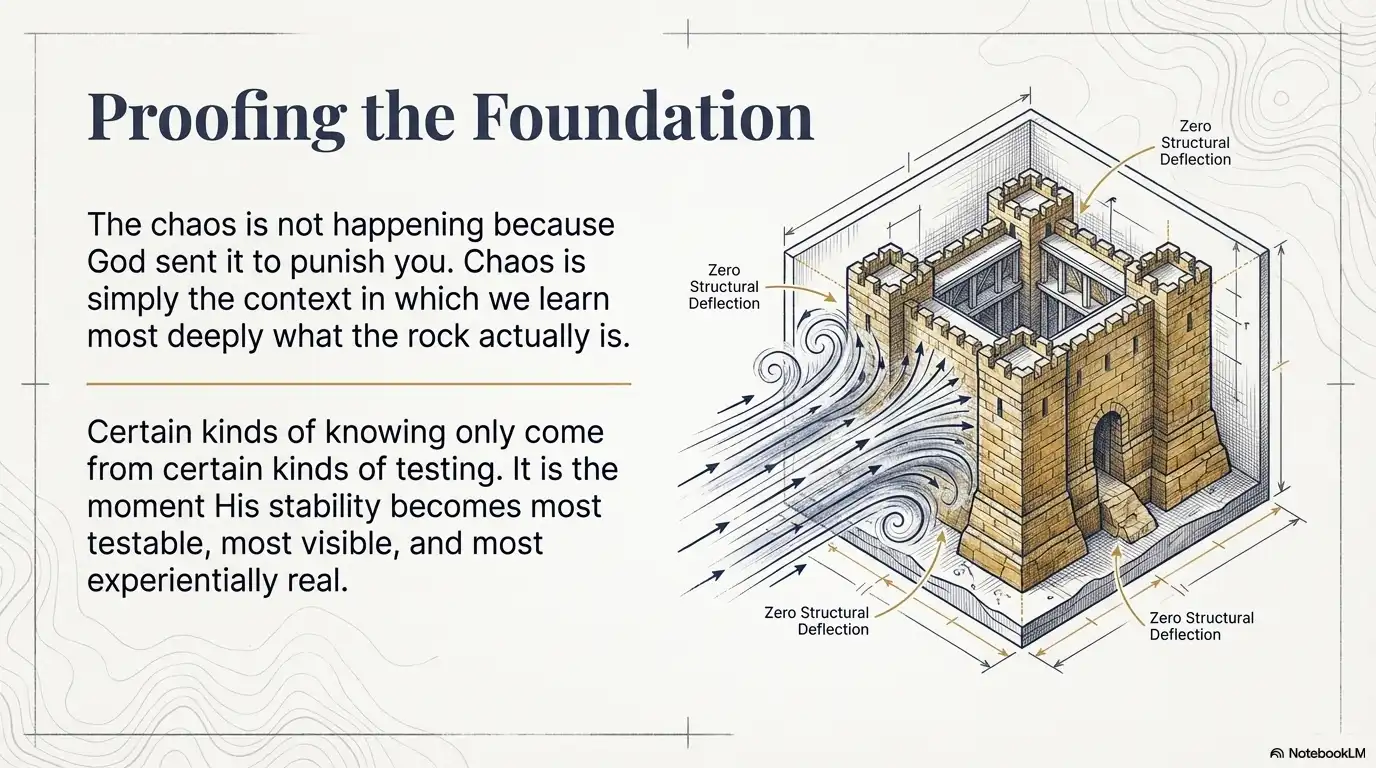
But rock doesn’t move because the weather above it is violent. The storm doesn’t dislodge the foundation — it just makes the foundation more necessary. The chaos in your life right now is not evidence that God has shifted. It’s actually the moment in which His stability becomes most testable, most visible, and — for those willing to anchor there — most experientially real.
David discovered this through decades of genuine destabilization. The chaos, it turned out, was the context in which he learned most deeply what the rock actually was. Your chaos might be doing the same thing. Not because God sent it to punish you, but because certain kinds of knowing only come from certain kinds of testing.
7. Writing Down the Chaos Is an Act of Courage, Not Defeat
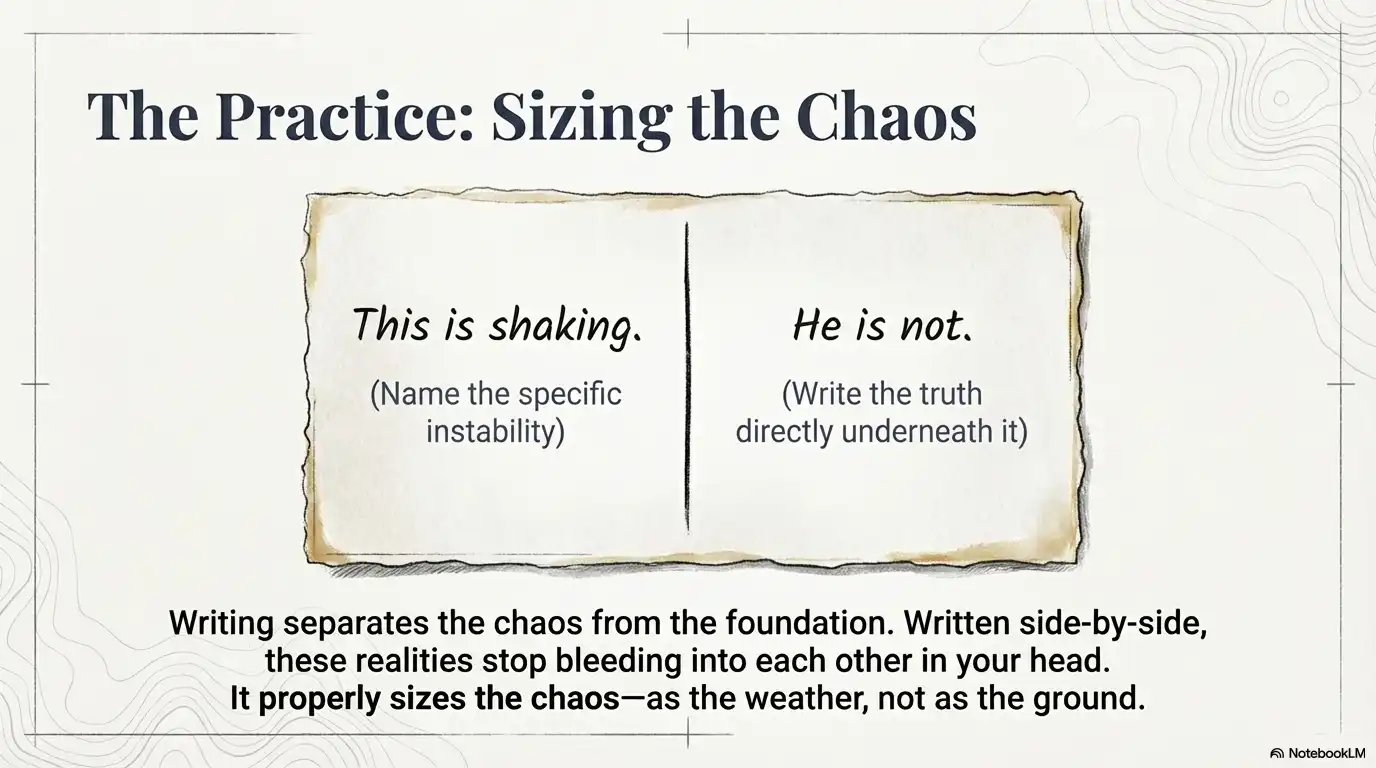
Today’s practice asks you to name an area of current instability. And for some people, that feels counterproductive — like giving the chaos more attention will make it worse. But there’s something important that happens when you name the shaking thing specifically and then write the truth directly underneath it.
It separates the chaos from the foundation. It makes visible, on the page, the distinction between what is moving and what is not. This is shaking. He is not. Written side by side, those two realities stop bleeding into each other the way they tend to do when everything lives only in your head. The chaos doesn’t go away. But it gets properly sized — as the weather, not as the ground.
✦ FAQ: Real Questions, Real Answers
Q: My circumstances have been unstable for a long time — not just a rough patch, but years. It’s hard to experience God as a rock when nothing has actually stabilized. How do I hold this verse honestly?
That kind of prolonged instability is genuinely exhausting, and it deserves to be acknowledged as such rather than quickly redirected. Long seasons of chaos have a way of eroding not just energy but the capacity to trust — because trust, at some level, requires the experience of things being held. Here’s what’s worth distinguishing though: the rock David describes isn’t proven by the chaos ending. It’s proven by the fact that you are still here. You have survived what you were convinced, at some point, might end you. Whatever has been holding you through the long instability — the fact that you haven’t been utterly destroyed by what should have destroyed you — that’s the rock’s fingerprints, even when it didn’t feel like stability. The evidence may be quieter than you hoped. But look for it. It’s likely there.
Q: When chaos hits, I don’t reach for God — I reach for distraction, control, or other people. How do I change that instinct?
Slowly, and with genuine compassion toward the instinct rather than judgment. Those reaching patterns — distraction, control, other people — developed for good reasons. They were the resources available to you when the chaos was first teaching you how to cope. They probably helped, at least partially, at some point. The goal isn’t to condemn them. It’s to gradually, through repetition and practice, create a new first reach. That’s what this challenge is doing — building a habitual return to truth so that in the moment of chaos, there’s a more practiced pathway to the rock. You won’t rewire a long-established coping instinct in eight days. But you’re building something real. Be patient with the process and keep returning, even when the old reach happens first.
Q: The chaos I’m dealing with is something I caused. Can God still be my rock when the instability is my own fault?
Yes — and David, of all people, is the right voice to answer that question. Some of the most destabilizing seasons of David’s life were directly caused by his own choices. The consequences were real. The pain was real. The chaos was genuinely of his own making in some instances. And yet the declaration of 2 Samuel 22 — my rock, my fortress, my deliverer — came from the same person who had caused some of his own worst storms. God being your rock is not contingent on the source of the chaos. It’s contingent on His character. Which doesn’t change based on whether you contributed to your own hard season.
Q: I feel like I’m supposed to be calm and peaceful because God is my rock — but I’m actually really scared and anxious. Am I doing this wrong?
Not at all — and this is worth being really clear about. The rock doesn’t eliminate fear. It gives fear somewhere to stand that won’t collapse. You can be genuinely scared and genuinely anchored at the same time — those two things are not mutually exclusive. The peace that comes from God-rooted confidence isn’t the absence of anxiety. It’s, to borrow from Philippians, a peace that exists alongside and even through hard circumstances, not one that requires you to have no hard feelings about hard things. If you’re scared, name that honestly. Bring the fear to the rock rather than trying to manufacture calmness before you get there. The rock holds anxious people. That’s rather the point.
Q: How do I stop spiraling when the chaos is active and loud and I can’t seem to focus on anything else?
A few practical things that tend to interrupt the spiral rather than simply resist it. First — name what’s actually true right now, in this moment, as distinct from what you’re projecting forward. Spiraling is almost always future-oriented: what if this gets worse, what if it doesn’t resolve, what if I can’t handle what’s coming. Grounding in the present moment — what is actually true right now, as opposed to what you fear about tomorrow — narrows the threat to a manageable size. Second — physicality helps. Something as simple as standing up, going outside briefly, or speaking the verse out loud rather than just thinking it engages your body in the anchoring rather than leaving it entirely in your head where the spiral lives. Third — return to the language of the verse itself. He is my rock. Present tense. Not “He will be” once this resolves. Right now. In the middle of the loud chaos.
Q: What’s the difference between trusting God as my rock and just being passive about my chaotic circumstances?
This is such a worthwhile distinction to make. Trusting God as your rock is not passivity — it’s a foundation for action, not a substitute for it. A person standing on solid rock can move with more stability and purpose than a person scrambling on shifting ground. David, who wrote this psalm, was also someone who fought battles, made decisions, pursued enemies, and governed a nation. He didn’t treat God as his rock instead of doing anything. He treated God as his rock while doing everything — which meant his actions came from a place of stability rather than panic. Trust and effort are not opposites. The trust is what makes the effort purposeful rather than frantic.
Q: I identified my area of chaos and writing it down made it feel more real and overwhelming, not less. Is that normal?
Yes — and it’s worth understanding why. When we externalize something that’s been living in our heads, it sometimes feels larger initially because we’re now looking at it directly rather than managing it from a peripheral distance. That can feel like the writing made it worse. It didn’t — it made it visible. And visible things can be addressed in ways that internal, swirling things cannot. The overwhelm you feel looking at it on the page is, oddly, a sign that you’ve done something useful. Now hold it up against the second sentence you wrote underneath it. The Lord is my rock. This chaos doesn’t change His stability. Let those two truths sit beside each other. Not forcing one to erase the other — just letting them coexist on the page. That’s the beginning of perspective, even if it doesn’t feel like resolution yet.
Q: I’ve been through chaos before that I thought God would stabilize — and it didn’t stabilize. It got worse, and eventually it just ended badly. How do I trust this again?
Honestly, that experience deserves real respect rather than a quick theological fix. When something we trusted failed to work the way we believed it would, the damage isn’t just circumstantial — it’s to the trust itself. And rebuilding trust, whether in God or in anything else, is not primarily an intellectual exercise. It happens through gradual, repeated exposure to trustworthiness over time. What might be worth sitting with is this: in that hard season that ended badly — in what ways were you actually held that you didn’t notice at the time, or only recognized later? Not held from pain. Held through it. The rock doesn’t promise to prevent every bad outcome. It promises to be underneath you even in the ones that happen anyway. Distinguishing between those two things — between what God promises and what we assumed He promised — is sometimes the beginning of a more honest, and ultimately more durable, faith.
Eight days in. You’ve been showing up through real content, and that matters. Whatever chaos is present in your life right now — you’re not navigating it without a foundation. See you tomorrow.