


The Confidence to Stand Still
There’s a specific kind of exhaustion that doesn’t come from working too hard or sleeping too little. It’s the exhaustion of someone who has been fighting — constantly, vigilantly, without a break — to manage, defend, control, and hold together things that were never meant to be theirs to carry alone.
If you know that exhaustion, this verse was written for you.
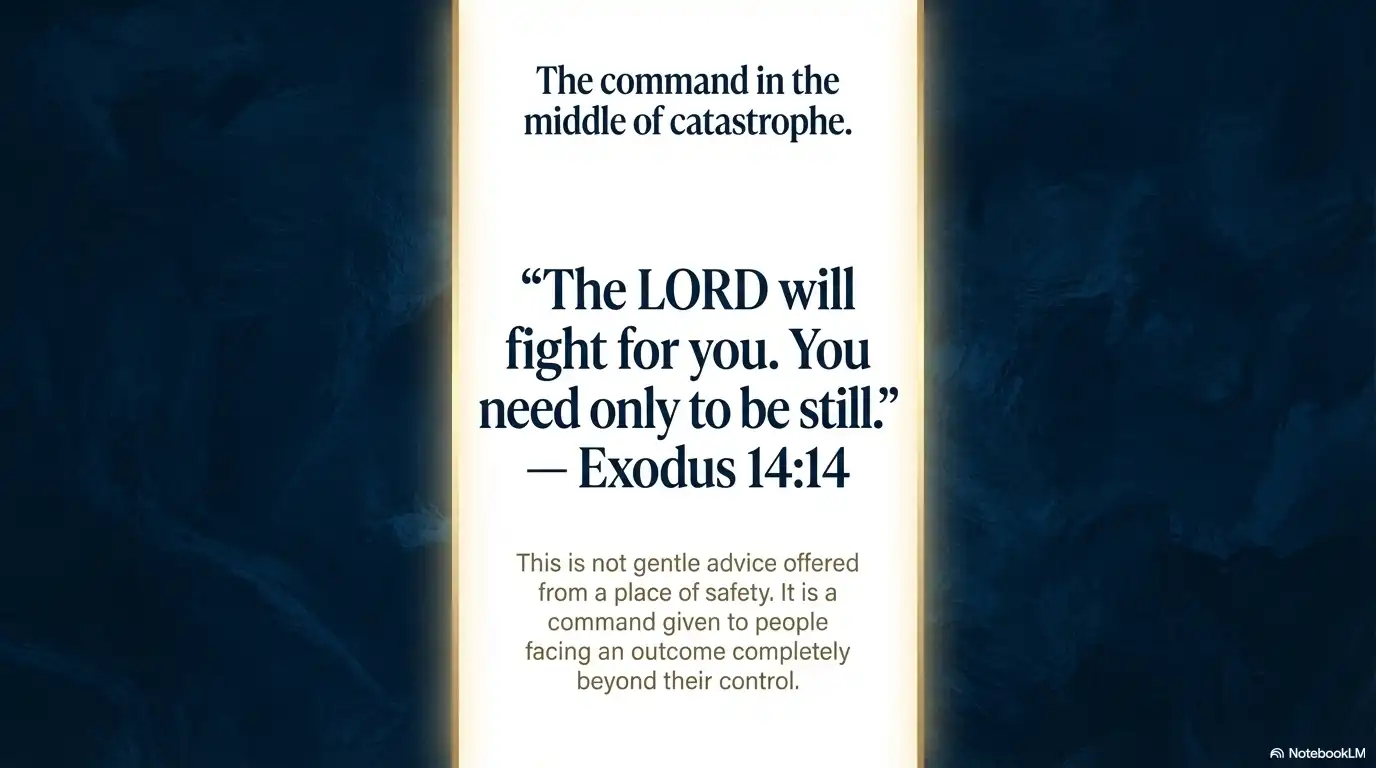
And the story behind it is, honestly, one of the most dramatic backdrops in all of Scripture. Which means the instruction it contains isn’t gentle advice offered from a place of safety. It’s a command given in the middle of what looked, from every human angle, like certain catastrophe.
1. The Israelites Were Not in a Difficult Situation — They Were in an Impossible One
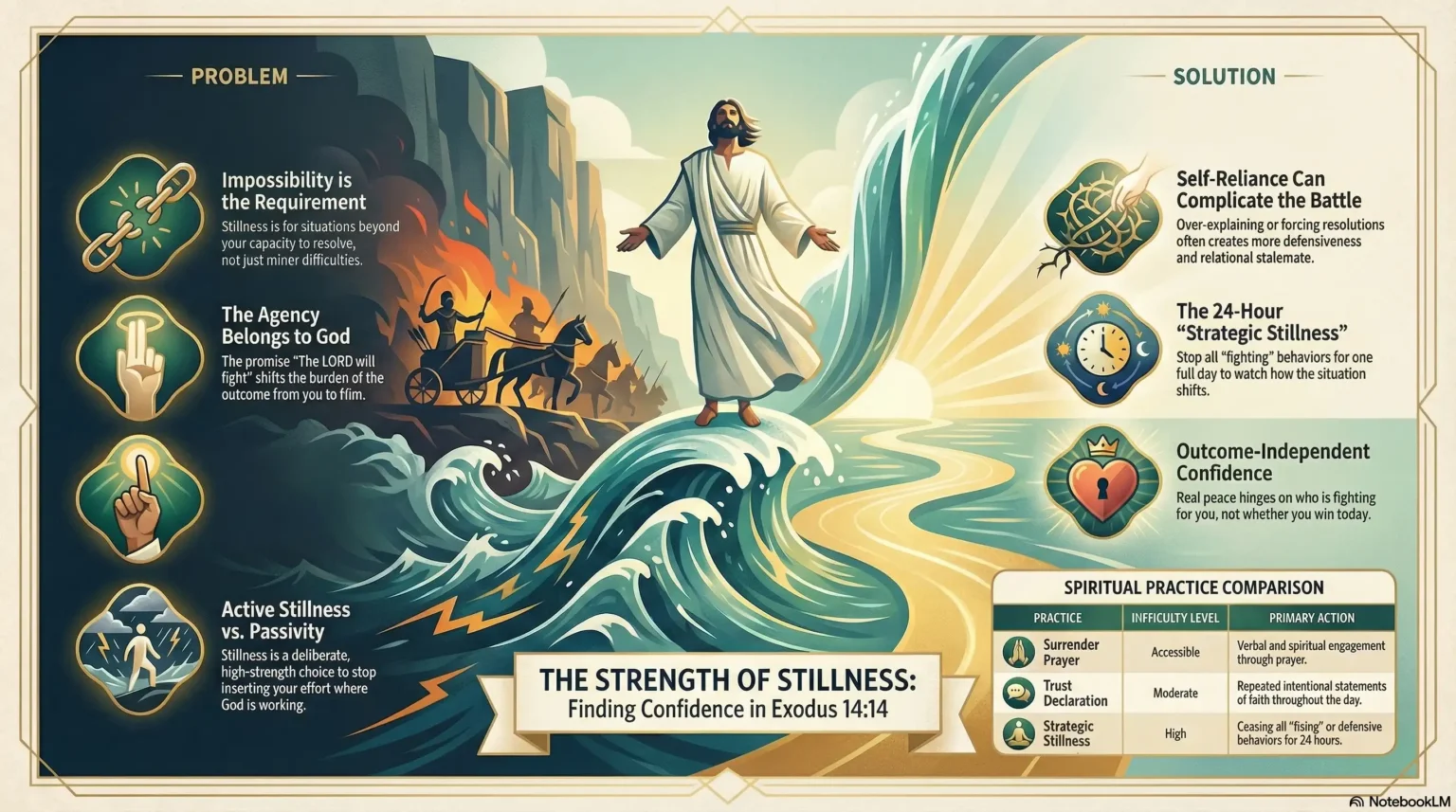
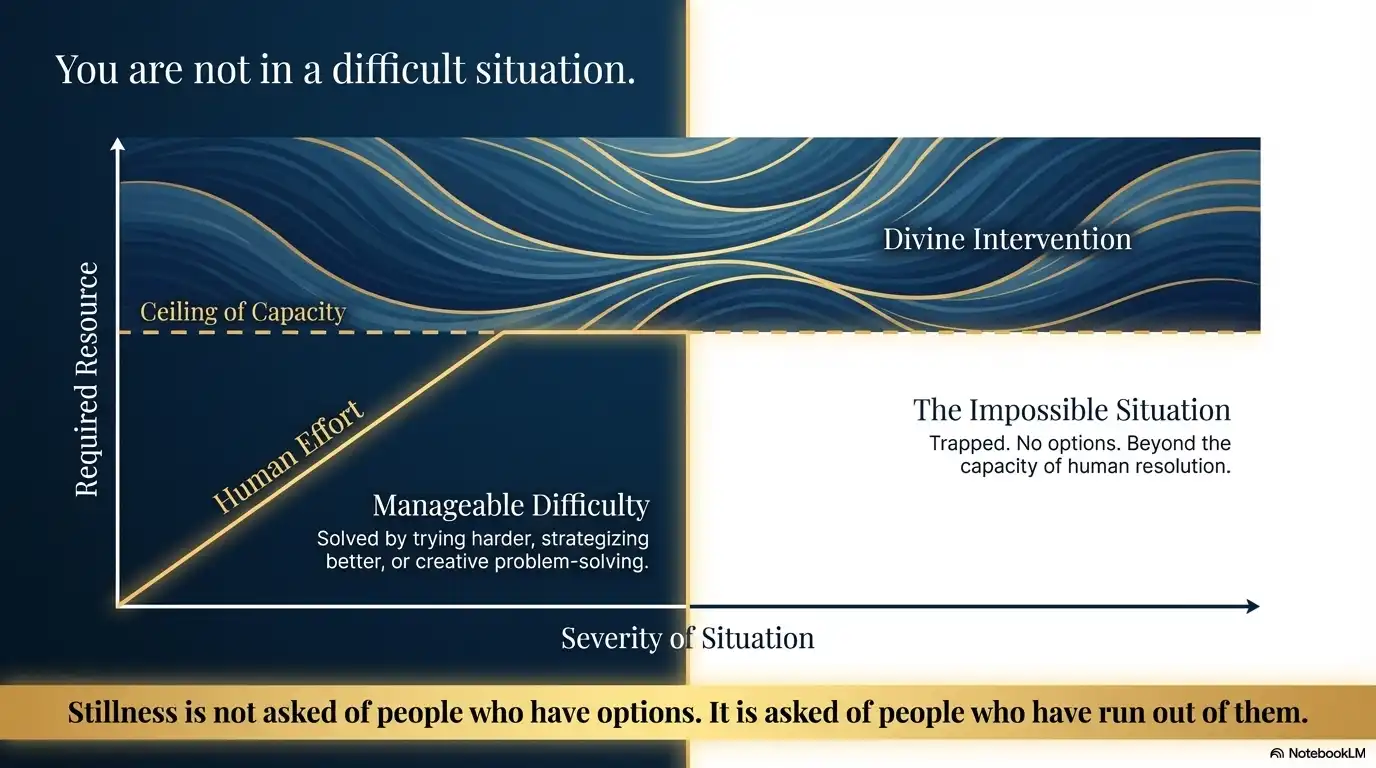
Let’s be clear about what was actually happening in Exodus 14. The Israelites were not facing a challenging obstacle that required extra effort or creative problem-solving. They were trapped — the Red Sea directly ahead of them, the most powerful army in the known world closing in from behind. There was, by every reasonable calculation, no way out. This wasn’t a hard situation. It was an impossible one.
And it’s into that situation — not a manageable difficulty but a genuine impossibility — that Moses speaks these words. The LORD will fight for you. You need only to be still.
This matters enormously for how you receive the verse. God’s instruction to be still wasn’t given to people facing something they could probably handle if they just tried a little harder. It was given to people facing something that was completely beyond their capacity to resolve. The stillness being asked for here is not the stillness of someone who has options and is choosing the peaceful one. It’s the stillness of someone who has run out of options and is being asked to trust that the God who brought them this far has not run out of them.
If your current battle feels genuinely impossible — beyond your ability to fix, defend, or manage — you’re in exactly the right position to receive what this verse is actually offering.
2. “The LORD Will Fight For You” — The Subject of That Sentence Is Everything
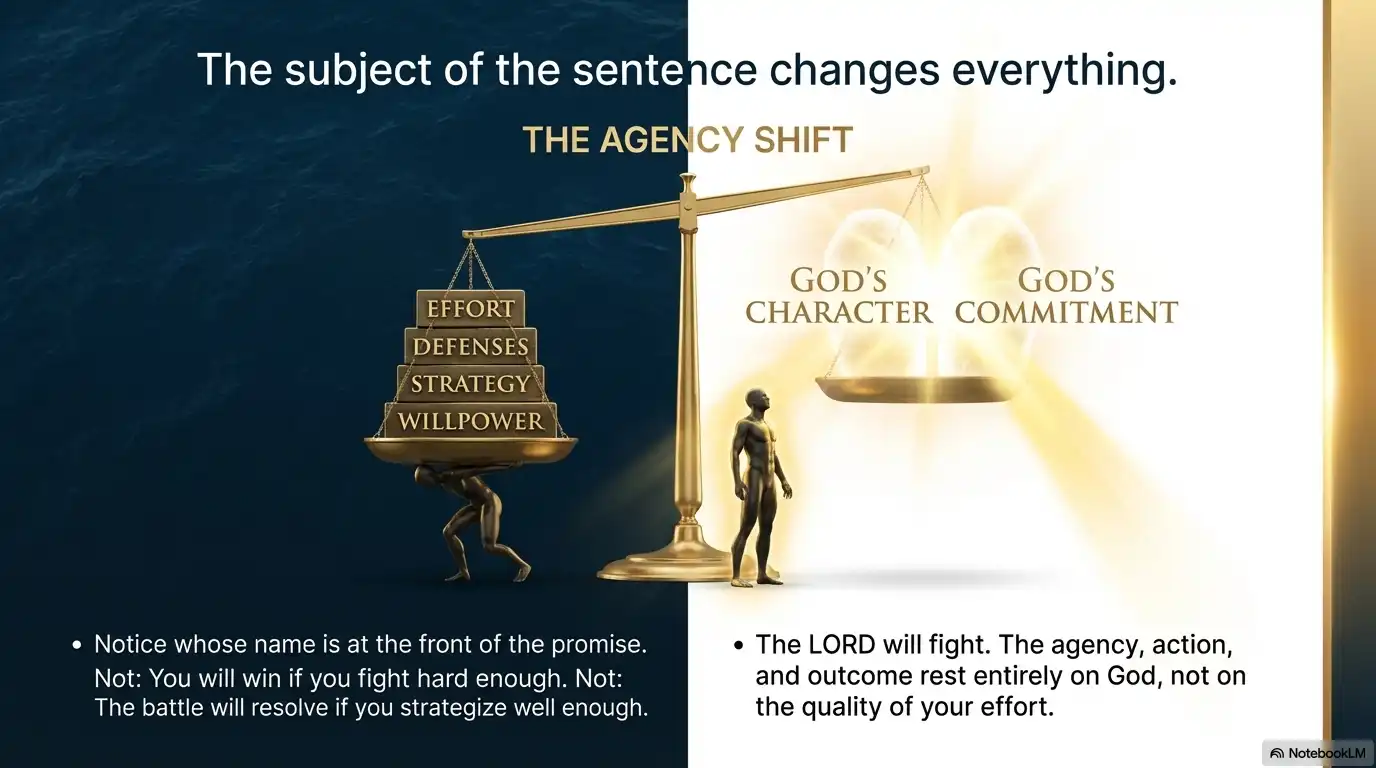
Notice whose name is at the front of this promise. Not you will win if you fight hard enough. Not the battle will resolve if you strategize well enough. The LORD will fight. The agency, the action, the outcome — all of it rests on God’s character and God’s commitment, not on the quality of your effort or the strength of your defenses.
This is a fundamentally different confidence architecture than the one most of us were raised on. We were taught, implicitly or explicitly, that outcomes depend on effort — that if you work hard enough, fight smart enough, defend yourself well enough, good things follow. And while that’s not entirely wrong in ordinary life, it becomes a crushing burden in the battles that are genuinely beyond human capacity to win.
The kind of battles this verse is addressing — the ones where your reputation is being unfairly attacked and you can’t control the narrative, the ones where a relationship is fracturing despite everything you’ve tried, the ones where anxiety has been running the show no matter how hard you willpower your way through it — those battles have a ceiling on what human effort can accomplish. And God’s instruction in those moments is not try harder. It’s step back. This one is Mine.
3. “Be Still” Is One of the Most Countercultural Commands in Scripture
In a world that equates action with progress and stillness with passivity, the instruction to be still feels almost irresponsible. Surely there’s something more to be done. Surely just standing there can’t be the right answer when everything is on the line.
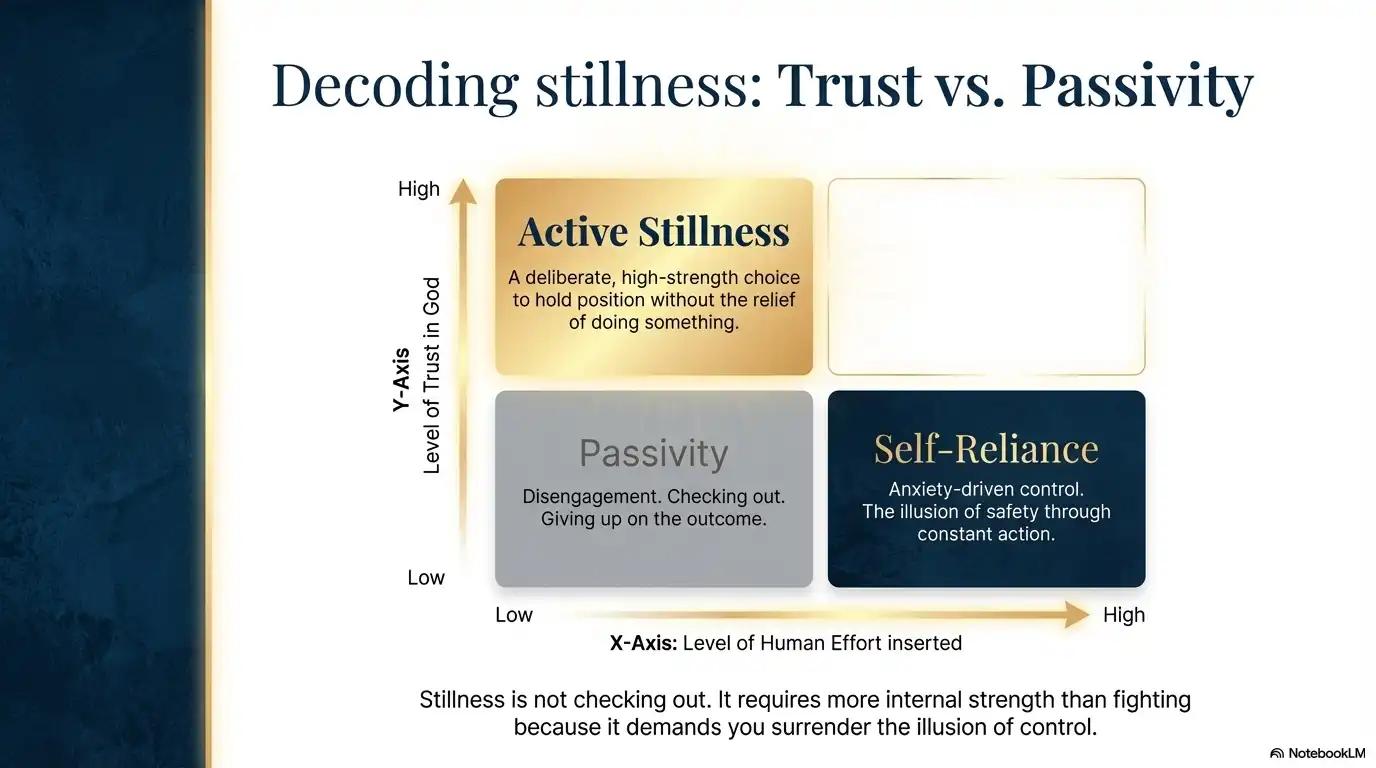
But stillness in this context is not passivity — and today’s email is exactly right to name that distinction. Passivity is disengagement. It’s checking out, giving up, not caring about the outcome. That’s not what’s being asked for here.
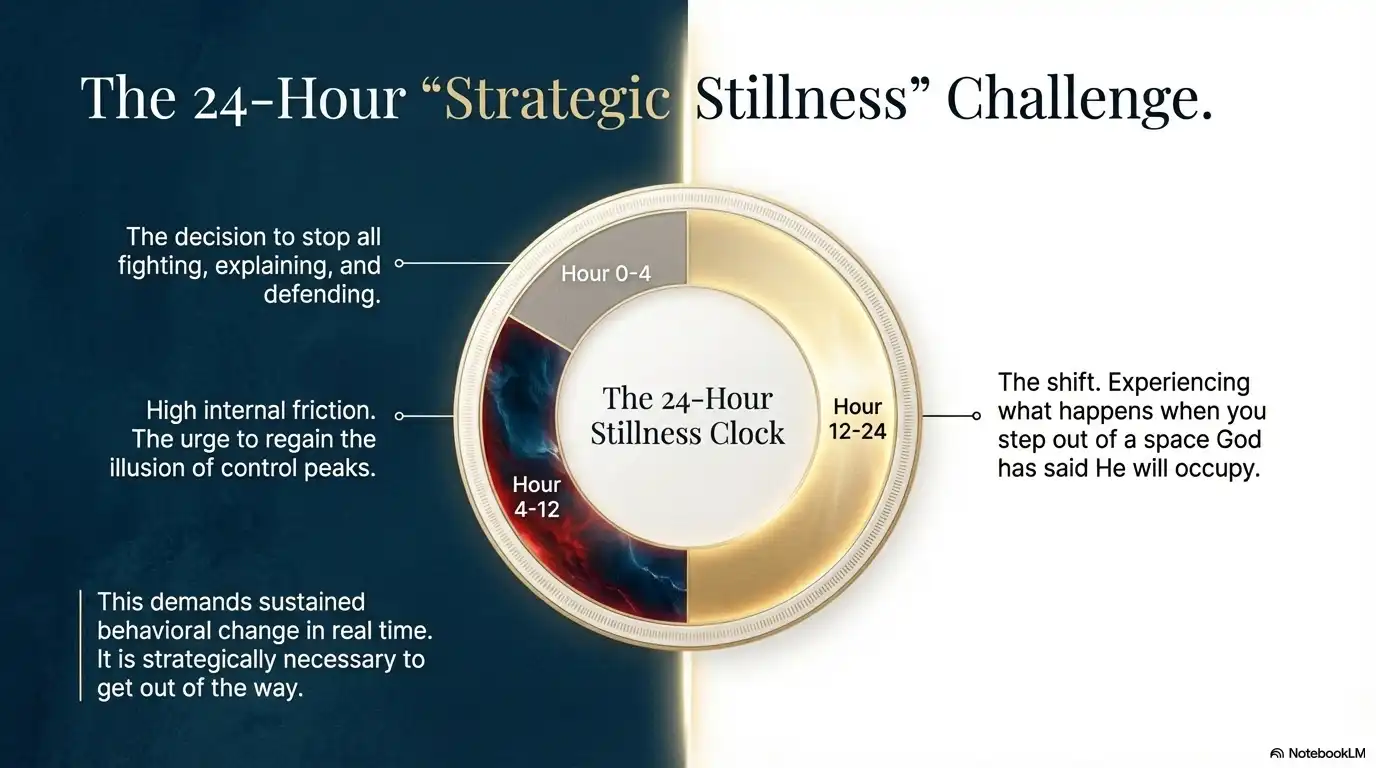
The stillness of Exodus 14:14 is an active posture of trust. It requires more internal strength than fighting, in some ways, because it demands that you hold your position without the relief of doing something — without the illusion of control that action provides. It’s the deliberate choice to stop inserting your own effort into a space that God has said He will occupy. That’s not easy. For most of us, frankly, it’s one of the hardest things there is.
But here’s what’s worth noticing: the Israelites who stood still and watched God fight for them at the Red Sea witnessed something they never could have produced by swimming harder or fighting better. The miracle that came was categorically beyond what human effort could have accessed. The stillness was not just spiritually correct — it was strategically necessary, because what God was about to do required them to be out of the way.
4. The Battles We Fight in Our Own Strength Often Make Things Worse
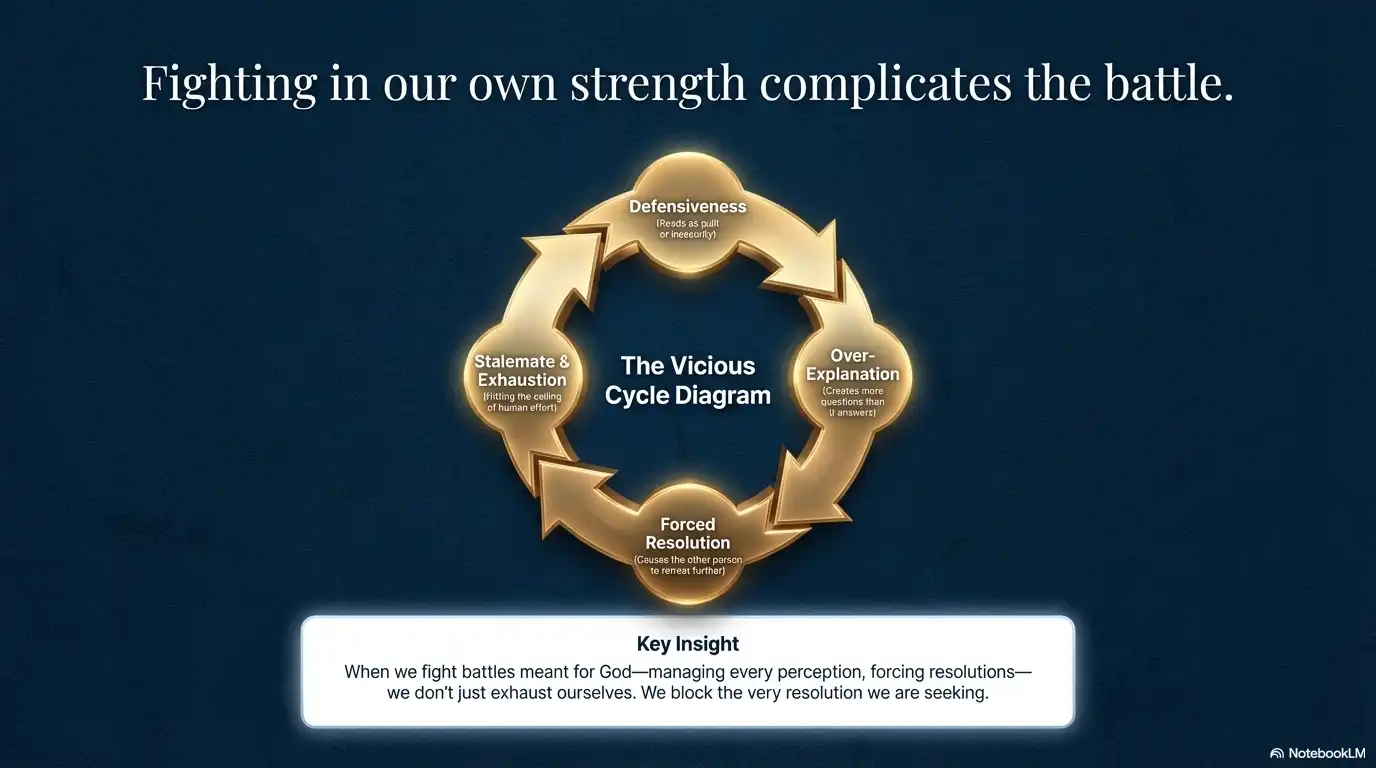
This is worth naming honestly, because it’s one of the more uncomfortable implications of this verse. When we fight battles that were meant for God — when we defend ourselves against every criticism, when we try to control every outcome, when we manage every perception, when we force resolutions that only God can bring — we don’t just exhaust ourselves. We often actually complicate the situation.
Think about what tends to happen when you fight for your reputation in your own strength. The defensiveness that reads as guilt. The overexplanation that creates more questions than it answers. The energy spent on managing what people think that could have been spent on simply being the person you actually are. Or the relationship you’ve been trying to fix through sheer relational effort, where the harder you push for resolution the more the other person retreats.
There are battles where the most effective thing you can do is genuinely stop fighting and let Something larger move. Not because the battle doesn’t matter, but because your involvement has reached the ceiling of what it can accomplish, and beyond that ceiling there is either God’s involvement or continued stalemate.
Recognizing which battles fall into that category is, honestly, one of the more sophisticated forms of wisdom available. And it starts with the willingness to ask — honestly, without defensiveness — is my fighting this making it better, or am I just not willing to stand still?
5. Confidence That Doesn’t Depend on Winning Is a Different Kind of Confidence Entirely
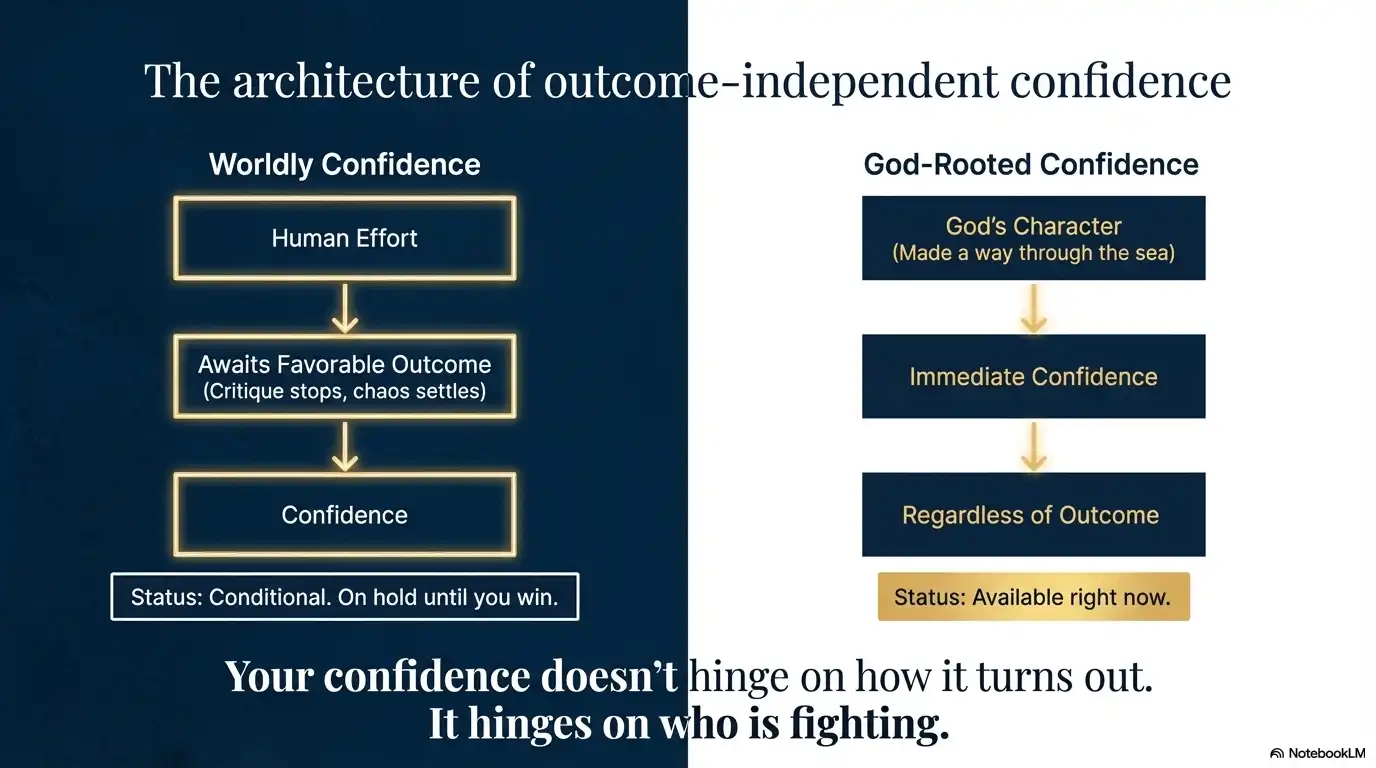
Here’s what changes when you genuinely internalize that God fights for you: your confidence stops being outcome-dependent. And that’s, actually, a profound shift.
Most of the confidence we try to build — the performance-based kind, the achievement-based kind, the reputation-based kind — is quietly contingent on winning. On the criticism not landing. On the relationship resolving the way we hope. On the anxiety eventually stopping. On the chaotic situation finally settling. And while we’re waiting for those outcomes, the confidence is on hold. Conditional. Available only when things go our way.
God-rooted confidence in this verse is structured completely differently. It says: I don’t have to win this battle to know I’m held through it. The God who fought for people trapped between an army and a sea — who made a way where there was categorically no way — is the same God who is positioned to fight for you in the impossible thing you’re currently facing. Your confidence doesn’t hinge on how it turns out. It hinges on who is fighting.
That kind of confidence is available right now, before the outcome is known. Which is, genuinely, the only kind of confidence worth having.
6. Stillness Is Also a Form of Testimony
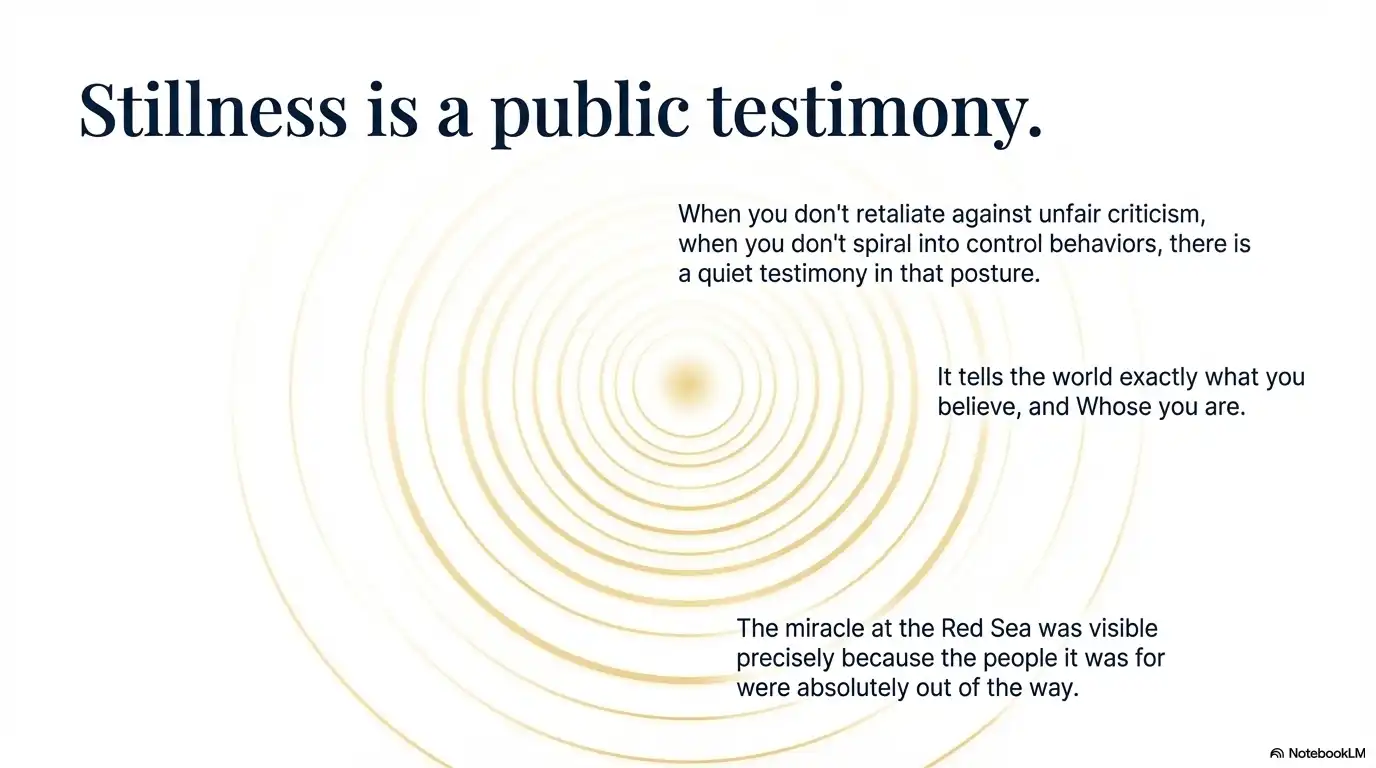
There’s something worth considering that today’s content doesn’t explicitly name, but that’s woven into the fabric of the Exodus story. When the Israelites stood still and God parted the Red Sea, the people watching — including the Egyptians — saw something that no human strategy could have produced. The miracle was visible precisely because the people it was for were not in the way of it.
Your stillness in a battle that everyone around you expects you to fight has a similar quality. It’s, actually, a form of witness. When you don’t retaliate against the unfair criticism. When you don’t spiral into control behaviors in the chaotic situation. When you stop trying to force the relationship back together through sheer willpower — there’s a quiet testimony in that posture. It says something about what you believe, and about Whose you are, that active fighting never quite communicates in the same way.
That doesn’t mean stillness is always easy or always publicly understood. It wasn’t for the Israelites either — they had people in the crowd asking Moses why he’d brought them out there to die. Trusting God to fight for you will sometimes look, from the outside, like you’ve given up. But you haven’t. You’ve just transferred the fight to Someone whose track record with impossible situations is, frankly, significantly better than yours.
7. The Three Release Practices Are Not Equally Easy — and That’s Okay
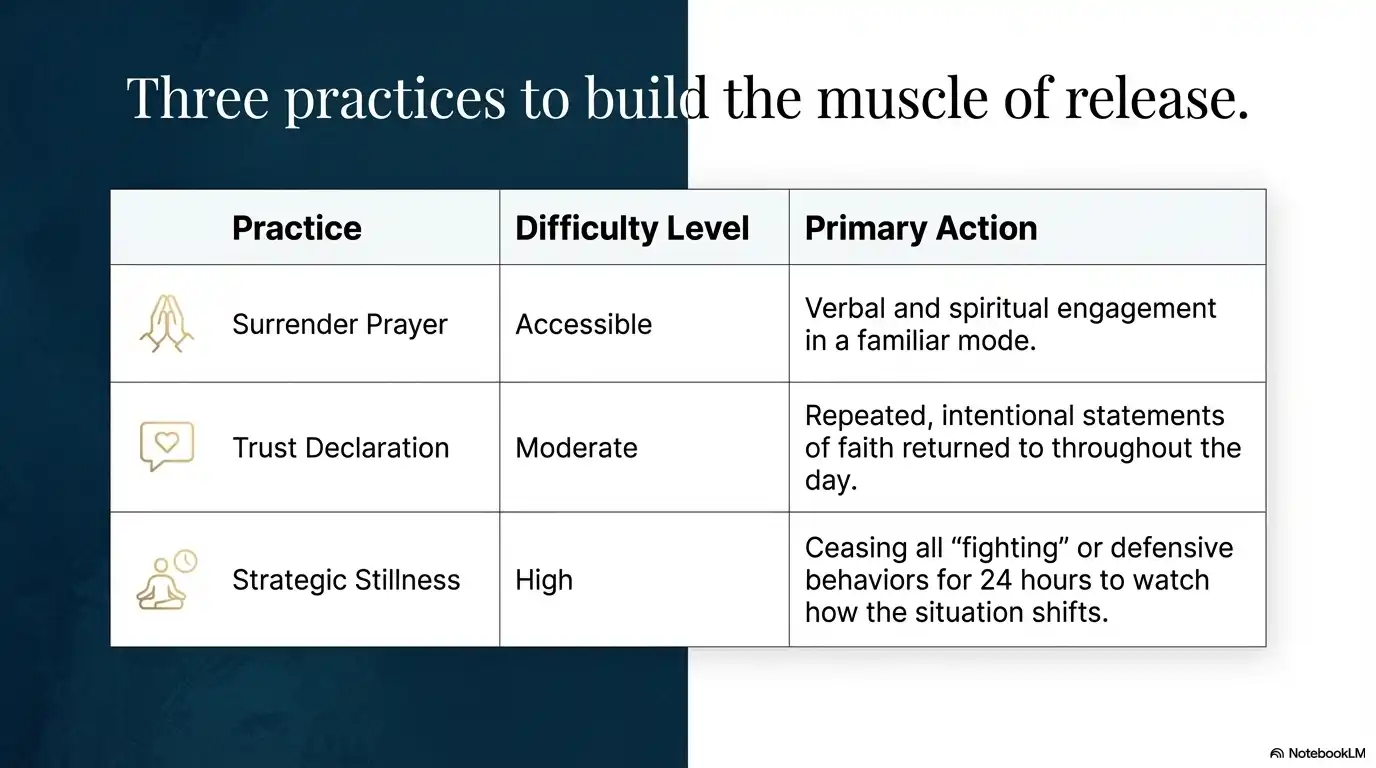
Today’s practice offers three options for engaging with this truth, and it’s worth being honest that they’re not equivalent in difficulty. The surrender prayer is probably the most accessible entry point — you’re engaging verbally and spiritually in a familiar mode. Strategic stillness — actually stopping the fighting behavior for 24 hours and watching what happens — is considerably more demanding, because it requires sustained behavioral change in real time. The trust declaration is somewhere in between: it’s verbal and intentional, but it’s also something you can return to repeatedly throughout the day.
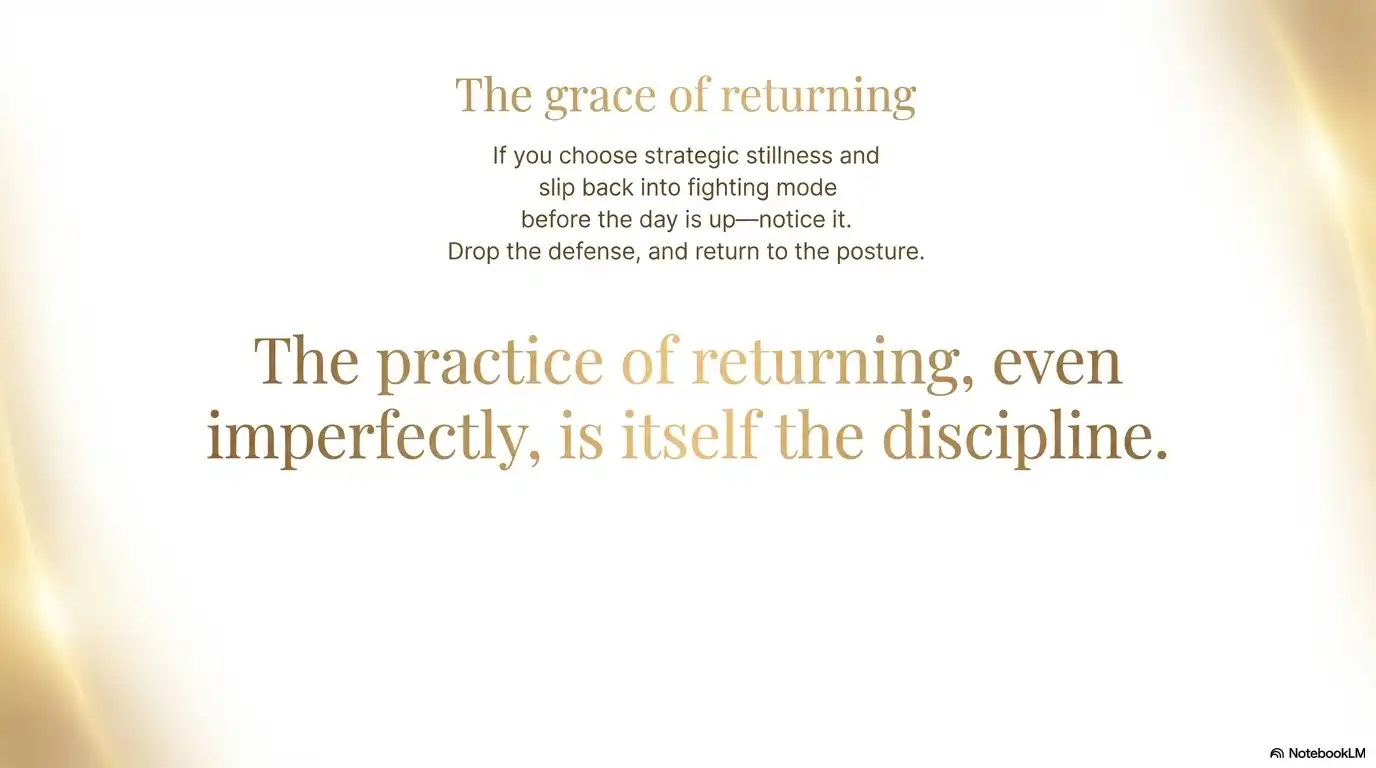
None of them is the wrong choice. The right choice is the one that actually engages you with the truth rather than just checking the box. Be honest with yourself about which one that is. And if you choose strategic stillness and slip back into fighting mode before the 24 hours are up — that’s okay too. Notice it. Return to the posture. The practice of returning, even imperfectly, is itself the discipline.
✦ FAQ: Real Questions, Real Answers
Q: How do I know which battles I should fight in my own strength and which ones I should hand to God? Is everything supposed to be surrendered?
This is such a genuinely important question, and the honest answer is that the line isn’t always obvious — which is part of why it requires ongoing discernment rather than a single rule. A few diagnostic questions that tend to help: Have I done what is actually mine to do here — the conversation that needed to happen, the effort that was genuinely required, the practical step that was within my capacity? If yes, and the situation is still beyond resolution, that’s often the signal that you’ve reached the ceiling of what human effort can accomplish. Another question worth asking: is my continued fighting driven by genuine purpose, or by the anxiety of not being in control? If the honest answer is the second one, that’s usually a strong indicator that you’ve crossed from responsible engagement into striving that belongs to God. You’re not abdicating responsibility by surrendering what’s beyond your capacity. You’re practicing wisdom.
Q: “Be still” sounds great, but my brain won’t stop. How do I actually achieve stillness when everything in me is screaming to do something?
That gap between the instruction and the felt experience is completely real, and it’s worth addressing practically rather than just spiritually. A few things worth trying: first, recognize that stillness in this context is not primarily a mental state you achieve — it’s a behavioral choice you make. You can be internally noisy and still choose not to send the defensive email, not to force the conversation, not to take the controlling action. The stillness starts in behavior, and the internal quiet sometimes — not always, but sometimes — follows the behavioral surrender rather than preceding it. Second, physical practices tend to help: deliberate slow breathing, a short walk, something that moves anxious energy through your body rather than leaving it spinning in your head. Third — and this might be the most honest thing to say — some level of internal noise while choosing stillness is not a failure of faith. It might just be what trust looks like in a nervous system that’s been trained to fight.
Q: I’ve been still before — I’ve surrendered battles to God — and they didn’t resolve the way I hoped. The Israelites got a miracle. I didn’t. How do I keep trusting this?
That’s one of the most honest and important questions in this entire challenge, and it deserves a real answer rather than a tidy one. Not every surrendered battle ends with a parted sea. Some of them end in outcomes that are genuinely painful, and the absence of the miracle you hoped for is a real grief that deserves to be named. What’s worth sitting with is this: the promise in this verse is not that every battle God fights for you will end the way you want. It’s that you won’t be fighting alone, and that the outcome — whatever it is — will be held within the larger story of a God whose purposes run longer than any single battle. That’s not a satisfying answer in the middle of a painful outcome. But over time, with enough looking back — the kind we practiced yesterday — patterns of faithfulness tend to become visible even in seasons that didn’t resolve the way we prayed they would. The miracle was sometimes a different shape than expected.
Q: I feel guilty about not fighting harder for something that matters to me — a relationship, a goal, an important situation. Isn’t surrendering it to God just giving up?
No — and the guilt you feel is worth examining gently rather than acting on reflexively. Surrender in this context is not the same as not caring or not trying. It’s the recognition that there is a ceiling on what your effort can accomplish, and that beyond that ceiling, continued straining in your own strength is both exhausting and potentially counterproductive. You can care deeply about the relationship and stop trying to force it into resolution through sheer will. You can be fully invested in the goal and release the white-knuckled control of every variable that affects it. Caring and surrendering are not opposites. In fact, real surrender often requires caring deeply — because if you didn’t care, there’d be nothing to release.
Q: What does “God fighting for me” actually look like in practical terms? I’m not expecting a Red Sea moment.
Honestly, it looks different in different situations — and that’s worth holding with some openness rather than a fixed expectation. Sometimes it looks like an unexpected conversation that shifts a conflict you couldn’t resolve yourself. Sometimes it looks like a door opening in a direction you weren’t looking, after you stopped forcing the door you were trying to open. Sometimes it looks like an internal peace that arrives in the middle of an unresolved situation — not resolution, but settledness that you didn’t manufacture. Sometimes it looks like the thing you were dreading simply not materializing. And sometimes it looks, in hindsight, like the way the difficult outcome you didn’t want was quietly shaping something in you that the outcome you wanted never could have. The shape of God fighting for you is often more varied and more subtle than the dramatic version — but it’s worth developing the eyes to notice it, even in its quieter forms.
Q: I tend to fight battles for other people — trying to fix, rescue, and manage things on their behalf. Does this verse apply to that too?
Very much so — and this is, actually, one of the more significant applications of this verse that doesn’t always get named directly. Fighting battles for other people — trying to rescue adults from consequences, manage someone else’s journey, fix what isn’t yours to fix — is a form of striving that carries its own particular exhaustion. And the release it requires is, if anything, harder than releasing your own battles, because it involves trusting not just that God will handle your situation but that He is also actively present in someone else’s. That trust is demanding. But the alternative — making yourself responsible for outcomes that belong to God and to the other person — is both unsustainable and, quietly, a form of not trusting God with people you love. Releasing battles that belong to others is not abandonment. It’s, ultimately, one of the most loving things you can do.
Q: I chose the “strategic stillness” option but I’m not sure what I’m supposed to be watching for. What does it look like to watch what God does?
Great question, and it’s worth being concrete about. Watching what God does in a period of strategic stillness is essentially the practice of noticing — specifically noticing what happens in the situation when you stop inserting your effort into it. Does anything shift that you didn’t cause to shift? Does the other person reach out when you stop pursuing? Does an unexpected resource appear when you stop forcing a solution? Does the anxiety quiet slightly when you stop feeding it with control behaviors? You’re looking for movement that isn’t traceable to your own doing. Not necessarily dramatic movement — small shifts count enormously here. Keep a brief log during the 24 hours, even just a few sentences, of what you notice. Often, the act of watching attentively is itself transformative — because it shifts your orientation from managing the outcome to being genuinely curious about what God will do. That’s a different interior posture, and it tends to produce different results.
Ten days. You’re in the final stretch now, and honestly — the fact that you’re still here says something real about what’s been built in you over these past ten days. Rest in that today. See you tomorrow.