


Learning to See What’s Actually There
There’s a particular kind of confidence crisis that hits differently than all the others. It’s not the crisis of feeling unworthy or uncapable. It’s the crisis of feeling genuinely, completely alone in something — surrounded by opposition, outnumbered by circumstances, facing something that looks, from every visible angle, like it has you beat.
That’s exactly where Elisha’s servant was standing on the morning this verse was spoken. And the way the story unfolds is, honestly, one of the most quietly revolutionary accounts in all of Scripture.
1. The Servant’s Fear Was Entirely Reasonable — That’s the Point
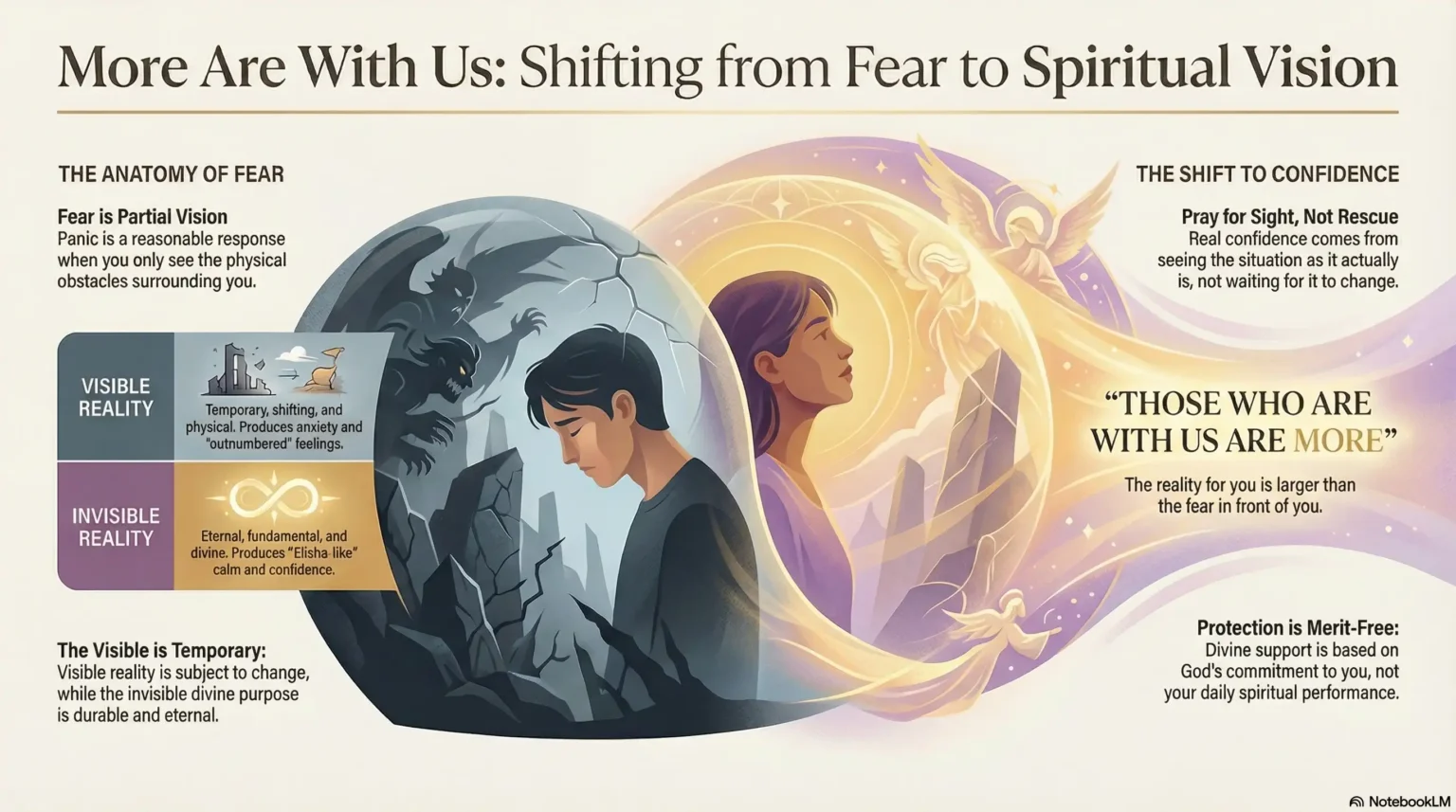
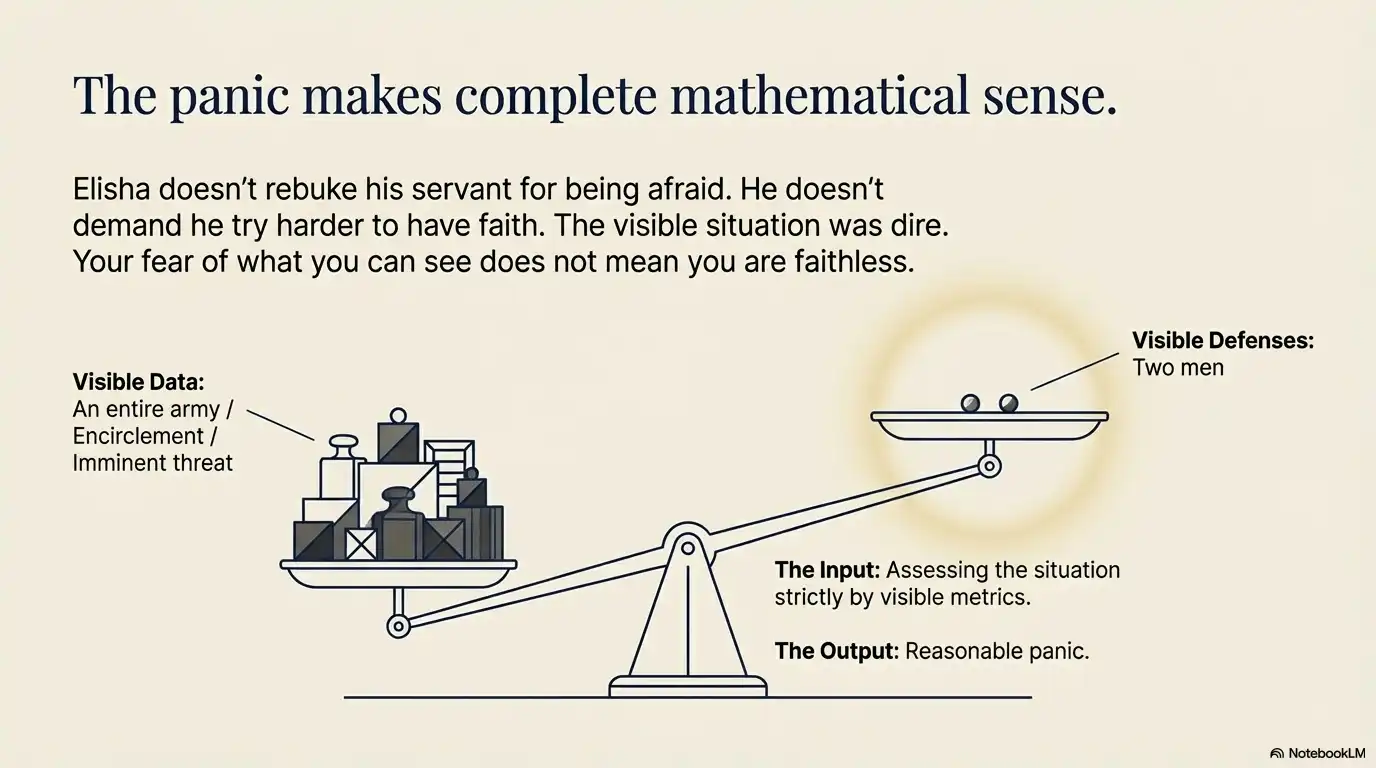
Before we get to the chariots of fire, it’s worth pausing on the servant’s reaction. He woke up, looked out at what surrounded them, and panicked. And the thing is — his panic made complete sense. An entire army, sent specifically to capture Elisha, encircling the city. The visible situation was, by every reasonable assessment, dire.
Elisha doesn’t rebuke him for being afraid. He doesn’t tell him to pull himself together or try harder to have faith. He simply prays that the servant’s eyes would be opened to see what was already there — what had been there the whole time, completely invisible to eyes that could only process the natural dimension of the situation.
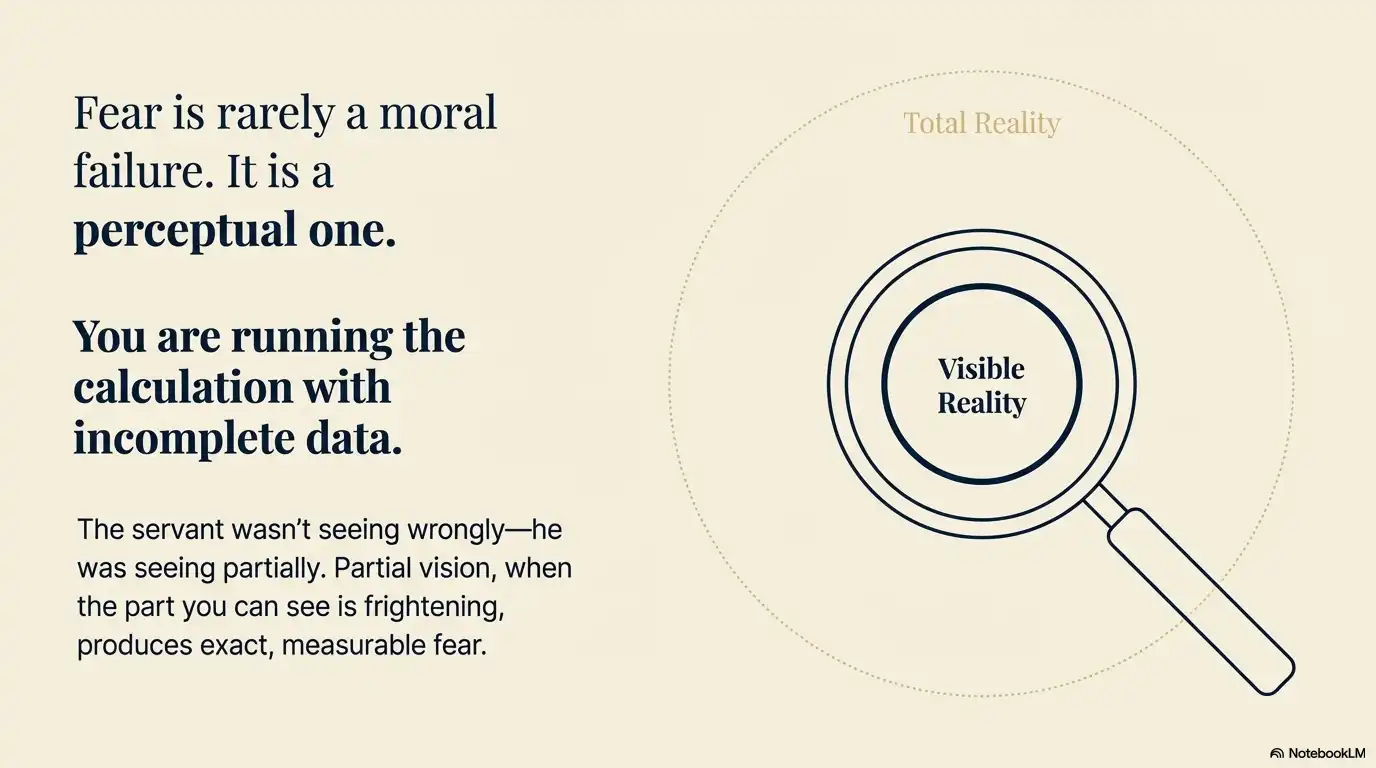
That’s a remarkably gentle and instructive response. It treats the servant’s limited vision not as a moral failure but as a perceptual one. He wasn’t seeing wrongly — he was seeing partially. And partial vision, when the part you can see is frightening, produces exactly the fear he experienced.
If you’ve been feeling outnumbered or overwhelmed and wondering whether your anxiety means your faith is insufficient — this story is quietly but directly addressing that. Your fear of what you can see doesn’t mean you’re faithless. It might just mean you’re not yet seeing everything that’s there.
2. “Those Who Are With Us” — The Plural Is Intentional
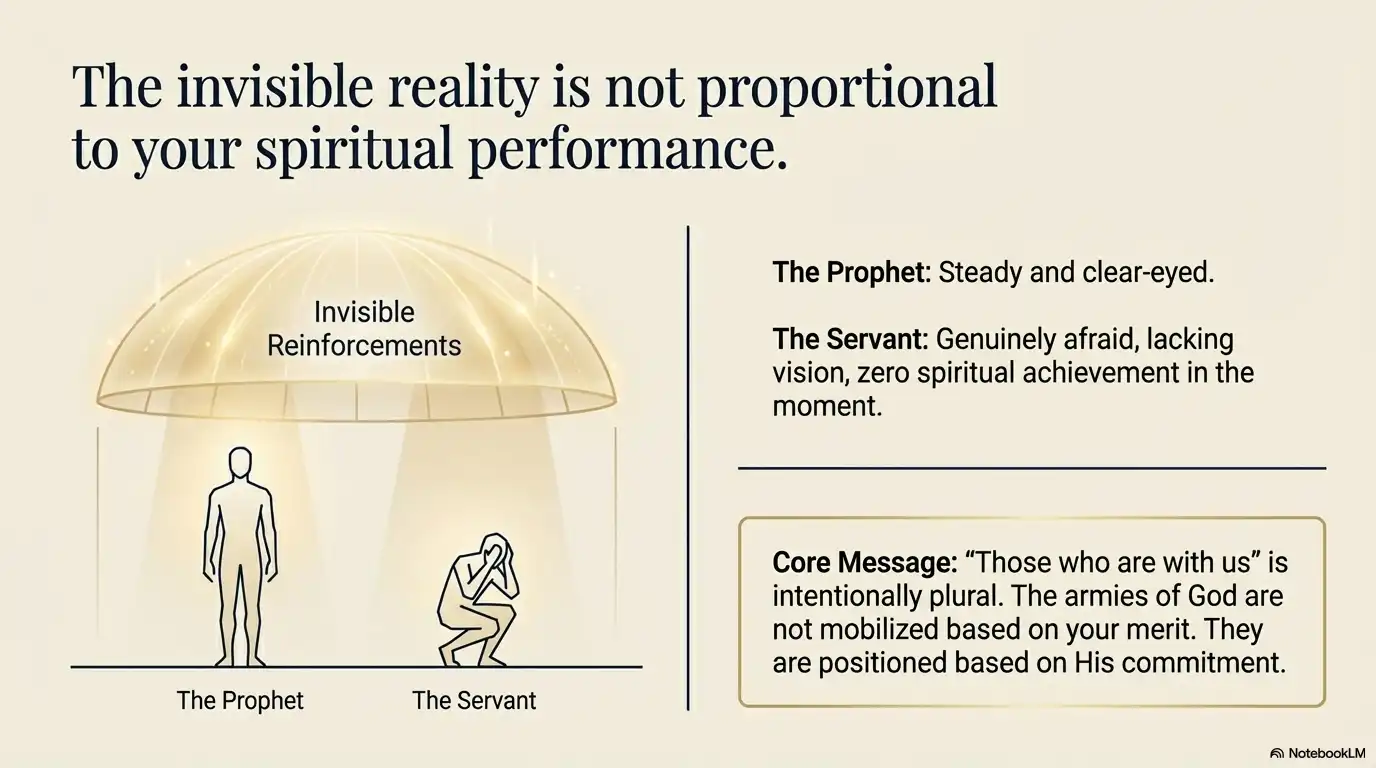
Elisha doesn’t say I am not afraid. He says those who are with us are more. The protection being described is not exclusive to the spiritually elite or the uniquely anointed. It’s collective. It belongs to us — to the prophet and the terrified servant standing next to him equally.
The servant hadn’t done anything particularly impressive. He hadn’t earned the chariots of fire through spiritual achievement. He was simply present, genuinely afraid, standing next to someone who could see further than he could — and the protection that surrounded them covered him just as completely as it covered Elisha.
That’s worth receiving carefully. The invisible reality that surrounds you is not proportional to your faith output or your spiritual performance on any given day. It’s not scaled to how confident you felt this morning or how well you did on yesterday’s journal practice. The armies of God, so to speak, are not mobilized based on your merit. They’re positioned based on His commitment. And that commitment covers you — the version of you that’s afraid, that can’t see clearly, that genuinely feels outnumbered. That version is covered just as fully as the version of you that’s steady and clear-eyed.
3. The Prayer That Changed Everything Was Not a Prayer for Rescue — It Was a Prayer for Vision
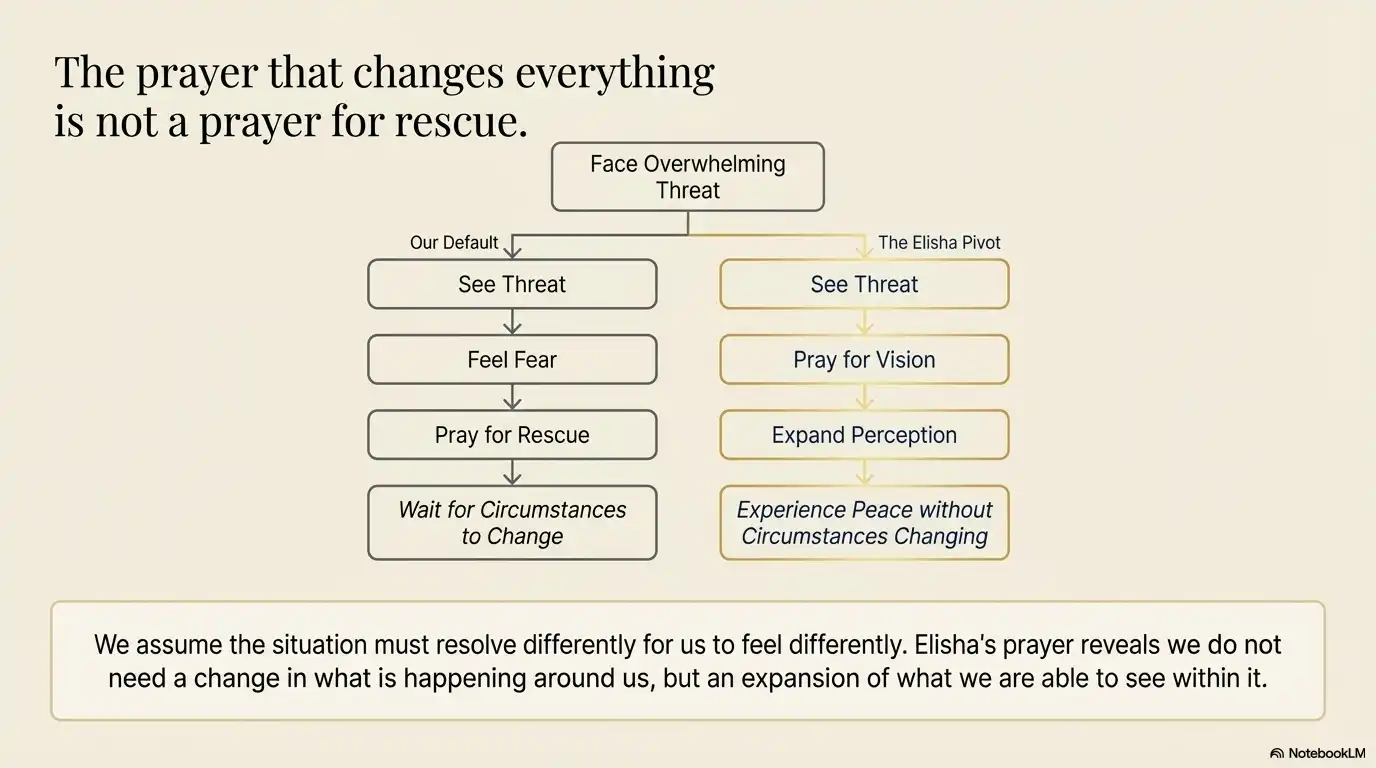
This is one of the most practically significant details in the entire passage, and it’s easy to glide past. Elisha doesn’t pray for the enemy army to be defeated first. He doesn’t pray for the situation to change before the servant can feel better about it. He prays for the servant’s eyes to be opened to see the situation as it already, actually was.
The answer to the servant’s fear was not a change in circumstances. It was a change in perception.
That sequencing is important for how we think about confidence. We tend to assume that what we need before we can feel differently is for the situation to resolve differently — for the opposition to back down, for the outnumbered feeling to be addressed by visible reinforcements, for the circumstances to shift in a way that makes courage feel more reasonable. But Elisha’s prayer suggests something else entirely: that what we most need is not a change in what’s happening around us, but an expansion of what we’re able to see within it.
The chariots of fire were there before the servant could see them. The reality didn’t change when his eyes opened. His access to it did.
4. Invisible Reality Is Still Real Reality — Actually, It’s More Real
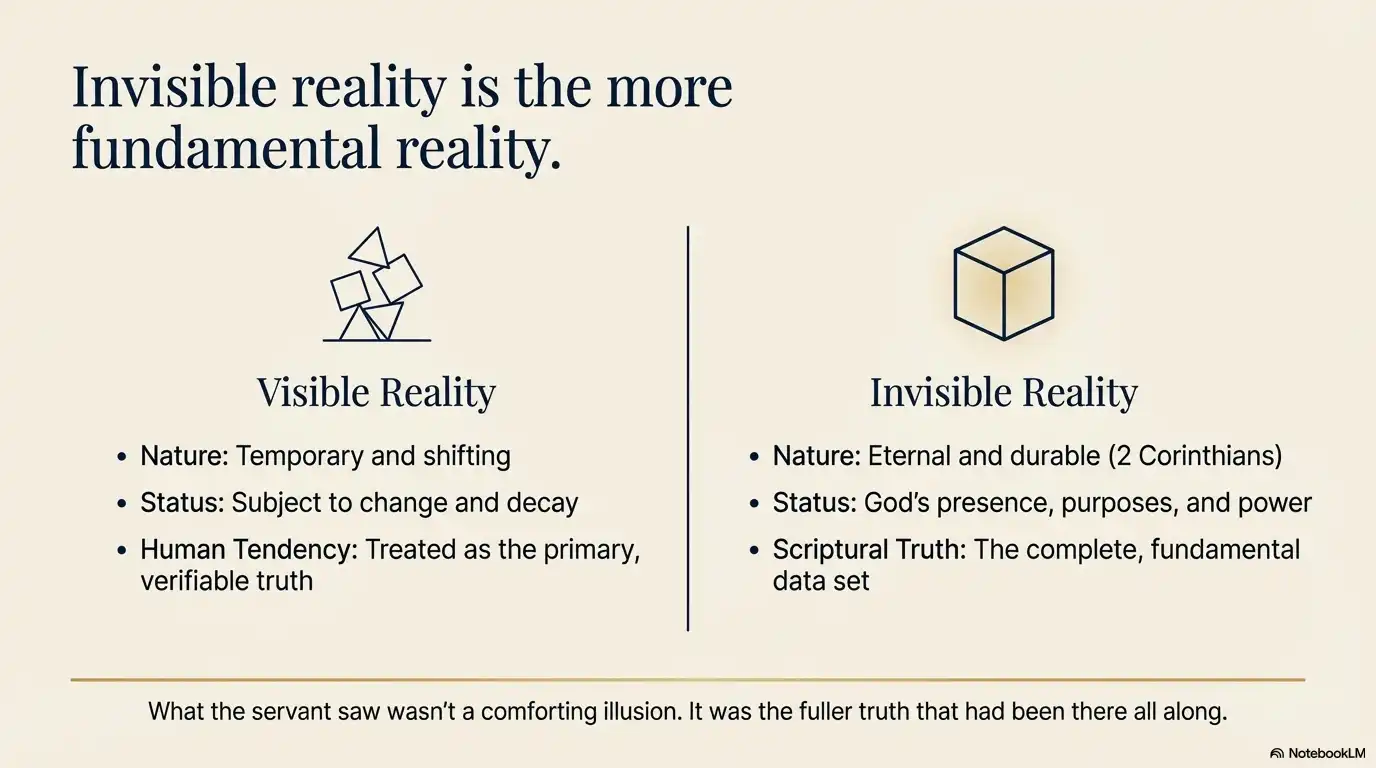
Here’s something worth sitting with philosophically for a moment, because it runs counter to so much of how we’re trained to evaluate situations. We treat visible, measurable, externally verifiable reality as the primary kind of reality — and invisible reality as, at best, a nice supplementary belief for the spiritually inclined.
Scripture consistently inverts this. The visible, physical world is described throughout as temporary, shifting, subject to change and decay. The invisible — God’s presence, His purposes, His power — is described as the more durable, more fundamental reality. Paul puts it directly in 2 Corinthians: what is seen is temporary, what is unseen is eternal.
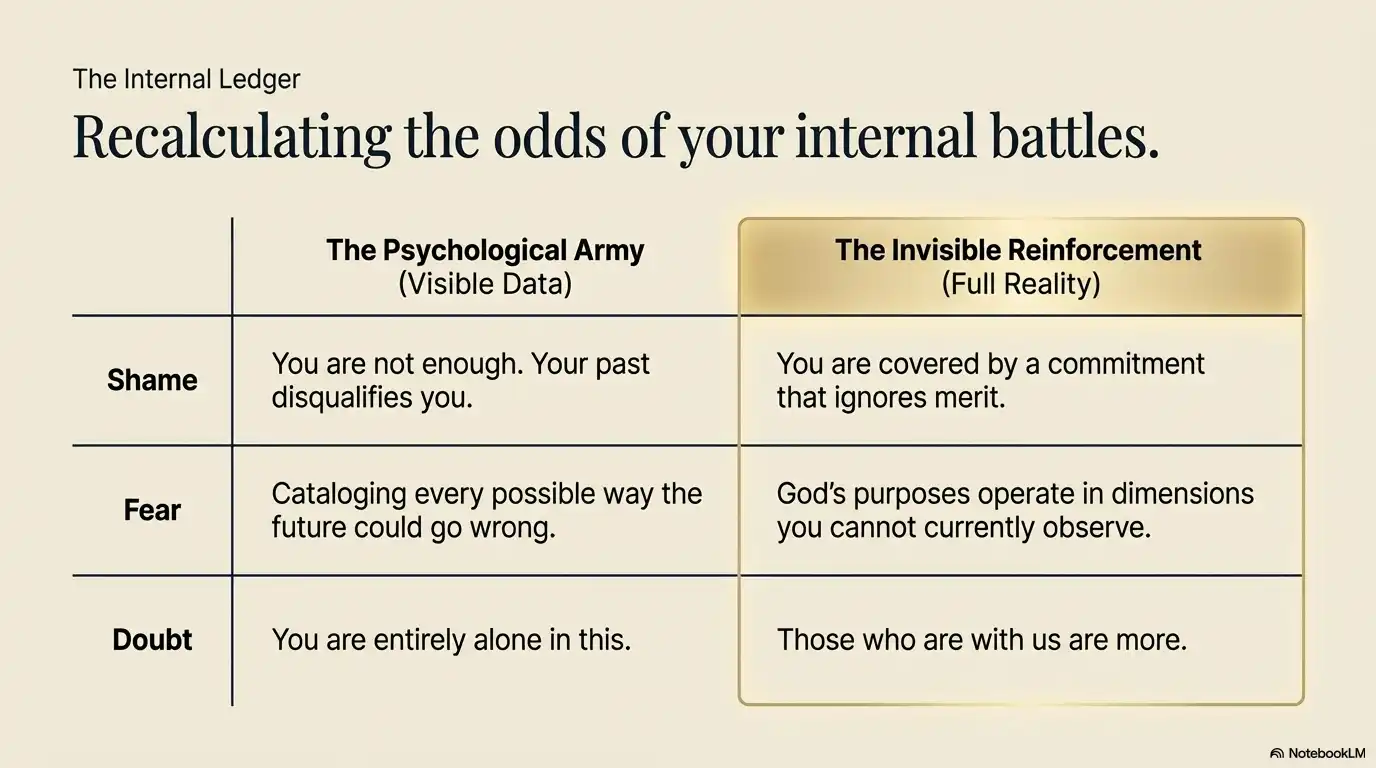
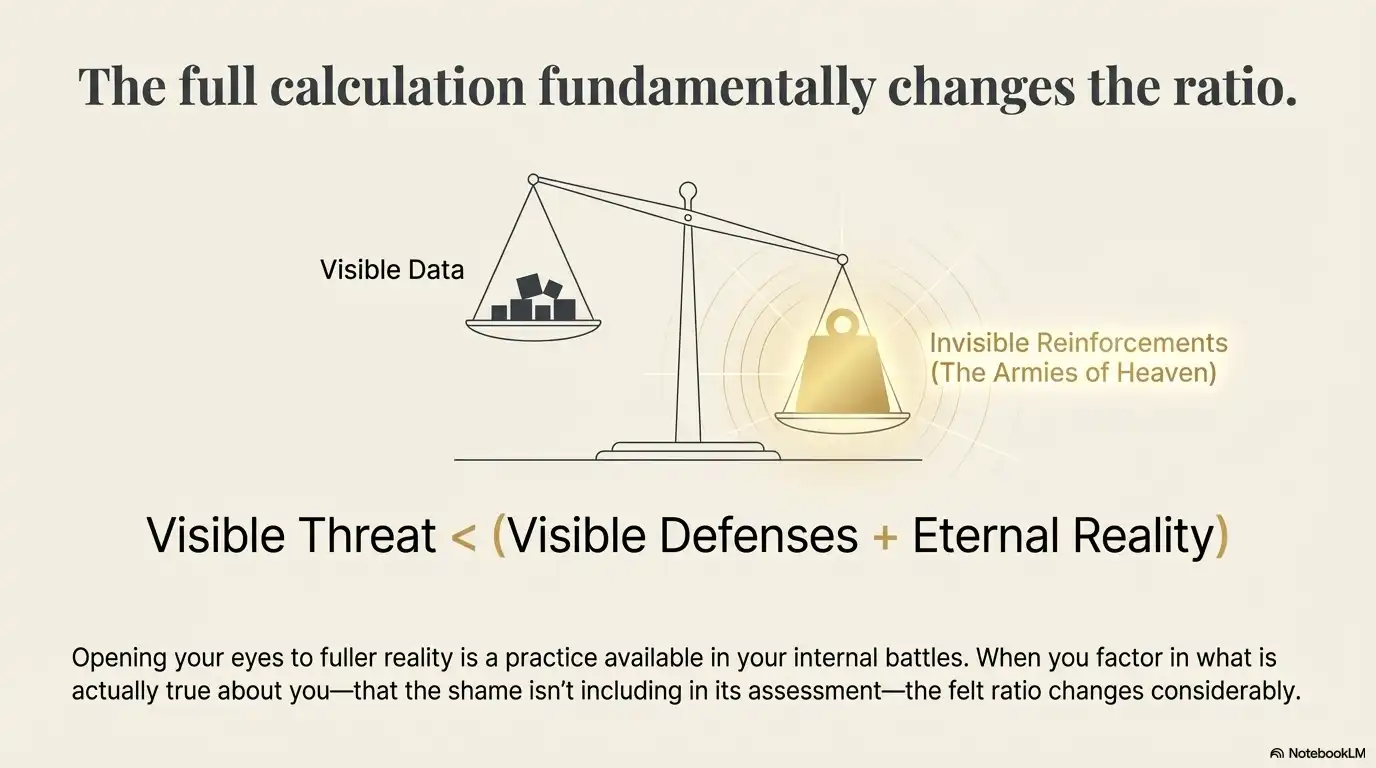
Which means when you feel outnumbered because of what you can see, you’re actually evaluating your situation with incomplete data. You’re running the calculation with only the visible variables included. The full calculation — the one that incorporates the armies of heaven, the God who is for you, the purposes that are operating in dimensions you can’t currently observe — comes out very differently.
That’s not wishful thinking. That’s the more accurate assessment. What Elisha’s servant saw after his eyes were opened wasn’t a comforting illusion. It was the fuller truth that had been there all along.
5. Feeling Outnumbered Is Often a Signal About What You’re Looking At, Not What’s Actually There
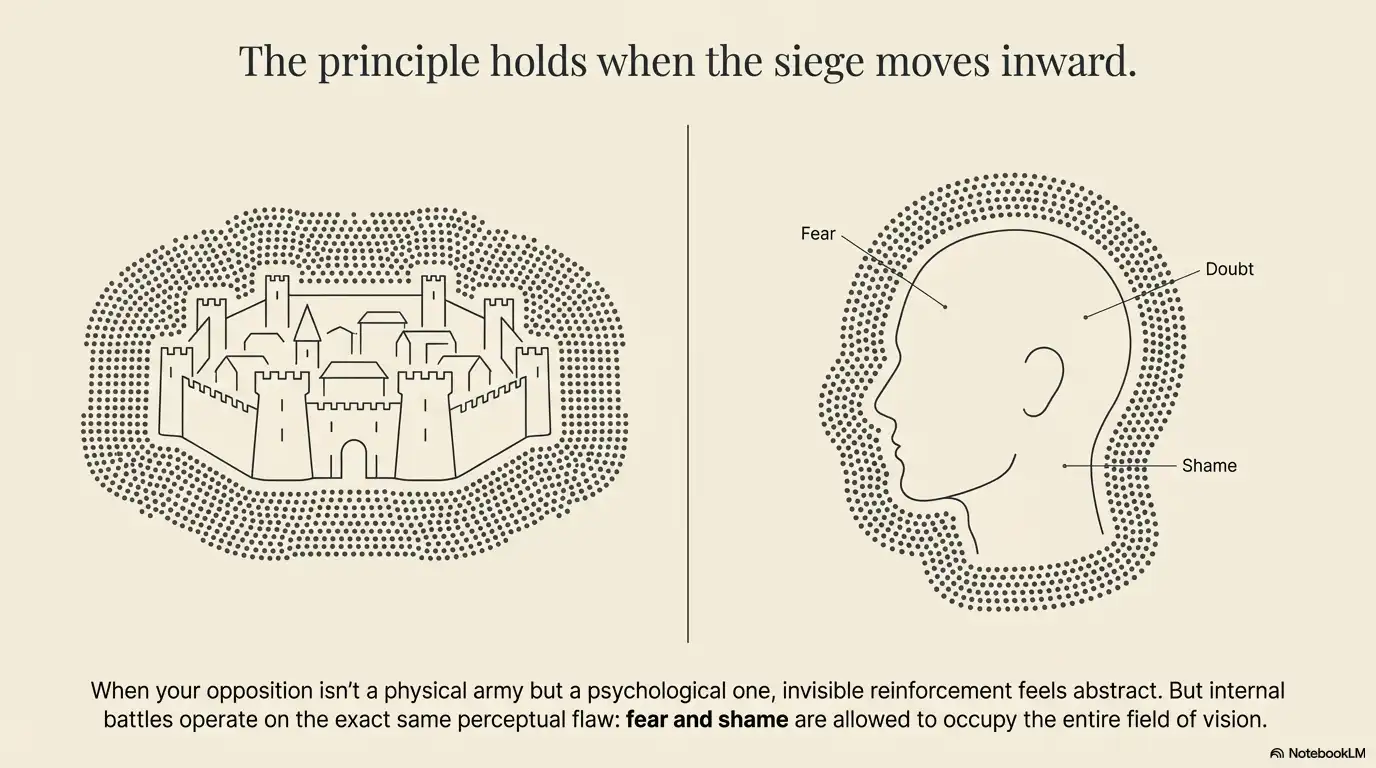
This is worth applying practically to the kinds of internal battles today’s practice names — fear, doubt, shame — because those are the situations where the “more are with us” truth is hardest to access. When what surrounds you isn’t a physical army but a psychological one — the loud, familiar voices of shame telling you you’re not enough, or fear cataloguing every possible way the thing ahead could go wrong — the invisible reinforcement can feel even more abstract than it does in a concrete external situation.
But the principle holds. The internal battles that feel most overwhelming are often battles that have been allowed to occupy the entire field of vision — where the fear or shame has gotten so loud and so close that it genuinely appears to be all there is. The prayer Elisha prays — open my eyes to see what’s really here — is just as applicable to the interior landscape as to the exterior one. What’s already present in the situation, beyond what the fear is showing you? What is actually true about you and your circumstances that the shame isn’t including in its assessment?
Opening your eyes to fuller reality is a practice available in the internal battles too. And it tends to change the felt ratio considerably.
6. Elisha’s Confidence Was Not Performative — It Was Perceptual
It’s tempting to read Elisha as simply a very spiritually impressive person who had achieved a level of faith most of us can’t access. And there’s no question he had a deep and well-developed relationship with God. But the source of his calm in this passage wasn’t a superior personality or unusually heroic courage. It was that he could see more than his servant could.
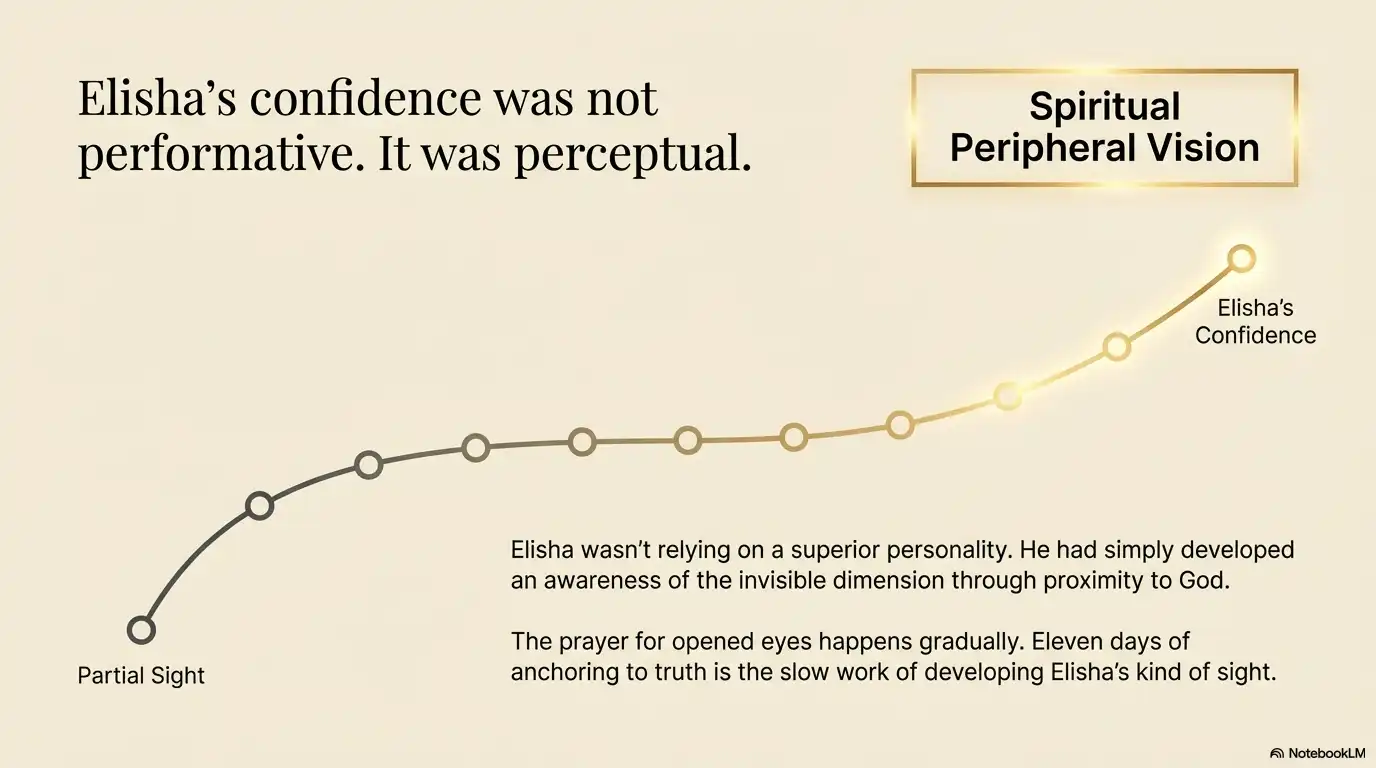
His confidence was a direct function of his perception. He knew what was surrounding them. He had, through a life of proximity to God, developed something like spiritual peripheral vision — an awareness of the invisible dimension that informed his assessment of every visible situation.
That capacity — while perhaps more developed in Elisha than in most — is not exclusively his. The prayer for opened eyes is available to every person in this challenge. Not necessarily as a dramatic supernatural vision, but as a gradually developing awareness, cultivated through exactly the kind of daily truth-engagement you’ve been doing for eleven days, that the visible situation is never the complete picture.
You’re building that capacity right now. Eleven days of returning to truth, of anchoring to what’s real beyond what’s immediately visible — that’s the slow work of developing Elisha’s kind of sight. It doesn’t happen overnight. But it’s happening.
7. “Don’t Be Afraid” Lands Differently When It Comes With a Reason
One of the things worth noticing about how Elisha responds to the servant’s panic is that he doesn’t just issue the command don’t be afraid and leave it at that. He provides the basis for it: those who are with us are more than those who are with them. And then he prays for the servant to see the evidence with his own eyes.
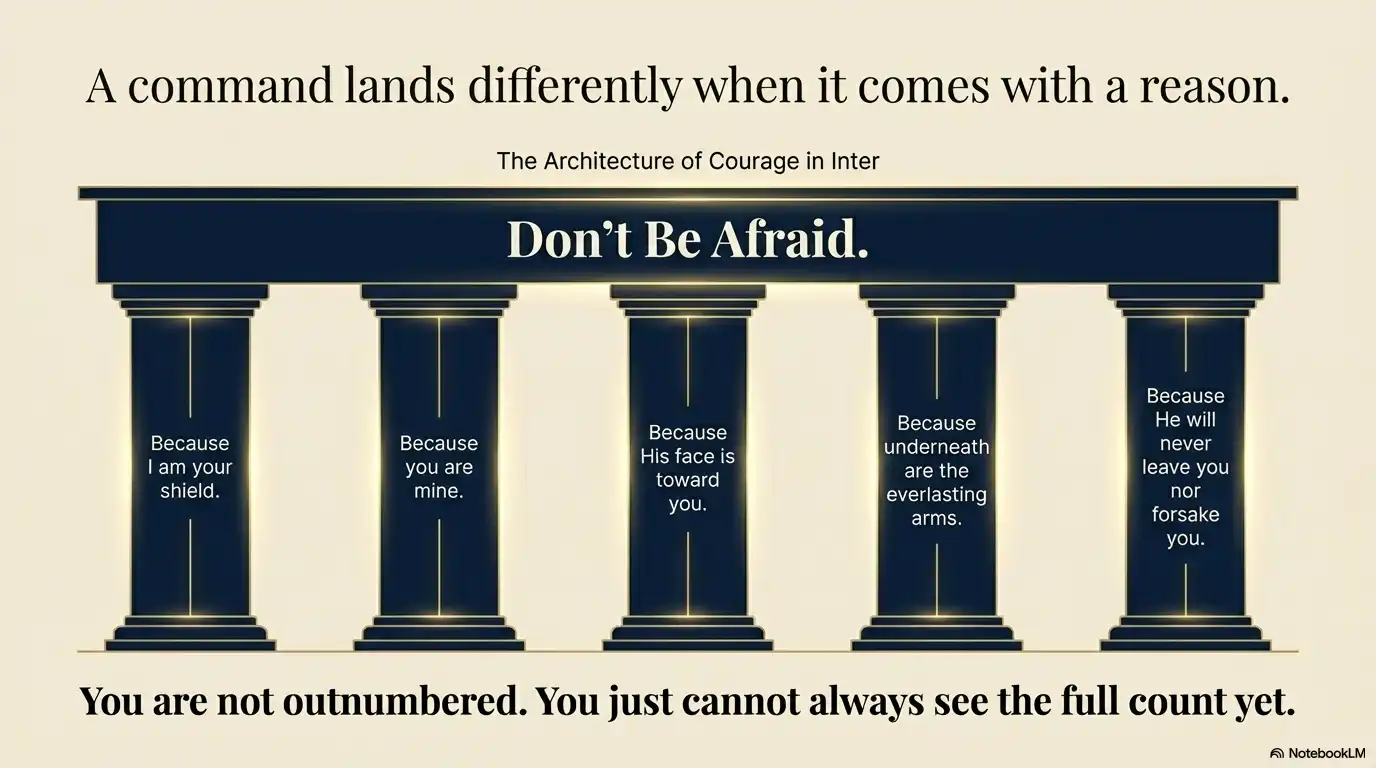
Throughout this challenge, we’ve been building toward this same pattern. Don’t be afraid — because I am your shield. Don’t be afraid — because you are mine. Don’t be afraid — because His face is toward you. Don’t be afraid — because underneath are the everlasting arms. Don’t be afraid — because He will never leave you nor forsake you.
Every single one of those commands comes with a reason. And the reason is always the same at its core: the reality that surrounds you is larger and more for you than what the fear in front of you is claiming. You are not outnumbered. You just can’t always see the full count yet.
✦ FAQ: Real Questions, Real Answers
Q: I want to believe that more are with me than against me, but I genuinely can’t feel it. Does that mean it isn’t true?
Not at all — and this is actually one of the most important distinctions in today’s content. The chariots of fire surrounding Elisha and his servant were just as present before the servant’s eyes were opened as after. The reality didn’t change when the feeling caught up to it. What changed was the servant’s access to what was already true. Feeling and reality can diverge significantly, especially in seasons of sustained pressure, fear, or discouragement. The feelings are real — they’re not being dismissed here. But they’re not the most reliable reporters on the full situation. The truth that more are with you than against you is not conditional on your ability to feel it on any given morning. It’s structural. It’s based on who God is and what He has committed to. The feeling, for most people, tends to catch up eventually — but it follows the truth; it doesn’t precede it.
Q: I believe in God’s presence, but angels and chariots of fire feel like ancient supernatural stuff that doesn’t apply to my regular life. How do I make this relevant?
That’s a genuinely fair question, and you’re probably not alone in feeling that way. Here’s a reframe that might help: the specific form of the invisible support — whether chariots of fire or something else entirely — matters less than the underlying truth the image is pointing to. What the passage is communicating is that the dimension of reality you can observe is not the complete dimension. God’s presence, God’s purposes, God’s activity on behalf of His people — these operate in ways that are not always visible or measurable by ordinary means. You don’t need a specific theology about angels to receive the foundational claim: the situation you’re in contains more than what you can currently see, and what you can’t see is for you rather than against you. Let the chariots of fire be an ancient, vivid illustration of a principle that applies to your life in whatever form it takes there.
Q: The opposition I’m facing is very real and very human — difficult people, unfair circumstances, legitimate threats. Does “more are with us” actually change any of that practically?
It doesn’t change the circumstances themselves. It changes how you navigate them — and that, honestly, is where the practical difference lives. A person who knows they’re not alone in the opposition can make decisions from a place of stability rather than panic. They can choose not to respond reactively, not to make fear-driven decisions, not to sacrifice their integrity in an attempt to manage the threat. They can hold their ground — quietly, clearly, without the desperate energy of someone who believes the outcome rests entirely on their own ability to defend themselves. The opposition is still real. But you’re not navigating it as someone who is genuinely outnumbered and alone. That interior shift produces measurably different choices. And different choices tend to produce different outcomes over time.
Q: What does it actually mean to “open my eyes to invisible reality”? Is this about prayer, or something more specific?
Both, honestly — and a few other things too. Prayer is the most direct access point: asking God specifically to help you see your situation more completely, the way Elisha prayed for his servant. But there are also more gradual, practiced ways this happens. Returning repeatedly to truth — which is exactly what this challenge has been doing for eleven days — is a form of slowly training your perception toward fuller reality. So is the practice of noticing God’s activity in ordinary moments that you might otherwise attribute entirely to coincidence or your own effort. So is reading Scripture not as information to process but as a lens to develop — one that, over time, makes the invisible dimension more legible. Opening your eyes to what’s really there is less a single dramatic moment and more a gradually cultivated way of seeing. You’re already in the process of developing it.
Q: I feel outnumbered internally — by shame, by fear, by old thought patterns. Does this verse speak to that, or only to external opposition?
It absolutely speaks to that — and in some ways, the internal application is even more important than the external one for most people doing this kind of work. The internal voices of shame, fear, and self-doubt are, in a real sense, the opposition that most consistently tries to convince you that you’re alone, outmatched, and without backup. And the principle holds there too: those voices — however loud and familiar they feel — are not the complete picture of what’s present in your interior life. The Spirit of God, described throughout Scripture as an advocate, a comforter, a helper who intercedes — that Presence is operating in your interior world just as much as in your external circumstances. The shame doesn’t have the whole field to itself, even when it sounds like it does. There is more present than the fear is reporting.
Q: I prayed for my eyes to be opened and nothing felt different. Is there something wrong with my prayer?
Nothing is wrong with your prayer — and the honest answer is that opened eyes rarely arrive as a sudden dramatic shift. For the servant in the story, it was immediate. For most of us in ordinary life, it’s more gradual — a slow accumulation of moments where fuller truth becomes slightly more accessible, where the fear loses a little of its grip, where something that felt overwhelming yesterday feels slightly more navigable today. The prayer is worth continuing. Not as a formula you need to get right, but as a repeated orientation of your attention toward the fuller reality you can’t yet fully see. The asking itself matters — it positions you as someone who believes there’s more to see, which is already a different posture than assuming that what fear is showing you is all there is.
Q: I’ve shared in the forum a few times during this challenge. Today feels different — I feel really alone and not sure I want to share. Is that okay?
More than okay — and honestly, the fact that you’re still here on Day 11 when you’re feeling this way says something significant about your commitment to this process. Some days the forum feels accessible and some days it doesn’t, and both are completely valid. Feeling alone while engaging with a passage about not being alone is not ironic. It’s actually quite human, and it’s the exact condition the verse is speaking into. You don’t have to perform okayness to belong in this community. You can be in the hard place and still be here. In fact, being in the hard place and still showing up is arguably the most honest and courageous version of participation there is. Stay with it. The chariots are there even on the days you can’t see them.
Eleven days. Three to go. Whatever has felt impossible about this journey so far — you haven’t been carrying it alone, even in the moments it felt most that way. See you tomorrow.